Tag: Physics

New catalog more than doubles the number of gravitational-wave detections made by LIGO, Virgo, and KAGRA observatories

When the densest objects in the universe collide and merge, the violence sets off ripples, in the form of gravitational waves, that reverberate across space and time, over hundreds of millions and even billions of years. By the time they pass through Earth, such cosmic ripples are barely discernible. And yet, scientists are able to […]

Read More

MIT faculty, alumni named 2026 Sloan Research Fellows

Eight MIT faculty and 22 additional MIT alumni are among 126 early-career researchers honored with 2026 Sloan Research Fellowships by the Alfred P. Sloan Foundation. The fellowships honor exceptional researchers at U.S. and Canadian educational institutions, whose creativity, innovation, and research accomplishments make them stand out as the next generation of leaders. Winners receive a two-year, […]

Read More

New study unveils the mechanism behind “boomerang” earthquakes

An earthquake typically sets off ruptures that ripple out from its underground origins. But on rare occasions, seismologists have observed quakes that reverse course, further shaking up areas that they passed through only seconds before. These “boomerang” earthquakes often occur in regions with complex fault systems. But a new study by MIT researchers predicts that […]

Read More

Terahertz microscope reveals the motion of superconducting electrons

You can tell a lot about a material based on the type of light you shine at it: Optical light illuminates a material’s surface, while X-rays reveal its internal structures and infrared captures a material’s radiating heat. Now, MIT physicists have used terahertz light to reveal inherent, quantum vibrations in a superconducting material, which have […]

Read More

MIT engineers design structures that compute with heat

MIT researchers have designed silicon structures that can perform calculations in an electronic device using excess heat instead of electricity. These tiny structures could someday enable more energy-efficient computation. In this computing method, input data are encoded as a set of temperatures using the waste heat already present in a device. The flow and distribution […]

Read More

Study: The infant universe’s “primordial soup” was actually soupy

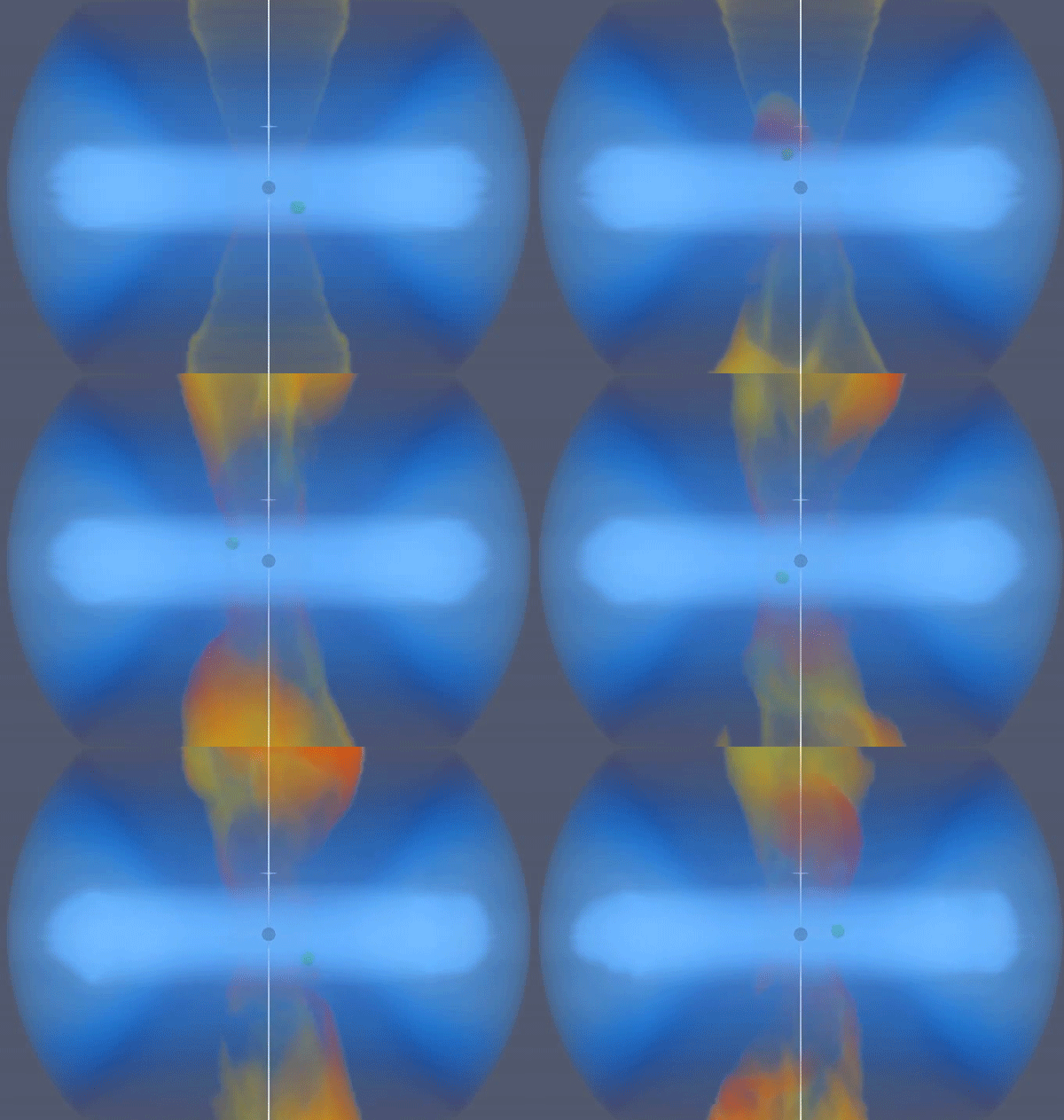
In its first moments, the infant universe was a trillion-degree-hot soup of quarks and gluons. These elementary particles zinged around at light speed, creating a “quark-gluon plasma” that lasted for only a few millionths of a second. The primordial goo then quickly cooled, and its individual quarks and gluons fused to form the protons, neutrons, […]

Read More