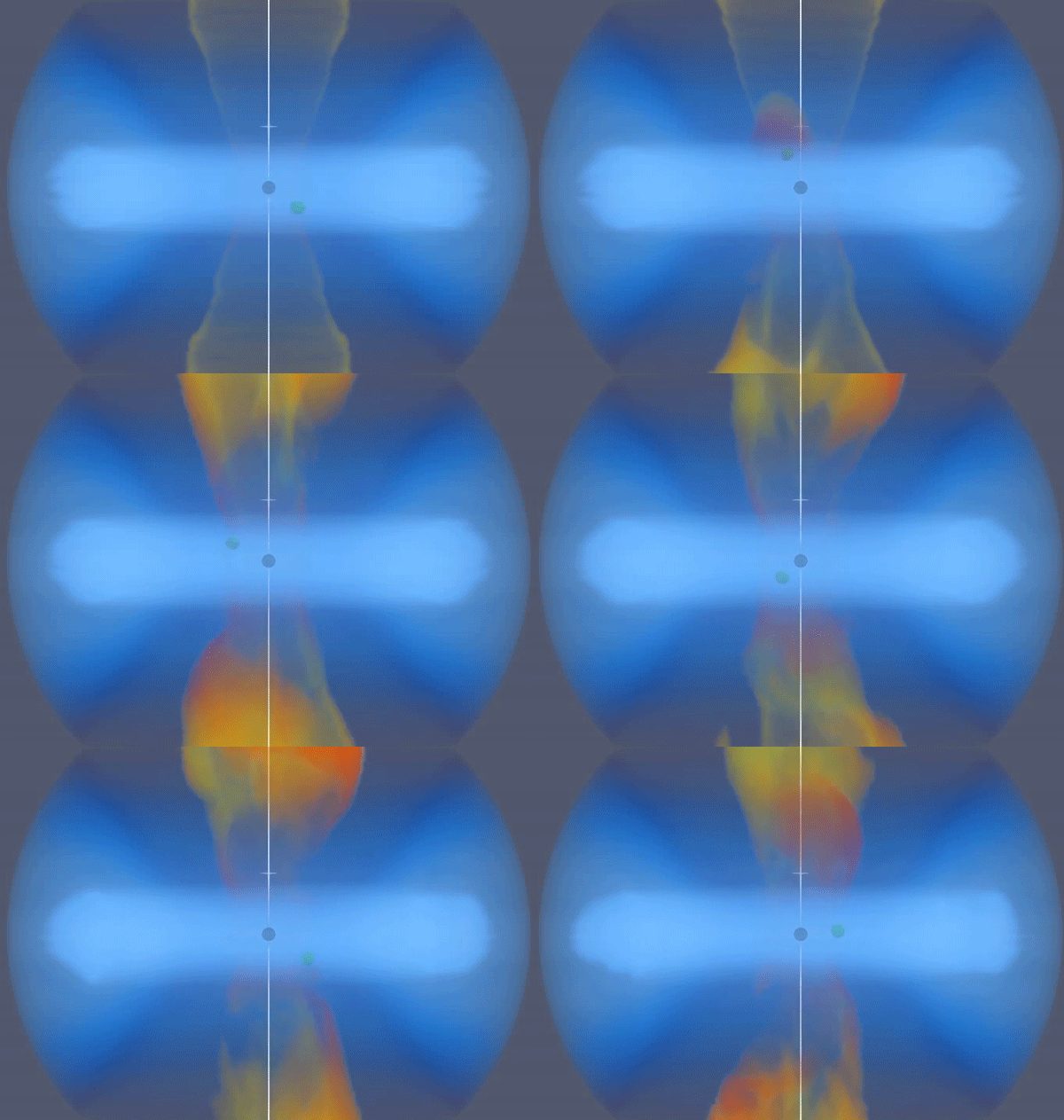
A supermassive black hole at the heart of a nearby galaxy is behaving similarly to black holes that existed just after the Big Bang, voraciously feeding on copious amounts of matter. The relatively close cosmic titan could therefore provide insight into the much more distant universe. Indeed, the intense accretion behavior demonstrated by the supermassive […]
Read MoreTag: Black holes
Scientists have discovered the oldest quasar ever seen, and it shines with the light of a trillion suns
Using the European Space Agency’s Euclid space telescope, astronomers have discovered a treasure trove of 31 black-hole-powered quasars in the early universe. The most impressive of these new discoveries is the most ancient and distant quasar ever seen, shining with the light of a trillion suns just 670 million years after the Big Bang. Quasars […]
Read More
Many black holes had past lives, new research shows
When a star dies, a black hole is born. This has been the textbook origin story for most black holes. At the end of a massive star’s life, its outer layers blast away in a brilliant supernova, and its core collapses into a gravitationally tight and dense region, forming a black hole. Recent discoveries from […]
Read More
Black hole’s ‘point of no escape’ studied with the loudest gravitational waves ever heard
The loudest crash of gravitational waves ever heard has offered us insight into event horizons, the boundaries beyond which nothing can escape the grips of black holes. The gravitational wave signal GW250114 was picked up in January 2025 by LIGO (Laser Interferometer Gravitational-Wave Observatory), Virgo, and KAGRA ( Kamioka Gravitational Wave Detector). The signal was […]
Read More
Listening for the echoes of black holes
Black holes are often misunderstood to be just that: dark and mysterious voids that are somehow akin to Alice in Wonderland’s mind-bending rabbit hole. But rather than a tunnel of nothing, a black hole is actually something — and a lot of it. The densest objects in the universe, black holes exert tremendous gravitational pull, […]
Read MoreJames Webb Space Telescope finds evidence the mysterious ‘little red dots’ are black hole stars
Astronomers using the James Webb Space Telescope may be close to solving the mystery of “little red dots” in the early universe. The team has studied one of these strange objects, designated GLIMPSE-17775, finding evidence it is a black hole star — a ravenously feeding, growing supermassive black hole cocooned in a dense cloud of […]
Read MoreStrange ‘spacetime crystals’ could give birth to tiny black holes
When we think about a black hole, we probably picture some vast cosmic titan, greedily consuming any matter unfortunate enough to fall within its gravitational influence. Thinking deeper, we probably imagine this ravenous cosmic beast forming from the explosive collapse of the core of a massive star. Maybe we even picture a supermassive black hole […]
Read MoreThese record-breaking black hole winds could create a category 79 hurricane on Earth
Astronomers have discovered a distant quasar — or active nucleus of a galaxy — that’s powered by a feeding supermassive black hole blasting out winds at record-breaking speeds of 30% the speed of light, around 201 million miles (323 million kilometers) per hour. This is the fastest black hole wind seen specifically in ultraviolet wavelengths. […]
Read More
MIT astronomers discover the earliest known flickering quasar
A supermassive black hole lies at the heart of every galaxy, including the Milky Way. When a black hole is active, it pulls material in as a whirpool of high-temperature gas and dust. As this cosmic material piles up and falls onto a black hole, it lights up its vicinity, radiating a huge amount of energy. […]
Read MoreCan black holes turn into white holes? It’s not such a crazy idea, scientists say
New research suggests that black holes born during the Big Bang could live much longer than previously estimated. In fact, these tiny primordial black holes may live long enough to become energy-spewing white holes with the mass of a human eyebrow hair. Primordial black holes are proposed to have formed through fluctuations in the incredibly […]
Read MoreAstronomers discover a ‘lost world’ of black hole mergers: ‘It’s the astronomical equivalent of uncovering an ancient civilization’
Astronomers have struck “black gold” — a treasure trove of black hole mergers. And the discovery was made by analyzing ripples in the very fabric of space and time, or spacetime, called gravitational waves. This massive haul of mergers contained within the Gravitational Wave Transient Catalogue-5.0 (GWTC-5), released on Tuesday (May 26), could change our […]
Read More
James Webb Space Telescope discovers a black hole that formed before its host galaxy. Scientists aren’t sure how
Observations of ancient galaxies called “Little Red Dots” by the James Webb Space Telescope (JWST) could finally answer the question: which comes first, the black hole or its galaxy? It turns out that the answer isn’t what scientists expected and could thus represent a complete paradigm shift in our understanding of how black holes grow. […]
Read MoreMost powerful ‘ghost particle’ ever may have come from a cosmic particle accelerator fed by a black hole
Scientists have discovered an ultra-powerful “ghost particle” or neutrino, which struck Earth and was detected in the Mediterranean Sea in 2023, may have been blasted at Earth by blazars powered by a feasting black hole engine. Blazars are a type of quasar, the regions at the hearts of galaxies that host feeding supermassive black holes […]
Read More
The Haystack 37m Telescope: A new era of astrophysical research
The Haystack 37m Telescope has been a landmark in radio astronomy and radar studies of the solar system since its first light in 1964. Over the following four decades, it supported NASA’s Apollo landings on the moon, made planetary radar maps of the surface of Venus, contributed to experimental tests of Einstein’s general relativity, supported the development […]
Read MoreA new way to spot signs of dark matter
Dark matter is thought to make up most of the matter in the universe, but the only way it interacts with its surroundings is through gravity. If two colliding black holes spiral through a dense region of dark matter and merge, gravitational waves rippling across space and time could carry an imprint of that dark […]
Read MoreBlack holes slamming into scorching stars may be causing mysterious blue flashes in the cosmos
Out in the universe, there exist mysterious and powerful bright blue cosmic explosions called Luminous Fast Blue Optical Transients (LFBOT) — and new research may finally have some answers as to where these strange blasts come from. The first of these explosions was spotted in 2018, and only 14 have been detected since, leading to […]
Read MoreHow do the biggest black holes in the universe form? Ripples in spacetime provide a clue
Scientists have discovered that the universe’s most massive black holes may form in the densest of stellar environments, or so-called globular clusters. It is in these clusters where violent collisions are common, suggesting a chaotic new origin for these cosmic titans of our cosmos. Scientists pinpointed this potential birthplace of massive black holes by studying […]
Read MoreJames Webb Space Telescope’s strange little red dots may really be ‘black hole stars’, X-ray data suggests
The discovery of an X-ray signal coinciding with the location of one of the mysterious ‘little red dots’ found by the James Webb Space Telescope (JWST) has strengthened the theory that the dots are ‘black hole stars’ — huge, dense clumps of gas energized by the presence of a growing supermassive black hole within them. […]
Read MoreDid decaying dark matter help create the universe’s first supermassive black holes?
New research suggests that supermassive black holes that existed before the cosmos was 1 billion years old may have formed with a helping hand from dark matter, the universe’s most mysterious stuff. Ever since the James Webb Space Telescope (JWST) first began reporting data back to Earth in the summer of 2022, it has been […]
Read More
‘Dancing’ jets erupting from a cannibalistic black hole have the power of 10,000 suns
Astronomers watched as jets blasting from a black hole cannibalized a blue supergiant companion star. Data from the Square Kilometre Array Observatory (SKA) radio telescope allowed the team to measure the power of these outbursts, finding them as powerful as the output of 10,000 suns, which could help to reveal how they shape entire galaxies […]
Read More
Ripples in spacetime may have revealed 1st evidence of tiny black holes born in the Big Bang
Ripples in the very fabric of space and time called “gravitational waves” may have provided the first tantalizing evidence of tiny black holes born during the Big Bang. These primordial black holes could, in turn, account for most if not all of the universe’s most mysterious stuff, known as dark matter. Unlike stellar mass black […]
Read More
Galaxy starves its supermassive black hole, loses 95% of its brightness
Astronomers watched a distant galaxy cut off the “food,” or general matter, flowing to its central supermassive black hole. As the regions around feeding black holes are often brighter than the combined light of every star in their host galaxy, this led to a radical change in brightness occurring over just 20 years. The starvation […]
Read More
Two physicists and a curious host walk into a studio…
This March on The Curiosity Desk, GBH’s daily science show with host Edgar B. Herwick III, MIT scientists dropped by to address the questions: “How close are we to observing the dark universe?” (Thursday, March 12 episode) and “Is Earth prepared for asteroids?” (Thursday, March 26 episode). Up first, Prof. Nergis Mavalvala, dean of the […]
Read MoreCould our universe exist because black holes ate up all the antimatter?
One of the most fundamental and curious mysteries in the universe is the fact that anything exists at all. That is because during the Big Bang, equal amounts of matter and antimatter particles should have been created — antimatter being like the “opposite” of regular matter, meaning it’s made up of antiprotons and antielectrons. And […]
Read More
New catalog more than doubles the number of gravitational-wave detections made by LIGO, Virgo, and KAGRA observatories
When the densest objects in the universe collide and merge, the violence sets off ripples, in the form of gravitational waves, that reverberate across space and time, over hundreds of millions and even billions of years. By the time they pass through Earth, such cosmic ripples are barely discernible. And yet, scientists are able to […]
Read More
Hubble and Chandra space telescopes hunt for rogue black holes wandering through dwarf galaxies
Using NASA’s Hubble Space Telescope and Chandra X-ray Observatory, astronomers have hunted for “wandering” black holes drifting through dwarf galaxies. The discovery of these rogue black holes in such small galaxies could provide a “fossil record” that helps to explain how supermassive black holes grew to masses of millions or even billions of times that […]
Read MoreCould the secret to black hole formation be locked away in this record-breaking ancient quasar?
A faraway fluctuating quasar has been seen dimming and brightening by an extraordinary amount, changes in luminosity equivalent to 2 trillion times the brightness of the sun . It is the first time that a flickering quasar has been seen in the early universe, this one dating back 12.9 billion years – just around 900 […]
Read More
New fear unlocked: runaway black holes
This article was originally published at The Conversation. The publication contributed the article to Space.com’s Expert Voices: Op-Ed & Insights. Last year, astronomers were fascinated by a runaway asteroid passing through our solar system from somewhere far beyond. It was moving at around 68 kilometres per second, just over double Earth’s speed around the sun. […]
Read MoreAstronomers solve the mystery of black holes’ delayed cosmic ‘burps’
Supermassive black holes are notoriously messy when devouring a star, but they can also linger over their meals, letting out massive radio “burps” months or even years after their cosmic feast appears finished. Now, scientists tracking these events have found there is no one-size-fits-all model for how black holes digest stellar material. Speaking Monday (June […]
Read More
Scientists may have found a ‘missing-link’ black hole ripping up and devouring a star
Astronomers have discovered that an unusual optical flare is the result of a star being ripped apart and devoured by a black hole — and what really sets this so-called Tidal Disruption Event (TDE) apart is the fact that the black hole involved seems to be an example of an elusive “intermediate mass black hole,” […]
Read More
NASA X-ray spacecraft catches jet erupting from 1st supermassive black hole imaged by humanity
Astronomers using NASA’s Chandra X-ray spacecraft have obtained the most detailed image yet of the jet erupting from the supermassive black hole at the heart of the galaxy Messier 87 (M87). If this black hole sounds familiar, that is because it made history in 2019 when it was revealed as the first black hole to […]
Read More