On the road to the demo: assistants, bills and a little rain
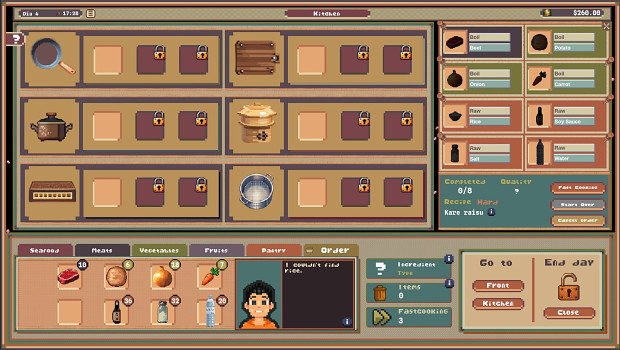
After a couple of months of testing, I have the results from the people who helped me playtest the game. Some of them had never played it before; others had tried an early version.
The results? Really valuable. We didn’t find many bugs that kept anyone from playing, which is a relief; however, testers had plenty to say about the game’s mechanics, and their feedback helped me fine-tune the gameplay.
Here’s a quick rundown of the biggest changes on the road to the demo.
Since the Yatai Master can cook quite a few recipes (well over 120), the player has every ingredient available from the start. I did this to avoid the complexity of unlocking ingredients as the game goes on, especially since so many dishes share ingredients: limiting them would leave you cooking the same dishes (almost all the time).
That decision creates a practical problem: when it’s time to cook, you have to dig through a lot of ingredients, which makes cooking harder and, quite possibly, pretty tedious.
Cooking without help – IndieDB
I’d thought about hiring assistants a while ago, but it never felt like a good fit for the game: I was afraid they’d steal the spotlight from the Yatai Master, Taro (that is, the player). Still, to ease the burden of juggling so many ingredients, it makes sense to bring in an assistant who, among other things, hands the player the right ingredients, so cooking feels more comfortable.

Of course, assistants get paid; they’re not interns. Which brings me to another new feature.

A recurring piece of feedback from testers was that they missed making meaningful decisions, especially when it came to managing money. Sure, you could already shop at different markets for different prices, but there wasn’t much else to do with your money.
At the same time, I always felt the game could put a bit more emphasis on managing finances, without sacrificing what I consider more important: the social side, the “third place” I want the yatai to be through its conversations with customers.
That’s how the weekly bills came about:
At the end of the week – IndieDB
The idea is simple and easy to grasp because it’s just like real life: if you don’t pay your bills, things get complicated. So every week, the Yatai Master has to decide whether to pay or not (assuming there’s money to pay with). Obviously, not paying has consequences.
Riding the momentum the testers gave me, I added a modest little feature: the weather now shows behind the game’s windows. When it rains, the water falls through whatever gaps it finds; the same goes for snow, and so on for every kind of weather.
Rain falls behind the game’s windows – IndieDB
The testers will take another pass at the latest version, and new feedback may come up, but at some point I’ll have to decide where to draw the line: January 10 is the deadline to submit the demo for review so it can be part of the next Steam Next Fest in February. After that, the game launches on March 1, wrapping up a journey of almost, almost, almost three years.
Thanks for reading this far.
Bye!
