DevLog #13 – Three drums at nightfall: candombe comes to camp
Last week Byzen got a neutral building nobody wanted to build: the slave market. You can’t buy labourers there. You can only buy freedom. A soldier walks up, parleys, pays 150 gold, and three people walk out as libertos and libertas, freed men and women who join your side. The market only exists where and when the slave trade was still legal, region by region: 1811 in Chile, 1812 in the Río de la Plata, 1821 in Venezuela, New Granada, Quito and Peru, 1825 in the Banda Oriental, and so on.
The obvious next question was what they do once the fighting stops. This week’s answer: when night falls and at least three of them have nothing to do, they pick up their drums, walk out past the edge of the camp and play candombe.

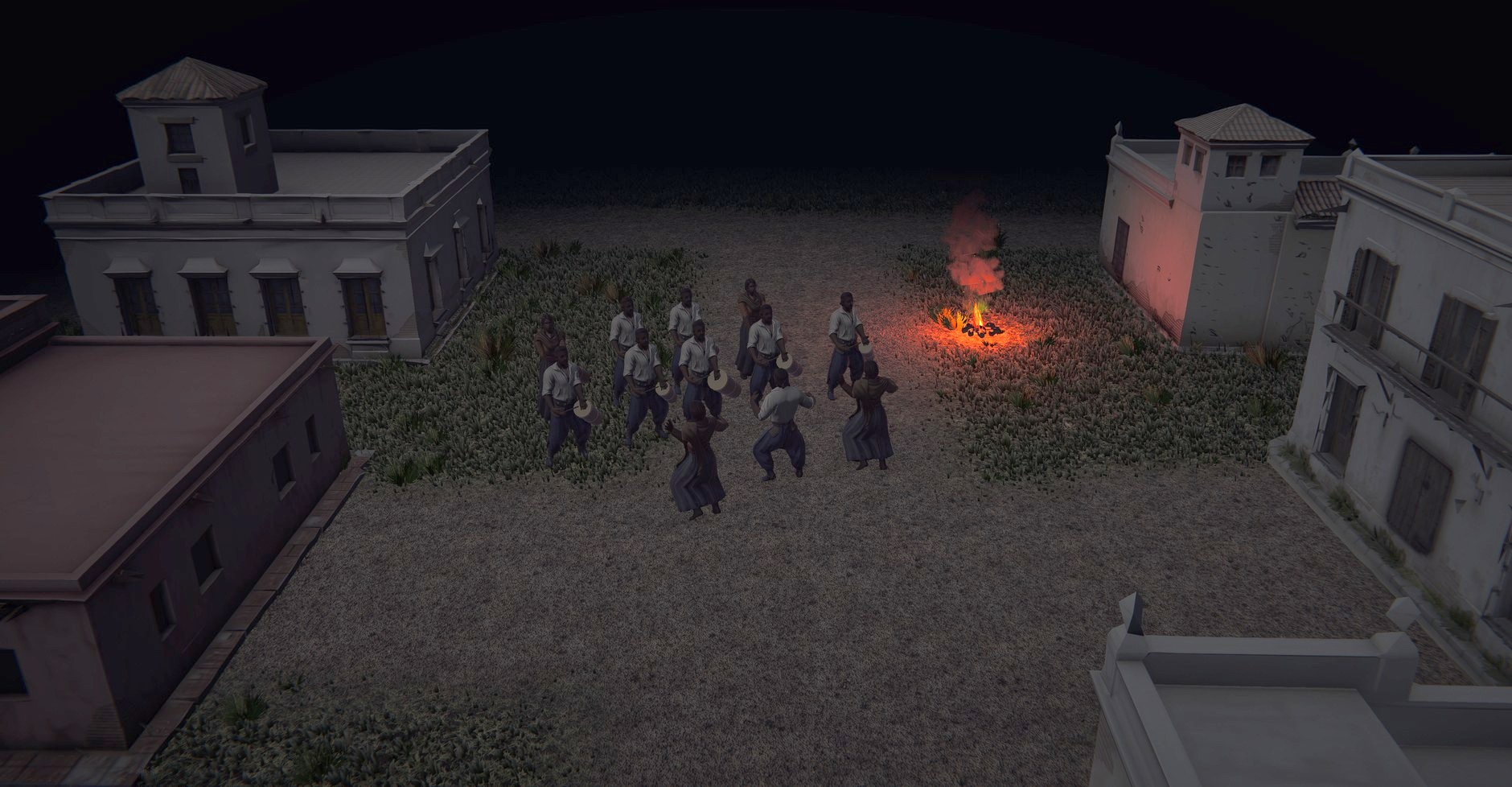
Twelve libertos, five of them women, rescued in Buenos Aires, 1806 (campaign mission 11). Nine drums, three dancers and a fire to tune the skins.
Candombe is the drum music and dance that enslaved Africans and their descendants brought to the Río de la Plata. In colonial Buenos Aires and Montevideo, the African “nations” gathered on Sundays and holidays to drum and dance. City councils were uneasy about those gatherings, and they tended to happen on the edges of town. The name candombe for all of it settled in during the 19th century, the century our game takes place in.
That edge-of-town detail is why the libertos in Byzen play outside the camp and not in the middle of it. They’re part of the army, and the army is part of the story. Freed slaves fought in the wars of independence in large numbers. San Martín’s 7th and 8th infantry battalions in the Army of the Andes were raised largely from libertos, and the patriot armies had bands of liberto musicians.
Candombe is also very much alive. UNESCO added it to the Representative List of the Intangible Cultural Heritage of Humanity in 2009, and every Sunday the drum calls still go through the Sur, Palermo and Cordón neighbourhoods of Montevideo. One honest note: the line-up we use, a cuerda of three drum types called chico, repique and piano, is the form candombe has today. We don’t know exactly what a camp’s drums sounded like in 1812. We chose the shape players can recognise, and we’d rather say so than pretend.
Every night the game looks, every second and a half, for libertos who are really idle: no orders, no patrol, not holding ground, on foot. With fewer than three, nothing happens. They can still join the ordinary night ronda with the rest of the troops, the mate-and-guitar gathering by the fire. With three or more, they form a cuerda:

The same rule from three libertos to forty. Morale tops out at around a dozen, but the cuerda keeps growing.
The spot is chosen once a night. The game takes the centre of the faction’s buildings and the building farthest from it, then searches outward from the side where the libertos are standing, past the last building plus the size of the formation. Every spot in the formation has to land on walkable ground: not inside a house, a fence or the river, and not down a gully. If the first direction doesn’t work, it turns 30 degrees at a time, then tries farther out.
If the libertos are far from camp, say they were just rescued in a market across town, they don’t cross a hostile city alone at night. If three or more of them are together, they play where they are. That’s what the top image shows: twelve people freed in the Buenos Aires of 1806, drumming in a square two hundred metres from their own camp.

From the normal camera, at night. The fire and the movement draw the eye to them.
The cuerda lights a small fire to one side. Candombe drums are traditionally held near a fire to tighten the skins. That fire is a real fire in our fire system, so the ronda treats it like any other campfire. Idle soldiers and peons drift over, sit on logs and pass the mate. One night, two gatherings: drums on one side, guitar on the other.

Three is enough, here with a liberta among them. Behind them the regular ronda has taken over their fire.
Like the ronda, candombe raises the faction’s morale, measured per minute so it compares with everything else in the morale system:
Candombe is an action, not a stance. Any order, or being attacked, takes a liberto out of the cuerda. Once they’re idle again at night, they go back. At dawn the cuerda breaks up by itself and the fire goes with it.
Until now libertos used the soldier’s model, the halberdier, whose halberd is modelled into his hand. He can’t hold a drumstick. So the liberto got his own model, built in Blender from our rigged townsman (the “paisano”) by a single script:
Drum hangs from the hips: the strap goes over the right shoulder, the drum sits at the left hip, tilted, with the head in front. Palo continues from the right hand to hold the stick.The first version only had men, which was wrong: women were part of the African nations’ dances from the start, and today they play in the cuerdas too. So the same script builds a liberta from our peasant woman model, with the same drums and the same two animations. One in three people rescued at the market is a woman. Libertas fight like libertos, and in the cuerda they get whatever spot comes up, drum or dance, exactly like the men.
The peasant woman’s rig rests in a T-pose, arms straight out, while the townsman’s rests in an A-pose. A straight arm gives the IK solver no hint which way the elbow should bend, so her arms stayed stiff. The script now detects a T-pose and adds pole targets that put the elbows down and back. Everything measured on the townsman (where the drum hangs, the strap’s path, where the dancing hands go) is shifted by the difference between the two models’ hips.
Our first pass at these two animations looked stiff, and we redid them before posting. The drummer barely moved, his stick hand was hidden behind the drum, and a sign error had everyone leaning back instead of over the drum. The dancers held their arms out like scarecrows and finished each bar with a clap that jumped. The versions below are the second take.
The animations are made with inverse kinematics and then baked to keyframes. Both are 96 frames at 24 fps: four seconds, two bars of 4/4 at 120, in place and looping.

Both loops on both models, as they come out of Blender.

Up close in the game: libertas and libertos on the drums, each with the drum of their role. In front, a liberta dancing.

The dancers, seen from behind the drums: a liberta and two libertos.
We don’t have candombe recordings yet, so the drums are synthesized, the same way the ronda’s guitar is. Each drum is its own four-second loop, the same length as the animations, so they never drift apart.

What each synthesized drum plays.
In the game, each drum type is its own looping sound, placed in 3D at the cuerda. It only plays if someone is playing that drum, and it starts in time with the ones already playing. Volume grows with how many people play it: one chico sounds at 55%, and each extra one adds less, because drums cover each other. A big cuerda can be heard from farther away: 60 metres plus 4 for each drum, up to 30 drums. If real four-second recordings are ever dropped into the project’s resources, the game uses them instead of the synthesis.

Skirmish, 18 libertos, seven of them women: thirteen drums, five dancers, and the ronda by the fire.
Next up: the drums for multiplayer clients, and Historyblog #4 on the original peoples of the Río de la Plata.