Elite no more. Browns' forgotten decade of heartbreak, heroes and change
EDITOR’S NOTE: We are observing the Browns’ 80th birthday with articles that define the franchise, one decade at a time.
We’ve rolled through the Cleveland Browns‘ first two decades — 1946-55 and 1956-65 — as franchise. Their rich history began with 20 years filled with championships, legends and Hall of Famers.
We continue here by presenting 10 items that defined the franchises third 10 years, 1966-75.
They still featured some big stars, even a few Hall of Famers. They nearly reached pro football’s biggest game in the early days of the Super Bowl’s rise. But they also began their decline as a franchise.
The Browns spent the entirety of the franchise’s first 10 seasons with Otto Graham at quarterback. Nine of their second 10 years unfolded with Jim Brown at running back.
They began their third decade without a player eventually deemed worthy of a statue. As the Browns mark their 80th birthday, Graham and Brown are the only two fitting that description.
For a while as the third decade rolled on, Cleveland remained one of the winningest teams in the NFL, under the head coach who replaced Paul Brown, Blanton Collier.

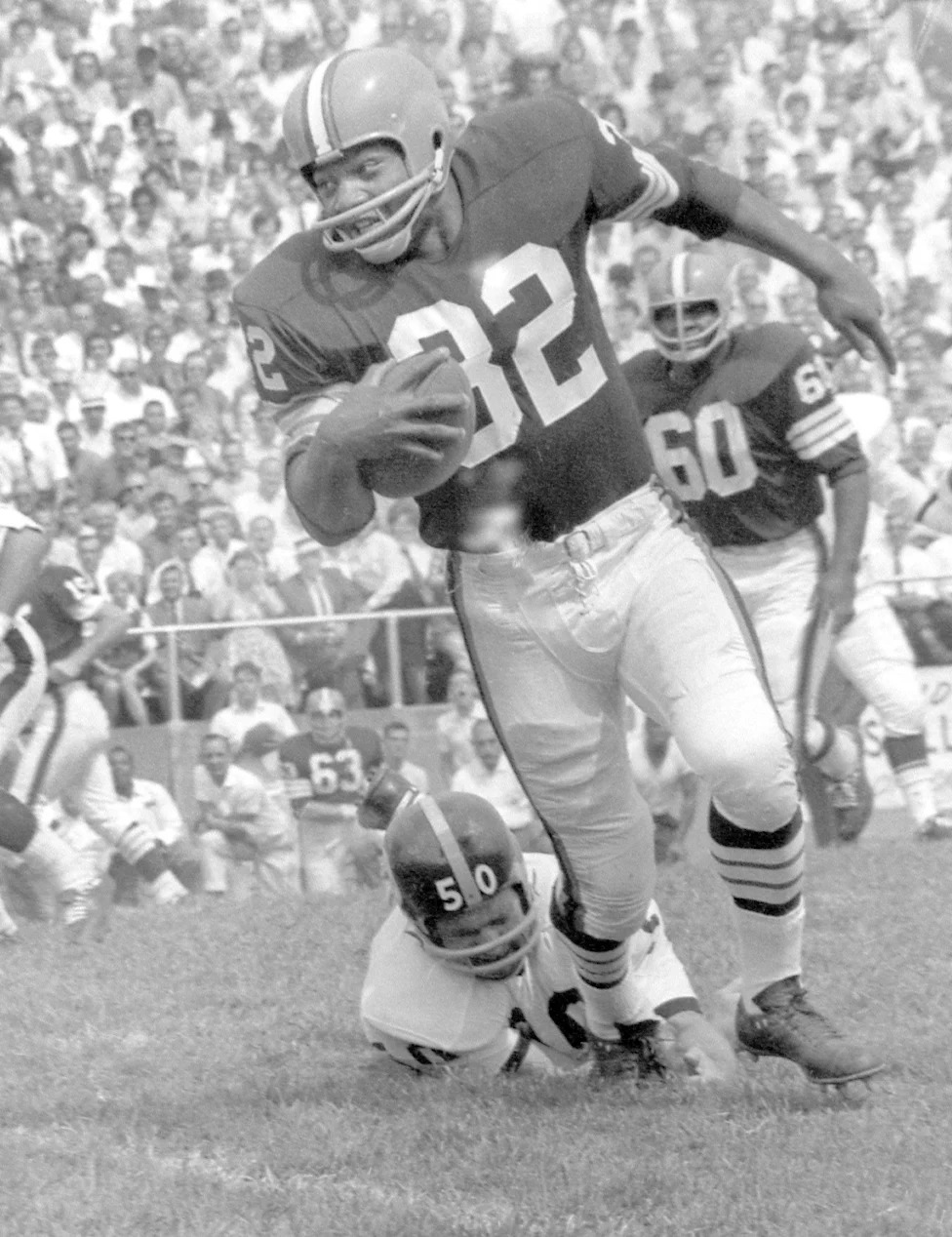
Aug 21, 1965; Los Angeles, CA, USA; FILE PHOTO; Cleveland Browns head coach Blanton Collier talks to John Wooten (60) on the sideline during a pre-season game against the Los Angeles Rams at the Los Angeles Memorial Coliseum. Mandatory Credit: David Boss-USA TODAY Sports
Collier was an older head coach, turning 60 in 1966, along the lines of current head coach Todd Monken turning 60 in 2026.
Perhaps a place in Ohio football was Blanton’s destiny – he was the son of O.H. Collier.
The Colliers lived in the Kentucky hills 80 miles south of Cincinnati. Blanton stayed close to home for college (Georgetown) and then to teach math and coach.
He was head football coach at Paris High School for as many years (16) as Paul Brown was head coach of the Browns. They met when Collier was assigned to the Great Lake Naval Base near Chicago during World War II.
In 1946, Brown took Collier with him as a staff member on the start-up Browns team.
From 1946-53 in Cleveland, before he replaced Bear Bryant as head coach at the University of Kentucky, Collier was a quiet force in one of the richest cultures in pro football history.
Don Shula, who was coached by Collier on the 1951 and 1952 Browns, counted Collier as the top mentor who helped him become the winningest coach in NFL history.
The 1953 Browns, who went 11-1, were filled with future NFL head coaches, including Collier, Graham, Chuck Noll, Weeb Ewbank, Mike McCormack, Walt Michaels and Abe Gibron.
Ewbank, like Collier, spent a long time in the high school ranks before joining Paul Brown at Great Lakes. Like Collier, Ewbank left a run as one of Brown’s Cleveland staffers in 1954 to become a head coach, in his case with the NFL’s Baltimore Colts.
Paul Brown found some of the circumstances behind his old friend Collier replacing him to be disturbing.
Collier won pretty big, though, with a 76-34-2 regular-season record as head coach of the Browns from 1963-70. His .688 winning percentage is top 10 all-time. Sean McVay, seen as one of the league’s top current pilots, has a .616 winning percentage in 10 seasons with the Rams.

Nov 28, 1965; Los Angeles, CA, USA; FILE PHOTO; Cleveland Browns running back (44) Leroy Kelly in action against the Pittsburgh Steelers at Pitt Stadium. The Browns defeated the Steelers 42-21. Mandatory Credit: Tony Tomsic-USA TODAY NETWORK
Blanton Collier wore glasses, was hard of hearing and kindly of manner.
Collier’s first three years as Paul Brown’s replacement could have gone better, but not much better. The regular-season records were 10-4, 10-3-1 and 11-3. The Browns won the NFL Championship Game against Don Shula’s Colts in 1964 and lost it to Vince Lombardi’s Packers in 1965.
As the 1966 season began, Jim Brown was in London filming “The Dirty Dozen.” Leroy Kelly was the new running back in Cleveland’s starting 11.
The Steelers wanted their own Jim Brown and spent the third pick of the ’66 draft on 6-foot-2, 240-pound West Virginia running back Dick Leftridge. He might have been the biggest draft bust in Pittsburgh history.
The Browns replaced Jim Brown with Kelly, who, as the 110th pick of the 1964 draft, proved to be a great draft steal.
In 1966, Kelly shifted gears from nifty return man to Hall of Fame ball carrier. He finished second to Gale Sayers in rushing yards and led the league with 16 touchdowns.
It was still Paul Brown’s roster, mostly. Seven of the nine 1966 Pro Bowlers were acquired by “PB” before 1963, as were the quarterback, Frank Ryan, and two defensive stalwarts from Stark County, Jim Houston (Massillon) and Vince Costello (Sandy Valley), among others.

1966; Cleveland, OH, USA; FILE PHOTO: Cleveland Browns wide receiver (42) PAUL WARFIELD makes a touchdown catch against the St. Louis Cardinals at Cleveland Stadium. Mandatory Credit: Tony Tomsic-USA TODAY NETWORK Copyright © 1966 Tony Tomsic
The 1966 Browns were almost great. They had a good chance to be the NFL’s representative against the rival AFL in Super Bowl I.
In the home opener against defending NFL champion Green Bay, they led 14-0 on two Frank Ryan-to-Gary Collins touchdown passes, but wound up losing at the wire, 21-20.
In a 41-10 rout of Pittsburgh, they got 100-plus running yards from both Leroy Kelly and Ernie Green. At one point, they went on a 7-1 hot streak.

Oct 15, 1967; Cleveland, OH, USA; FILE PHOTO; Cleveland Browns running back Ernie Green (48) carries the ball under pressure from St. Louis Cardinals defensive players Chuck Walker (79) and Pat Fischer (37) at Cleveland Municipal Stadium. Mandatory Credit Herb Weitman-USA TODAY Sports
Alas, the “1,” a 16-6 loss at Pittsburgh, wrecked the season. It cost the Browns a playoff spot and made no sense. The Steelers were 1-5-1, coming off a 52-21 loss to Dallas.
The NFL was in its last year before splitting into four divisions. Green Bay was the class of the seven-team Western Conference. Dallas and Cleveland fought it out in the eight-team Eastern Conference.
The stumble at Pittsburgh turned a Thanksgiving Day game at Dallas into a must-win. Quarterback “Dandy Don” Meredith outdueled Frank Ryan in a 26-14 loss that led to the Cowboys winning the Eastern Conference.
The Packers beat the Cowboys in the NFL Championship Game, then crushed the AFL champion Chiefs in the first Super Bowl.

Dec 21, 1969; New York, NY, USA; FILE PHOTO; Cleveland Browns quarterback Bill Nelsen (16) at the line of scrimmage against the New York Giants at Yankee Stadium. Mandatory Credit: Manny Rubio-USA TODAY Sports
The arrival of the expansion New Orleans Saints swelled the NFL to a balanced 16 teams in 1967, allowing the formation of four divisions and an expanded postseason.
The Browns went 9-5 to win the Century Division, which included the New York Giants, St. Louis Cardinals and Pittsburgh. They leaked a little oil, though, falling to 5-4 with a 55-7 loss at Green Bay. They rallied into the playoffs, but got clobbered 52-14 by Dallas.
Pittsburgh was the NFL’s worst team, going 16-38-2 under three different head coaches from 1964-67. In an unusual trade, the Steelers sent injury-prone starting quarterback Bill Nelsen to the Browns for backup QB Dick Shiner.
Shiner did not sparkle as a Steeler starter, going 3-16-1 in 1968 and 1969. Nelsen was a find for Cleveland.
Frank Ryan, aging and injury-worn, started the Browns’ first three games in 1968. Nelsen replaced him for the rest of the 14-game season.
Nelsen lost twice to a Browns nemesis, the St. Louis Cardinals, but was 9-0 against everyone else. The offense hummed, at one point, in consecutive games, fueling wins of 45-24 over the Steelers, 47-13 over the Eagles and 45-10 over the Giants.
The young star on an older roster was 26-year-old receiver Paul Warfield. He averaged more than 21 yards on 50 catches in the regular season and, in the playoffs, dazzled in a 31-20 home win over the Cowboys.
The Browns needed only to win the NFL Championship Game, at home game against Don Shula’s Baltimore Colts (a team they beat on the road in the regular season), to advance to Super Bowl III.
In a 13-degree wind chill, they left a crowd of 80,628 miserable with a 34-0 loss.
It might have gone down as Don Shula’s greatest win, had it not been followed by his worst loss, to a Jets team which wasn’t supposed to have a chance in the Super Bowl.

Oct 15, 1967; Cleveland, OH, USA; FILE PHOTO; Cleveland Browns tight end Milt Morin (89) scores a touchdown despite the efforts of St. Louis Cardinals linebacker Larry Stallings (67) at Cleveland Municipal Stadium. Mandatory Credit Herb Weitman-USA TODAY Sports
The 1969 Browns got a mulligan. Once again, they reached the NFL Championship Game, needing only to win to get to a Super Bowl.
They were tremendous in the first half of the season, leaning into the end of Leroy Kelly’s prime, and becoming a passing force with Bill Nelsen hitting three elite receivers, Paul Warfield, Gary Collins and tight end Milt Morin.
Nov. 2, 1969 became one of the most glorious days Municipal Stadium ever saw. A overstuffed house of 84,850 watched Morin catch seven passes for 102 yards. Warfield and Collins each made two touchdown catches. After throwing three interceptions, Dallas QB Craig Morton was benched in favor of 27-year-old rookie Roger Staubach. The Browns won 42-10.
A sobering 51-3 loss at Minnesota came a week later, but they won their next five to take the Century Division going away.
In the postseason, they clobbered the Cowboys again, 38-14, to reach the NFL Championship Game, with a berth in Super Bowl IV on the line. Unfortunately, the team that beat the Browns 51-3 stood in the way.

Jan 4, 1970; Bloomington, MN, USA; FILE PHOTO; Cleveland Browns (66) Gene Hickerson leads a sweep for running back (44) Leroy Kelly against the Minnesota Vikings in the NFL Championship Game. The Vikings defeated the Browns 27-7. Mandatory Credit: Tony Tomsic-USA TODAY NETWORK
The wind chill in Minnesota was minus-6. Alan Page and “The Purple People Eaters” kept the heat on Nelsen. The Vikings led 24-0 at halftime and won 27-7.
Coach Bud Grant, from the Paul Brown coaching tree, took his Vikings to New Orleans as a 12-point favorite against AFL champion Kansas City. Former Browns quarterback Len Dawson became Super Bowl MVP in a 23-7 Chiefs win.

Nov 1977; Cleveland, OH, USA; FILE PHOTO; Members of the 1970 Cleveland Browns on the bench. Mandatory Credit: Photo By Malcolm Emmons-USA TODAY Sports © Copyright Malcolm Emmons
They said it was a revolution when the American Football League began to grow in the 1960s. The AFL won the war and merged into the NFL in 1970.
The NFL swelled from 16 teams to 26. It went from four divisions to six, split between the American and National conferences.
The Browns’ new division, the AFC Central, included the Steelers and two immigrants from the AFL, the Cincinnati Bengals and Houston Oilers.
Cincinnati’s head coach and organizational czar was Paul Brown, who had steered the Browns to 10 straight league championship games from 1946-55, and who was fired by Art Modell after the 1962 season.
The AFC Central seemed a sweet situation for Cleveland. The Bengals were a third-year expansion team coming off a 4-9-1 year. The Oilers went .500 in their last two AFL seasons. The Steelers were fresh off a 1-13 flop.
Brown’s six-man coaching staff in Cincinnati included Vince Costello (one of his former Browns players) on defense and Bill Walsh on offense.

Proud players carry Cincinnati Bengals head coach Paul Brown off the field after the last game of the season at Riverfront Stadium when the Bengals beat the Boston Patriots for the AFL Central title, Dec. 20, 1970.
The first Browns-Bengals game — Blanton Collier vs. Paul Brown — drew 83,520. Cleveland won a 30-27 shootout.
The Bengals won the rematch in Cincinnati, 14-10, propelling them to the AFC Central championship with an 8-6 record. The Browns finished second at 7-7.
Modell vs. Paul Brown was a blood feud from the start, an obsession win in each man’s mind. Losing the division to Paul Brown coincided with the end of Blanton Collier’s employment as Modell’s head coach.

New York Jets cornerback Earlie Thomas tackles Cleveland Browns running back Bo Scott during the first Monday Night Football game, Sept. 21, 1970, in Cleveland. The Browns won in front of a record Cleveland football crowd of 85,703.
The 1970 season kicked off gloriously when the Browns beat “Broadway Joe” Namath’s New York Jets in the first Monday Night Football Game.
Keith Jackson, “Dandy Don” Meredith and Howard Cosell manned the ABC booth.
The crowd was 85,349, one of those overstuffed houses that made the look and feel of Municipal Stadium an overpowering spectacle.

A record Cleveland football crowd of 85,703 watches the first ever Monday Night Football game, Sept. 21, 1970. The Cleveland Browns beat the New York Jets 31-21 in the game that was televised in primetime on ABC.
Namath threw for 298 yards and pulled the Jets to within 24-21, late, but he also threw interceptions to Jim Houston and Walt Sumner, and finally a clinching pick-six to Billy Andrews.
TV history and a 3-1 start became forgotten as the Browns went 4-6 down the stretch. After a 7-7 finish, Nick Skorich replaced Collier.
In terms of persona, it was like going from Gandhi to Genghis Khan. Skorich grew up steel-mill tough on the Ohio River in Bellaire. He stood just 5-foot-9 but was tough enough to play on the Steelers’ offensive line. He had been on Collier’s Cleveland staff for six years and succeeded his boss at the age of 48.
Jim Brown remembered Collier as “a sweetheart of a human being.” No one sang “Let Me Call You Sweetheart” to Skorich, who alienated veterans, notably long-time left tackle Dick Schafrath.

Dec 26, 1971; Cleveland, OH, USA; FILE PHOTO; Cleveland Browns defensive tackle (72) Jerry Sherk on the sidelines during the 1971 AFC Divisional Playoff game against the Baltimore Colts. The Colts defeated the Browns 20-3 at Cleveland Stadium. Mandatory Credit: Tony Tomsic-USA TODAY NETWORK
Skorich’s 1971 team featured a memorable defensive front four of home-grown players, Walter Johnson (drafted in 1965), Jack Gregory (1967), Jerry Sherk (1970) and Joe “Turkey” Jones (1970).
Bill Nelsen threw 23 interceptions against 13 touchdown passes, but he tended to make the right play at the right time.
The Browns won the AFC Central at 9-5 in a last hurrah for aging icons such as Leroy Kelly, Gary Collins and Jim Houston. Skorich eventually benched Schafrath in favor of youngster Doug Dieken.
The Browns earned a home playoff assignment against the Baltimore Colts. It became a last career playoff win (20-3) for Colts legend Johnny Unitas.

Dec 24, 1972: Miami, FL, USA; FILE PHOTO; Cleveland Browns quarterback Mike Phipps (15) in action against the Miami Dolphins during the 1972 AFC Divisional Playoff Game at the Orange Bowl. The Dolphins defeated the Browns 20-14. Mandatory Credit: Dick Raphael-USA TODAY Sports
Quarterback Mike Phipps mostly sat behind Bill Nelsen in 1970 and 1971. Phipps’ placid personality seemed an odd fit for the gravelly Skorich, but it was time for them to be in the forefront together after Nelsen, his knees gone, threw three interceptions in the 1971 playoff loss.
Repercussions of the 1970 trade that sent Paul Warfield to the Dolphins in exchange for the draft pick that fetched Phipps are covered in our “story of the decade.”
It was not a surprise that the Browns went 10-4 when Phipps finally took over. He was a No. 3 overall pick in his third season.
The Steelers crawled out of their hole, though. They hadn’t made an NFL postseason since 1947. They were 6-8 in 1971, but they won the AFC Central at 11-3 in 1972, behind their own third-year quarterback, Terry Bradshaw, the No. 1 pick of the 1970 draft.
A series of Pittsburgh draft hits kicked in, including defensive linemen “Mean Joe” Greene and L.C. Greenwood (picked in 1969), cornerback Mel Blount (1970), linebacker Jack Ham (1971), and running back Franco Harris (1972).
The division was decided with two late-season Browns-Steelers battles within three weeks.
In a 26-24 win in Cleveland, the Browns got almost 200 rushing yards from Leroy Kelly and Bo Scott. In the rematch, Bradshaw uncorked a 78-yard touchdown pass to John McMakin. Phipps threw for 59 yards for the entire day and lost as much in sacks and interception returns. Pittsburgh won 30-0.
The Browns got to the playoffs as a wild card and scared undefeated Miami before falling 20-14.

Dec 16, 1973; Los Angeles, CA, USA; FILE PHOTO; Cleveland Browns quarterback Mike Phipps (15) hands off the Greg Pruitt (34) against the Los Angeles Rams at the Coliseum. The Rams defeated the Browns 30-17. Mandatory Credit: Darryl Norenberg-USA TODAY Sports
The 1973 Browns’ record of 7-5-2 was a mirage. They beat the 1-13 Houston Oilers twice. They beat the 4-10 Colts. They beat the 2-11-1 Giants. They tied the 2-11-1 Chargers.
The Bengals beat the Browns twice and won the AFC Central behind quarterback Ken Anderson, a third-round draft find out of Augustana in 1971. Mike Phipps regressed, throwing 20 interceptions against nine touchdown passes.
Guard Gene Hickerson, the last vestige from the Paul Brown days, retired after the season.
Rookie second-round pick Greg Prutt provided a spark as a runner, receiver and return man, but it was the last year for future Hall of Famer Leroy Kelly, who averaged 2.9 yards a carry.
Skorich’s three-year record was solid, 26-14-2, but the talent level deteriorated as Pittsburgh’s roster took off under former Cleveland Benedictine and Cleveland Browns player Chuck Noll.
There was one flashback to the glory days. Facing Pittsburgh at home, the Browns trailed 16-14 and faced third-and-long in the closing moments. Phipps scrambled and threw a 40-yard completion to Pruitt, setting up a game-winning TD run by Pruitt.
The Browns improved 7-3-1. Pittsburgh fell to 8-2.
The season and the Skorich regime got away from there.

Sep 29, 1974; St. Louis, MO, USA; FILE PHOTO; Cleveland Browns quarterback Mike Phipps (15) at the line of scrimmage against the St. Louis Cardinals at Busch Stadium. Mandatory Credit: Herb Weitman-USA TODAY Sports
The good news in 1974 was that the Browns were still playing the Steelers tough, despite two close losses. The bad news was that Pittsburgh won those games with backup QBs Joe Gilliam and Terry Hanratty. Terry Bradshaw eventually found the field, and himself, and led the team to its first Super Bowl.
In the Pittsburgh-at-Cleveland game, Hanratty threw more interceptions (three) than completions. The Browns’ offense, though, had its own quarterback problems, compounded by the likes of Steve Holden, Gloster Richardson, Jubilee Dunbar and Fair Hooker as a receiving corps.

Sep 30, 1973; Cleveland, OH, USA; FILE PHOTO; Cleveland Browns receiver Gloster Richardson (42) runs with the ball against the New York Giants at Cleveland Stadium. Mandatory Credit: Malcolm Emmons-USA TODAY Sports
Future Hall of Fame receiver Paul Warfield was long gone in the Phipps deal, starring for the Dolphins on 1972 and 1973 Super Bowl winners.
An early home loss to Paul Brown’s Bengals got Art Modell’s dander up and became part of the story of Phipps getting benched. The replacement was Brian Sipe, a No. 330 overall draft pick in 1972.
The game of the year in ’74 was a 36-35 loss at San Diego. Sipe looked like he might become something. The Chargers got four second-half touchdown passes from Dan Fouts.
The Browns could have had Fouts in the 1973 draft, but with the 47th pick selected a cornerback they wound up keeping for just a year, Jim Stienke. The Chargers chose Fouts a short while later.
Forrest Gregg, a Packers stalwart in the Vince Lombardi dynasty, arrived as Skorich’s offensive line coach before the ’74 season. After a 4-10 finish, Modell fired Skorich and replaced him with Gregg.
Greg Pruitt produced a 1,000-yard rushing season in 1975, and former Akron Garfield/Kent State star Larry Poole sparked local interest, but quarterback trouble took root.
Phipps returned to the starting job and threw eight interceptions without a touchdown pass during an 0-5 start.
Sipe got the ball back for a while, but the Browns’ third decade ended with a 3-11 thud.
Reach Steve at steve.doerschuk@cantonrep.com
This article originally appeared on The Repository: Elite no more. Browns’ forgotten decade of heartbreak, heroes and change


