How the world of Petrimin runs: no language model, one quarter at a time
A few people asked whether Petrimin uses an AI model to decide what happens. It doesn’t. The world
is a set of written rules, and this post goes through what they do.
What is simulated

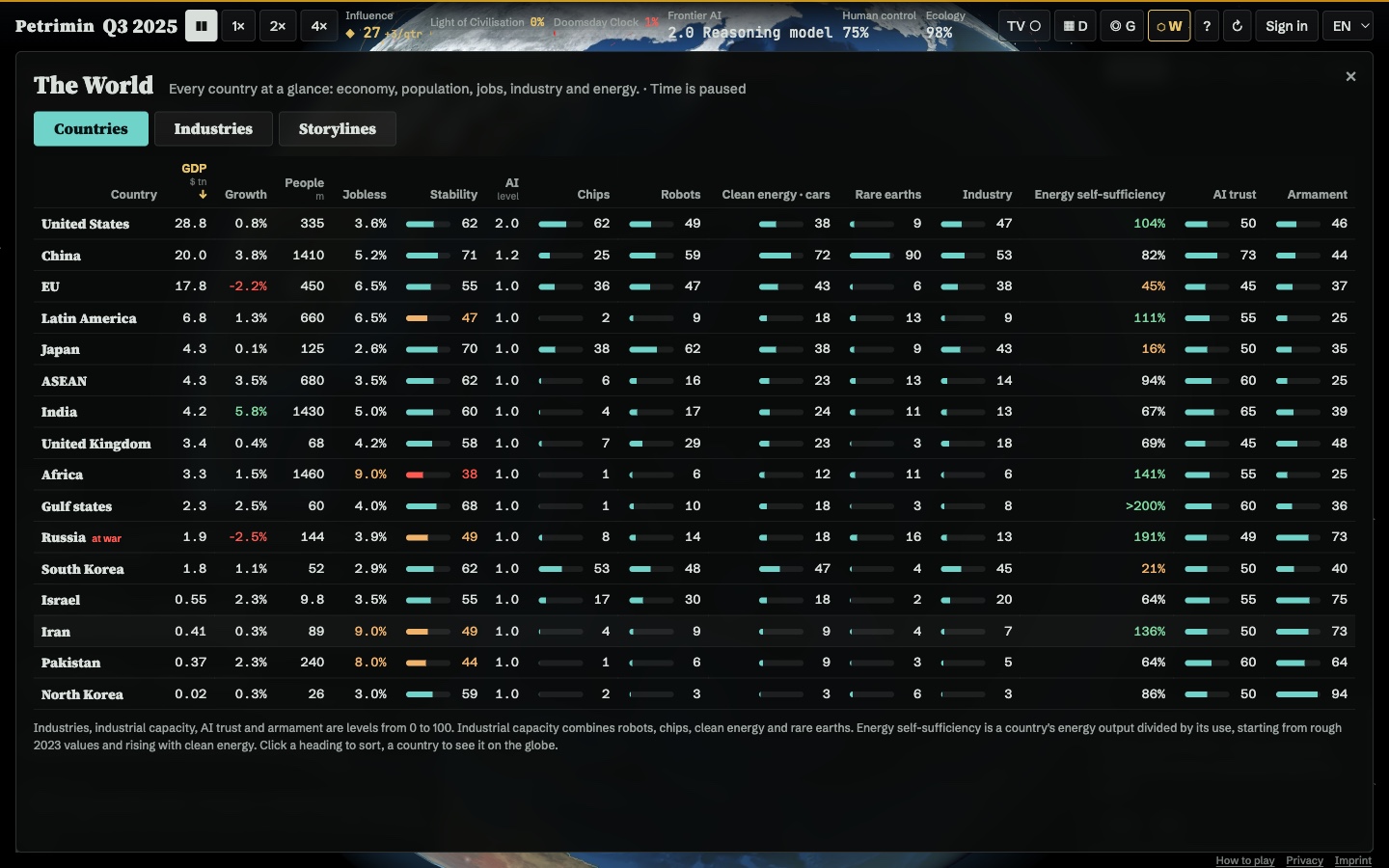
The world is made of 16 countries and regions, from the United States and China to ASEAN, Latin
America and Africa. Each has its own economy, employment, inequality, social stability, public
trust and five industries. On top of that the world has a few numbers of its own: the capability of
frontier AI, human control over it, what AI does behind humanity’s back (the game calls it the
dark side), space capability, the division between blocs, nuclear deterrence and the planet’s
ecology.
One quarter, always in the same order
Events and storylines first, then chips and compute, then frontier AI and space, then each
country’s economy. After that countries make their own decisions, relations and blocs shift,
conflicts and nuclear deterrence are resolved, the Web of Fate applies its effects, and last the
game checks whether an ending has been reached.
You run no country. Each one reacts to its own situation: tariffs, chip export controls, keeping up
in the AI race, redistribution, arming. A country’s character is written as its plausible national
interest, with no judgement on its political system, and real leaders appear by office only.
The price of a crossroads
When a country reaches a decision, every option has a weight: how much the country leans towards
it. The path it wants most costs 1 influence. The less it wants a path, the more that path costs.
Once you pay, it happens for certain.
If you’d rather not pay, you roll five dice. The total runs from 5 to 30, and that span is cut into
ranges by the weight of each option, using the real distribution of five dice. Middle totals come
up often and extremes rarely, and the cut already accounts for that.
Wars, and why they fade slowly
Tension on its own only rises to a standoff. A war always starts through a decision. Wars have
front lines, phases and outside support, and ceasefire talks can fail and be tried again a year
later. The effect of every event spreads to other countries along trade and friendship and fades
over the next three years. Bad events last longer than good ones.
Two bars, eight endings
Seven paths are scored every quarter. The leading bright path pushes the Light of Civilisation, the
leading dark path pushes the Doomsday Clock, and the stronger frontier AI gets, the faster both
move. At 70% a bar opens the final chapter, and at 85% humanity makes one last choice. So a game
never ends because a number slipped past a line; the last step is always a decision.
Left alone, the world most likely ends in ruin. The game’s tests check that, and they also check
that every ending can be reached by a player who aims for it.
Same seed, same world
Every random number comes from a generator inside the state of the world, so the same seed and the
same moves always give the same world. The simulation runs on the server. When you reach an ending,
the server can run your whole game again from the seed and your moves to verify the numbered
ending card.
What it isn’t
It’s no forecast. The events are invented, the 2023 figures are rough values for calibration, and
the map draws no borders.
Since launch
– Each of the eight endings has its own page
nuclear deterrence and the planet’s ecology.
One quarter, always in the same order
Events and storylines first, then chips and compute, then
frontier AI and space, then each country’s economy. After that
countries make their own decisions, relations and blocs shift,
conflicts and nuclear deterrence are resolved, the Web of Fate
applies its effects, and last the game checks whether an ending
has been reached.
You run no country. Each one reacts to its own situation:
tariffs, chip export controls, keeping up in the AI race,
redistribution, arming. A country’s character is written as its
plausible national interest, with no judgement on its political
system, and real leaders appear by office only.
The price of a crossroads

When a country reaches a decision, every option has a weight: how
much the country leans towards it. The path it wants most costs
1 influence. The less it wants a path, the more that path costs.
Once you pay, it happens for certain.
If you’d rather not pay, you roll five dice. The total runs from
5 to 30, and that span is cut into ranges by the weight of each
option, using the real distribution of five dice. Middle totals
come up often and extremes rarely, and the cut already accounts
for that.
Wars, and why they fade slowly

Tension on its own only rises to a standoff. A war always starts
through a decision. Wars have front lines, phases and outside
support, and ceasefire talks can fail and be tried again a year
later. The effect of every event spreads to other countries along
trade and friendship and fades over the next three years. Bad
events last longer than good ones.
Two bars, eight endings
Seven paths are scored every quarter. The leading bright path
pushes the Light of Civilisation, the leading dark path pushes
the Doomsday Clock, and the stronger frontier AI gets, the faster
both move. At 70% a bar opens the final chapter, and at 85%
humanity makes one last choice. So a game never ends because a
number slipped past a line; the last step is always a decision.
Left alone, the world most likely ends in ruin. The game’s tests
check that, and they also check that every ending can be reached
by a player who aims for it.
Same seed, same world
Every random number comes from a generator inside the state of
the world, so the same seed and the same moves always give the
same world. The simulation runs on the server. When you reach an
ending, the server can run your whole game again from the seed
and your moves to verify the numbered ending card.
What it isn’t
It’s no forecast. The events are invented, the 2023 figures are
rough values for calibration, and the map draws no borders.
Since launch
– Each of the eight endings has its own page
– The full rules are written up:
Petrimin.online
– A guide to how to play: Petrimin.online
– You can pick English, German or Chinese right on the start
screen
Play in the browser: Petrimin.online
If anything in the rules looks wrong or unfair to you, I’d like
to hear it in the comments.