10 Native Americans Who Changed American History
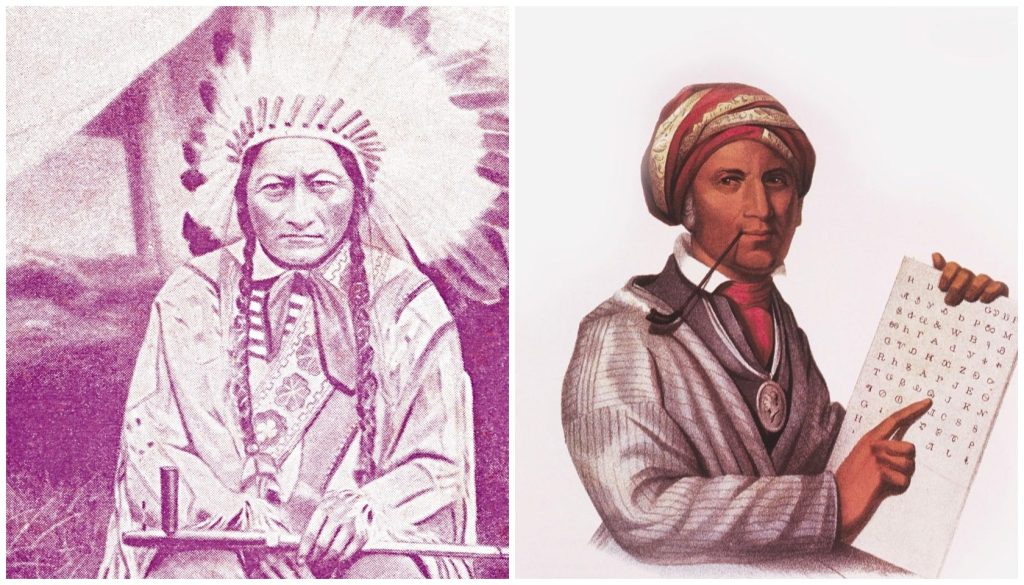

The history of America cannot be fully understood without recognizing the Native American leaders, visionaries, diplomats, educators, and advocates whose contributions helped shape the nation. Long before the United States became an independent country, Indigenous nations had established sophisticated societies, systems of government, trade networks, agricultural practices, and cultural traditions across the continent.
As European colonization expanded and the United States emerged, Native Americans played pivotal roles in diplomacy, exploration, resistance, education, medicine, and government. Some fought to defend their homelands, others worked to preserve their languages and cultures, and many challenged the barriers imposed upon their communities. Their stories are not simply chapters in Native American history; they are essential chapters in the history of America itself and many of these stories shape how we live today.
In honor of National Native American Heritage Month, here are 10 Native Americans who helped to change and transform American history.
Among the earliest Indigenous leaders remembered for promoting diplomacy was Chief Tamanend, a respected leader of the Lenni-Lenape, also known as the Delaware people, according to History. He is traditionally associated with efforts to establish peaceful relations with English colonists in the region that became Pennsylvania. Tamanend became a lasting symbol of diplomacy and friendship, particularly through his association with William Penn and the early relationship between the Lenape and the Pennsylvania colonists. According to the outlet, Tamanend met with Penn in the late 1600s “to establish an agreement of friendship and peaceful coexistence.”
Although some details of his life have been preserved through tradition and later accounts rather than extensive contemporary documentation, his legacy became deeply embedded in American historical memory. He became a celebrated leader in his community and was eventually dubbed the “Patron Saint of America,” History noted.

Pontiac, an Ottawa leader, became one of the most prominent Indigenous figures to challenge British expansion following the French and Indian War. After France surrendered much of its North American territory to Britain in 1763, British policies and growing colonial encroachment threatened Indigenous communities throughout the Great Lakes region. According to the Bill of Rights Institute, in May 1763, Pontiac, an Ottawa leader, helped launch a major Indigenous resistance movement by leading the siege of Fort Detroit and inspiring a broader uprising among numerous Native nations, including the Ojibwe, Potawatomi, Wyandot, Lenape, and Shawnee. Following the French and Indian War, Britain took control of the Great Lakes region and introduced policies that threatened Indigenous lands, sovereignty, and survival.
Known as Pontiac’s War or Pontiac’s Rebellion, the conflict demonstrated the military and political strength of Native nations, whose coordinated resistance resulted in the capture of eight of twelve British forts in the region. Although Pontiac was an important catalyst and spokesman, the uprising was a coalition of Indigenous nations, each exercising its own leadership and pursuing shared goals of defending ancestral territories and protecting their independence. Sadly, the resistance did not end British control, but it exposed the difficulties of imposing colonial authority across Indigenous territories and demonstrated that Native American nations were willing to go to extraordinary lengths to defend their ancestral lands, sovereignty, and way of life.

One of the most consequential Indigenous leaders in the struggle against American westward expansion was Tecumseh, a Shawnee leader and gifted political strategist. Recognizing that individual Native nations would struggle to resist the growing power of the United States on their own, Tecumseh worked to unite Indigenous communities into a broad confederacy. He believed that Native lands belonged collectively to the Indigenous nations that inhabited them and should not be surrendered through agreements made by individual groups without the consent of others.
His efforts brought together Native warriors and leaders from different nations in an attempt to protect their territories and political independence. During the War of 1812, Tecumseh allied with British forces against the United States. He was killed at the Battle of the Thames in 1813, but his vision of Indigenous unity remains an important part of Native American history. His leadership reflected a determination to defend not only ancestral lands but also the sovereignty and future of Indigenous nations.

Sacagawea, a Lemhi Shoshone woman, became an important figure in one of the most well-known exploration journeys in American history. As a young woman, she accompanied the Lewis and Clark Expedition from 1805 to 1806, traveling with the expedition through territory that was largely unfamiliar to the Americans leading it. She contributed as an interpreter, cultural intermediary, and guide, helping the expedition communicate with Indigenous communities and navigate relationships with different Native nations. Her presence also helped demonstrate that the expedition was not a military party, as women and children were commonly associated with peaceful traveling groups.
Her knowledge of the region, language skills, and connections to Indigenous communities provided valuable assistance. Although historical accounts of her individual contributions are sometimes exaggerated or simplified, Sacagawea’s role in the expedition remains significant. She has become a lasting symbol of Indigenous women’s contributions to exploration and American history, even though the expedition itself was part of the larger expansion of the United States into Native homelands.

The power of language and education became especially evident through the achievements of Sequoyah, a Cherokee scholar and inventor who accomplished something extraordinary: he developed a written system for the Cherokee language, according to National Geographic. Known as the Cherokee syllabary, his system consisted of characters representing syllables and allowed Cherokee people to read and write in their own language without first learning English. Completed in 1821, the syllabary transformed communication and education within the Cherokee Nation and helped strengthen cultural identity during a period of growing pressure from the United States.
His unique syllabary also contributed to the development of the Cherokee Phoenix, the first newspaper published by a Native American nation in the United States. Sequoyah’s achievement demonstrated that Indigenous knowledge, innovation, and intellectual accomplishments were every bit as significant as those celebrated in mainstream American history. His legacy continues through the Cherokee language and the generations who have worked to preserve it.
Red Cloud, an Oglala Lakota leader, became one of the most significant Indigenous political and military figures of the nineteenth century. At a time when American expansion threatened Lakota territory and traditional ways of life, Red Cloud led resistance against the construction of military forts and the growing presence of settlers along the Bozeman Trail in present-day Wyoming and Montana. The conflict, known as Red Cloud’s War, lasted from 1866 to 1868 and ended with a major victory for the Lakota and their allies.
Red Cloud subsequently participated in negotiations that resulted in the 1868 Treaty of Fort Laramie, according to The National Park Service. The treaty required the United States to abandon its forts along the Bozeman Trail and recognized a large territory for the Lakota, including the Black Hills. Although the United States would later violate the treaty’s protections, Red Cloud demonstrated the influence Indigenous leaders could exercise through both military resistance and political negotiation. His life reflected the determination of the Lakota people to defend their homeland and maintain their sovereignty.

Another influential Lakota leader was Sitting Bull, a Hunkpapa Lakota chief, spiritual leader, and prominent defender of Indigenous independence. He opposed the United States government’s efforts to confine Native peoples to reservations and surrender their ancestral territories. His influence extended beyond military leadership because he was also respected for his spiritual authority, wisdom, and ability to unite people during a period of tremendous uncertainty.
In 1876, Sitting Bull’s leadership and spiritual influence helped inspire Lakota and Northern Cheyenne resistance that culminated in the Battle of the Little Bighorn, where U.S. Army forces under Lieutenant Colonel George Armstrong Custer were defeated. Although Sitting Bull is often closely associated with the battle, he was not its battlefield commander; military leadership involved other Indigenous warriors, including Crazy Horse. Sitting Bull continued to resist government pressure in the years that followed. In 1890, he was killed during an attempt by Indian agency police to arrest him on the Standing Rock Reservation. His life remains an important reminder of the struggle for Indigenous sovereignty, cultural survival, and the right of Native nations to determine their own futures.

Chief Joseph, a leader of the Nez Perce, or Nimiipuu, people, became internationally recognized for his efforts to protect his community during one of the most tragic periods of Indigenous displacement in American history. In 1877, following escalating conflict over the removal of Nez Perce people from their ancestral lands, several bands attempted to escape forced relocation by traveling toward Canada. Chief Joseph became one of the principal leaders of this difficult journey, which involved approximately 1,170 miles of travel and a series of confrontations with U.S. military forces.
His leadership was marked by his determination to protect his people, particularly women, children, and elders, while attempting to avoid unnecessary bloodshed. After months of pursuit, the Nez Perce surrendered near the Canadian border in October 1877, approximately 40 miles from their intended destination. Chief Joseph subsequently became a prominent spokesperson for his people’s rights, speaking before American audiences and government officials about broken promises, injustice, and the suffering caused by forced removal. Although he never secured the return of his people to their homeland, his advocacy helped bring national attention to the treatment of Indigenous communities. His legacy endures as a symbol of leadership, perseverance, and the pursuit of justice.
The contributions of Indigenous women to American history continued into the twentieth century through the remarkable life of Dr. Susan La Flesche Picotte, a member of the Omaha Nation and a pioneer in American medicine. In 1889, she became the first American Indian woman to earn a medical degree, graduating from the Woman’s Medical College of Pennsylvania at the top of her class. Rather than pursue a more comfortable career elsewhere, she returned to the Omaha Reservation in Nebraska, where she provided medical care to a community with limited access to physicians, serving more than 1,200 people across 400+ miles, at just 24 years old, according to the National Park Service website.
She often traveled long distances to treat patients, regardless of their ability to pay. Her commitment extended beyond individual medical care. In 1913, she helped establish a hospital in Walthill, Nebraska, providing an important medical resource for the Omaha community. It was widely regarded as the first hospital on a reservation that was not funded by the government, the website noted.
At a time when Native Americans and women faced widespread discrimination and unequal opportunities, Picotte broke barriers through education, determination, and service. Her accomplishments helped advance healthcare while demonstrating the importance of accessible medical care in underserved communities. Today, she is remembered as a trailblazer whose work extended far beyond the medical profession.

The influence of Native Americans in American government reached another historic milestone through Deb Haaland, a citizen of the Pueblo of Laguna in New Mexico. In March 2021, Haaland became the first Native American to serve as a United States Cabinet secretary when she was confirmed as Secretary of the Interior under President Joe Biden. Her appointment was particularly significant because the Department of the Interior oversees federal responsibilities involving public lands, natural resources, and the government’s relationships and obligations to federally recognized tribal nations.
Before her appointment, Haaland served in the U.S. House of Representatives, where she was one of the first two Native American women elected to Congress. Her career brought Indigenous representation into some of the highest levels of American government, opening doors for future generations of Native leaders. During her tenure as Interior Secretary from 2021 to 2025, she brought Native American perspectives into national discussions about tribal sovereignty, environmental protection, public lands, and Indigenous communities.
Before entering national politics, Haaland built a diverse career in business and tribal leadership. She operated her own small business, producing and canning Pueblo Salsa, served as a tribal administrator at San Felipe Pueblo, and became the first woman elected to the Laguna Development Corporation’s Board of Directors. In that role, she helped oversee the business operations of New Mexico’s second-largest tribal gaming enterprise and successfully advocated for environmentally responsible business practices, demonstrating her commitment to economic development and environmental stewardship within Indigenous communities.
Her historic appointment represented more than an individual achievement; it marked an important moment in a country whose federal institutions had long excluded the people whose ancestral lands they governed.
The lives of these ten individuals reveal a history that is far broader and more complex than the familiar stories often taught in American classrooms. From Tamanend’s diplomacy and Tecumseh’s vision of Indigenous unity to Sequoyah’s extraordinary linguistic achievement, Red Cloud’s military and diplomatic leadership, and Sitting Bull’s defense of Lakota independence, each made contributions that helped shape the nation’s historical development. Sacagawea and Susan La Flesche Picotte demonstrated the importance of Indigenous women’s knowledge, courage, and leadership, while Chief Joseph brought national attention to the human consequences of forced displacement. Deb Haaland’s historic appointment demonstrated that Native American influence continues in contemporary American institutions.
It is also important to recognize that these ten figures represent only a small portion of the Indigenous leaders, thinkers, inventors, educators, artists, soldiers, and advocates who have shaped this country. Native American history did not end with westward expansion, the reservation era, or the signing of treaties. Indigenous nations remain living, sovereign communities with distinct languages, governments, traditions, and cultures. Their contributions extend into virtually every aspect of American life, from agriculture and environmental knowledge to military service, literature, science, education, and public service.
To understand America’s history honestly, we must recognize Native Americans not simply as people who witnessed the creation of the United States, but as people whose lands, decisions, leadership, resistance, knowledge, and accomplishments helped shape the country itself. Their stories deserve to be remembered, taught, and respected, not as a footnote to American history, but as an essential part of the American story.
SEE MORE:
Black Native Americans: The History Of A Shared & Complicated Legacy