DevLog #11 – Whistles, bodies and borrowed uniforms: stealth v0.3 and History Mode
Back in July we promised that some Byzen missions would be played the Commandos way: a handful of named characters, guards with vision cones, and no army to fall back on. That first version worked, but it was thin. You could crouch, crawl, watch the cones and knife a guard from behind, and that was about it.
Stealth v0.3 is what exists now. This devlog covers what it adds, what it still lacks, and two other things that landed over the same days: a History Mode that tells you what really happened in every mission, and a set of missions where the enemy isn’t an army at all.

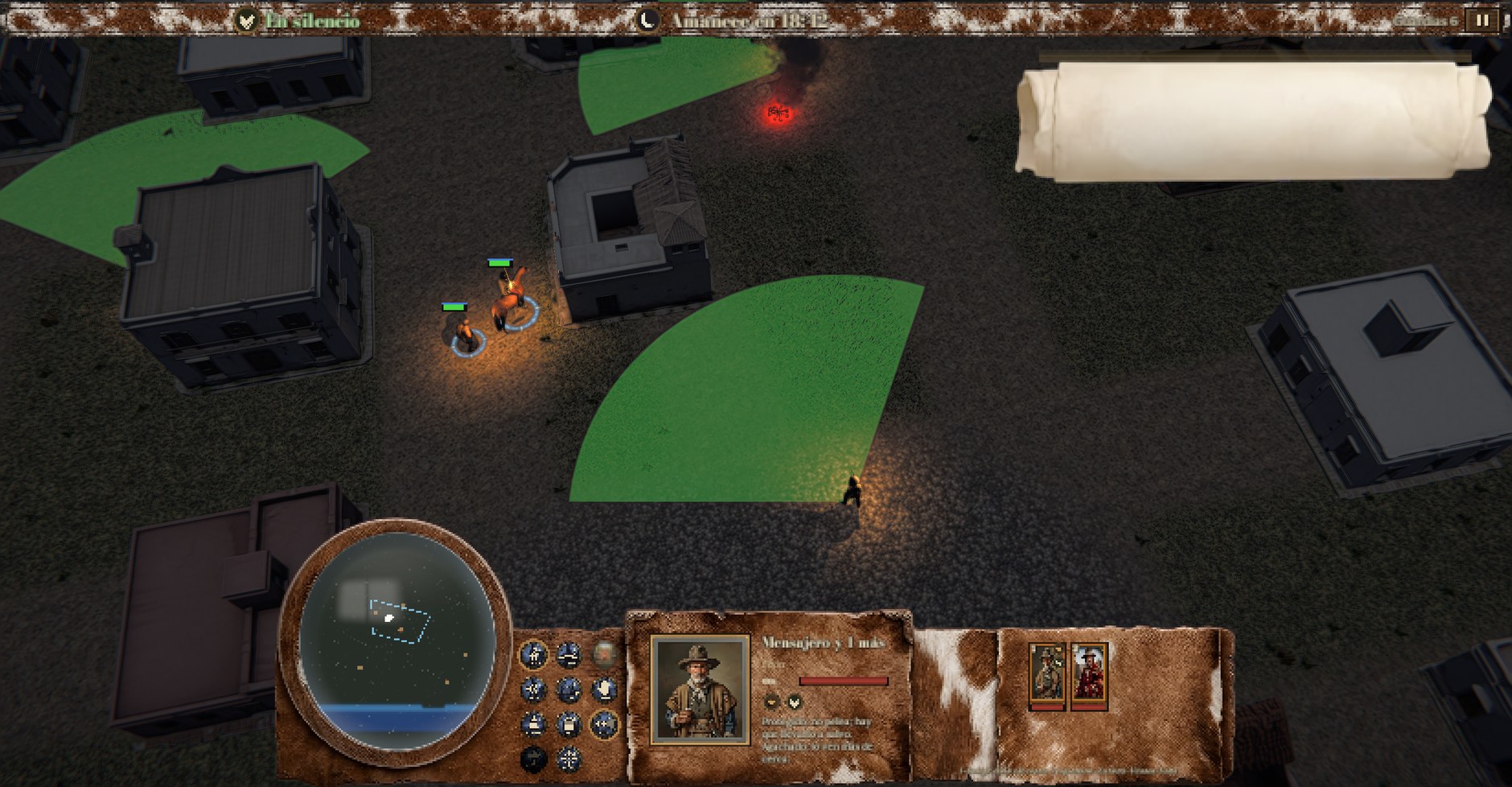
Caption: Kingston, 1815. Three guards, three vision cones, and a messenger and his guide crouched in the dark between them.
Stealth isn’t a mode you pick. It’s how certain missions are told, because that’s how those nights happened. Secret meetings in a bakery and a country house in 1811. A newspaper smuggled into Buenos Aires in May 1810, and the soap factory where the revolution was planned that same week. Bolívar in Kingston in 1815. The Thirty-Three Orientals landing at La Agraciada in April 1825, with a Brazilian gunboat on the river and Ignacio waiting on the shore with the horses.
Across the three campaigns there are eleven of these missions. All of them start at night, at 22:00, and the clock runs at three minutes of real time per in-game hour. Some can be lost by being seen once, some call a patrol if the alarm sounds, and some are lost if dawn catches you still inside.
Nothing about detection is hidden behind a dice roll, so here’s the rule. Each guard has a cone of 110°. While you’re inside it with a clear line of sight, the guard’s suspicion of you rises every second by:
55 × (1 − 0.65 × distance / range)
So a guard looking straight at you from close up fills fast, and one at the edge of his range fills at about a third of that speed. Out of sight, suspicion drains at 25 per second. At 30 the guard turns suspicious and comes to look. At 100 he raises the alarm, and the alarm doesn’t go back down.
Posture changes the range he sees you at. Crouching multiplies it by 0.6. Crawling multiplies it by 0.35, and since a crawling soldier’s head is only a quarter of a metre off the ground, a low stone wall or a dip in the terrain hides him completely.
Press X and a character whistles. Guards within about 8 metres turn toward the sound. You can also throw a stone or a bottle up to about 12 metres. A distracted guard walks over and searches for around six seconds, and while he’s investigating his suspicion doesn’t build. It’s the oldest trick in the genre, and it opens a gap in a patrol that otherwise had none.

Caption: The guide throws a bottle and the guard turns to the noise. The message (from the game’s Spanish UI) reads “A guard goes to check the noise.”
A guard you take down stays where he fell, and the next guard who walks past will find him. So now you can drag bodies, at 60% of normal speed and without attacking or crouching while you do it. Leave the body in a bush, in the shadows, or inside a building and it’s hidden. Leave it in the open and after about 20 seconds someone finds it, and that’s an alarm.

Caption: The messenger drags a guard he has just taken down toward a house, where nobody will find him.
Take a uniform from a guard and put it on. Guards stop treating you as an intruder, but they aren’t blind: one who gets within about 4 metres checks you, with roughly a 15% chance of seeing through it. If he does, his suspicion jumps straight to 60. Attacking anyone breaks the disguise.
To be honest about this one: right now the disguise changes your team colours, not your character’s clothes. The rules work. The look comes later.

Caption: One of Juana Azurduy’s guerrillas, wearing a royalist uniform, rides through the middle of a guard’s cone and the cone stays green. His panel warns that up close they can still recognise him.
Every character in a stealth squad now has a role, and it decides what they can do.
All eleven stealth squads now have roles, from one to three per squad. No squad has a Sapper yet, because no mission has a wall to breach yet (more on that below).

Caption: Juana Azurduy’s guerrillas, 1816. Her squad has a Leader, a Thief and a Marksman, the slinger selected here. His panel explains his ranged takedown and its cooldown.
Until now, crouching was the only modifier and it worked the same everywhere. Now bushes, shadows and rubble are real places. A character who is crouched inside one and has stood still for half a second becomes Hidden, and guards see him at a quarter of their normal range on top of the crouch. That’s 0.6 × 0.25, or 15% of the guard’s normal range.
Each character carries four slots: head, torso and two consumables. A uniform takes the head and torso together. Throwables, keys and future items go in the consumable slots. A full slot refuses the item and tells you why.
You can also go inside buildings now. Inside, guards can’t see you, and guards who aren’t alarmed don’t come in. A house is a hiding place, but it’s also a dead end if the alarm sounds while you’re in it.
Byzen is a game about real people, and a lot of players won’t know who Juana Azurduy was or why a town hall meeting on 22 May 1810 mattered. We already had a library of historical cards and a timeline. What was missing was something that tells the story while you play, without making you leave the mission.
Turn on History Mode (F7, or the button on the Diary page of the pause menu) and whenever a mission reaches a real historical moment, the game pauses and a parchment page opens. It tells you what happened at that point, adds a historical note, lists the dates from the timeline that belong to this mission, and shows the library cards the mission unlocks.

Caption: History Mode in the Kingston mission (game UI in Spanish). The page lists the library cards the mission unlocks, among them the attempt on Bolívar’s life.
The prototype covered ten events and had a flaw we only noticed later: it looked missions up by number, so mission 11 of one campaign showed the same text as mission 11 of the other two. Now every page belongs to a specific mission in a specific campaign, and all 86 missions have one.
Some of these stories would be hard to believe in a script. In Kingston, on the night of 9–10 December 1815, Bolívar didn’t sleep at home. A man named Félix Amestoy lay down in the hammock where Bolívar usually slept, and Pío, a servant bribed to kill Bolívar, stabbed him there. Before the month was out, Bolívar had left Jamaica for Haiti. In the game, that night is a stealth mission. In History Mode, it’s also a page you can read.
History Mode is off by default, and the setting is remembered between sessions.
Some of the hardest things the independence armies faced weren’t other armies. We wanted a few missions to put those on the map, with rules you can read and plan around, not just a scripted cutscene. Each one is a few lines in the mission file, so the same effect can be reused anywhere.
On 26 March 1812 an earthquake destroyed much of Caracas, and the royalists used it to turn people against the young republic. In El Terremoto de Caracas, the quake hits mid-mission. Each building takes damage equal to its maximum hit points times the quake’s strength, times a factor between 0.35 and 0.80 that changes from block to block, so some streets fall and others stand. Units take 10% of the quake’s strength. In our test run all nine buildings on the map took damage, about 41% of their hit points, and the number of fires went from 9 to 20.

Caption: Seconds after the quake, in the patriots’ camp. The health bars over the buildings show how much each one lost.
Emigración a Oriente is the 1814 flight from Caracas: soldiers, families and carts heading east with the royalist cavalry behind them. You escort the convoy across two rivers, the Tuy and the Uchire, and the carts slow to 40% of their speed while they’re in the water. Then the rain comes, and a river can rise up to 1.2 metres, about six millimetres a second.
An honest note: the first version of this mission won itself. The convoy walked to the goal in 3 minutes 17 seconds and the player didn’t need to do anything. Now the carts take the long way through both fords, and the flood comes back at 200 seconds, when the carts are reaching the Uchire. We’ve tested it with scripts. It still needs to be played by hand.

Caption: The convoy fording the Tuy. In the water the carts slow to 40% of their speed.
In early July 1819 Bolívar’s army crossed the Andes at the Páramo de Pisba, close to 4,000 metres up, in the rainy season. Many of the soldiers were llaneros from the plains, badly dressed for the cold, and many died on the way.
In El Paso de Pisba, any soldier who isn’t sheltered loses 13.4% of his maximum health every minute, down to a floor of 20%. The cold doesn’t kill him outright, but in six minutes he’s at a fifth of his health, and the next fight will. A soldier counts as sheltered if he’s inside a building, within 8 metres of a lit fire, or within 12 metres of one of your finished buildings. Every frozen soldier also drags down your army’s morale, up to 3 points per minute.
An earlier draft of the mission text said soldiers lost “1 HP per minute” and would freeze to death. Neither was true of the rules, so we fixed the text and made the rule match the history instead: the mountain wears the army down to nothing faster than the enemy can.

Caption: Six minutes into the cold. The men next to the house (left) have barely lost any health. The two out in the open (right) are down to the 20% floor.
When the British invaded Buenos Aires in 1806 and 1807, a lot of the fighting was done from the flat roofs of houses. In Calles de Fuego and other missions of that campaign, you can put up to four units on the roof of a rancho or a pulpería. A rooftop attacks with the full strength of the ranged units up there plus 40% of the melee ones, and reaches 3 metres further than the longest range among them, with a minimum of 5.
And one battle is won with votes. In Cabildo Abierto, 22 May 1810, the question is whether the viceroy stays. Each neutral household you win over brings five votes. Every 20 seconds the hall itself is counted: each of your men inside adds a vote, up to six, and the other side’s men take votes away. You can’t shoot your way to a majority, but who’s standing in the room matters.
As always, if there’s a night of the independence wars you think should be played without an army, tell us in the comments.