Dev log: directing a game the way the game directs you
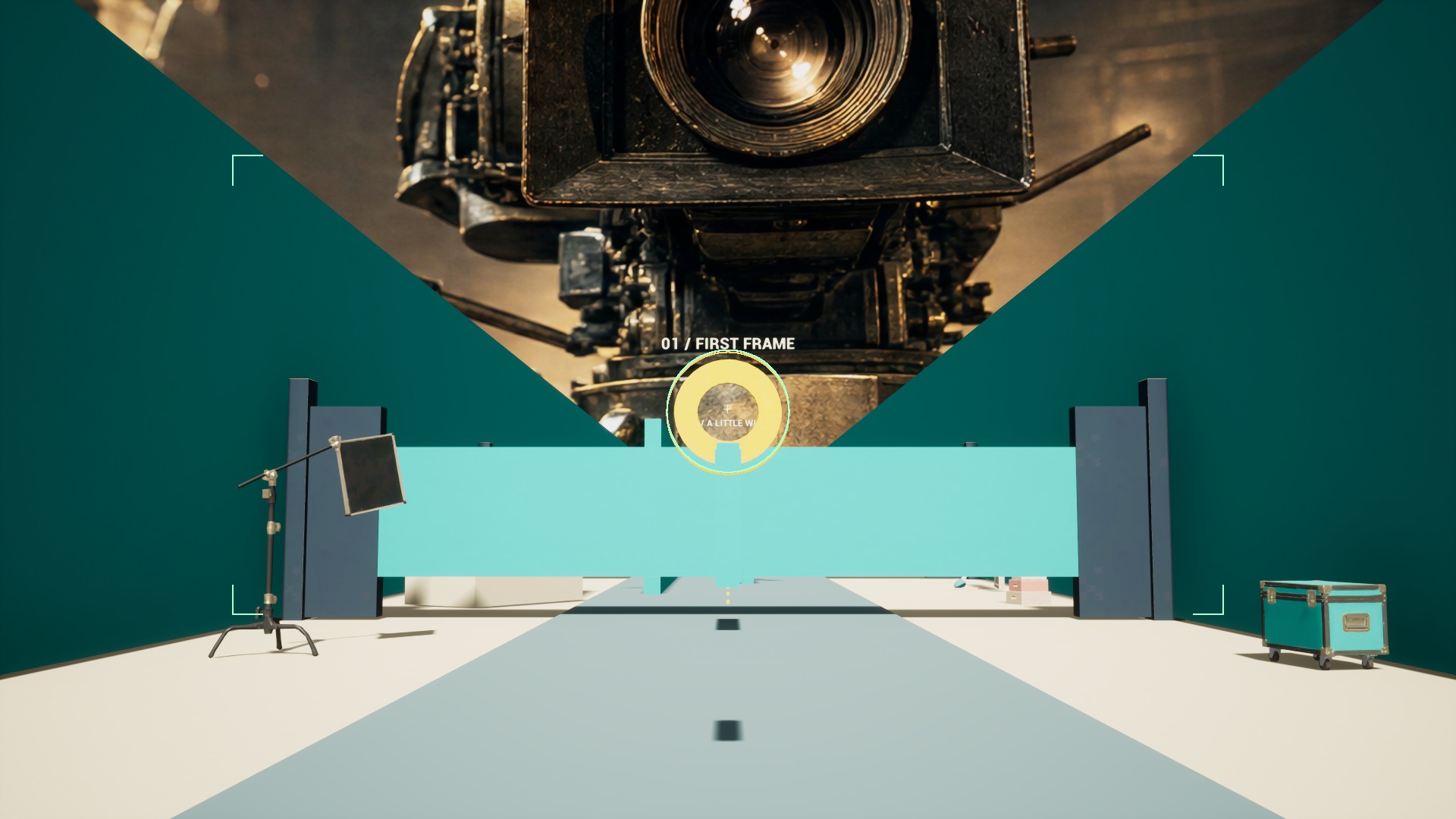
MATCH CUT is a first-person puzzle game on a miniature film backlot. You raise a viewfinder, line up two halves of a shape until they look like one thing, and call CUT. The edit becomes real. Two arcs become a ring, a van body and a cabin become a van, and the gate opens.
I made it in four days for the 2026 Epic AI MegaJam. I didn’t write the code by hand. I worked like a director: I played every build, gave notes in plain English, and AI agents (Codex and Claude Code) turned the notes into C++, levels, tests and builds. That’s the theme too. In the game you’re the camera and a director gives you notes. While I made it, I was the director and the agents were the crew.
This log covers how that worked, what broke, and what I learned.
The first playable had three shots on one road: a fan against a windmill, a toy van against a real van, and small steps against a monument. Each cut opened a gate.
The first bug was that nothing moved. WASD did nothing. The input handler was called Restart, which quietly overrode the engine’s own ACharacter::Restart and never called it, so the player never entered walking mode. It was renamed, and a test now pushes each movement key through the controller and checks the player actually moved. The fix took one line. The test means it stays fixed.
Then I played it, and my note was: “the puzzles in this are too simple.”
That was right. The road was the solution. You walked forward and the rings met. Every puzzle since then has followed one rule: the place you need to stand is never the obvious place.

A shot isn’t a distance check. It’s measured in screen space:
The near and far halves are built at a 1 : 2.25 scale, so they only match when the far one is 2.25 times as far away. Later shots tighten the windows: position error drops from 4.8% of screen height on the first shot to 2.2% by the end.
The whole backlot is built in C++ at runtime. The map has no puzzle geometry in it, which meant the agents could move a wall, rerun the tests and rebuild without anyone opening the editor.
Every change followed the same loop:
The rule I’m proudest of is in the log itself: a passing test is not a playtest. The playthrough proves the marks can be solved. It doesn’t prove the walk there is fun. Every entry in the diary says which check actually ran, and “no person walked it” gets written down when that’s the truth.
That honesty caught real bugs. The first 12-shot run passed for the wrong reason: a decoy was placed on top of a beam, physics pushed it onto the beam, and from there it solved the shot by accident. A test that only checked “green” would have missed that.
The best part of this process was how specific notes became specific changes.
“3 is not obvious and the objects don’t seem to match.” The rings lined up but the toy and the van didn’t, because the rings used fixed offsets rather than the meshes. Both vans were rebuilt from the same parts at the two scales, so when the rings match, the silhouettes match.
“The jump for the final cut is too hard.” The math said so too. The jump apex was about 127 units against a gap of about 130. The exit became a staircase you grow with one last shot, so the viewfinder is the way out, not a jump.
“The whole game is too easy to follow.” Signs like SCAFFOLD and BEAM that gave away the answer were removed. A false gold pair was left on the road as a decoy.
“Some of the cuts should be multiple shots” / “one cut reveals another.” On multi-shot cuts the second subject doesn’t exist until the first shot lands. It’s hidden at 2% scale and grows in.
“Could we cut the shapes and make the players complete the shape using the viewfinder?” This became the core idea of the game. Pairs used to be two copies of one object. Now every subject is cut in half: arcs that close into rings, blocks split down the middle, stairs missing every other step that the other flight fills in. The viewfinder completes the picture.

My note was “use mirrors, and get the shots from wonky angles.” The first version was a cheat: a gold frame, a dark tunnel and a sphere parked where the reflection should be. The rings went green, but “a green ring on a black pane is not a mirror.” I told it to “get the mirrors working.”
The real mirrors render a capture each frame from the player’s view, reflected through the glass plane, so the real object lands where the rings expect it.
They rendered nothing at first. Reading the render target back showed 0 of 921,600 pixels lit. The capture was forcing manual exposure with no bias, which crushed everything to black. After the fix, 921,143 pixels were lit.
Then the mirrors were washed out. Teal read as nearly white because each capture was tone mapped, and then tone mapped again on screen. The captures now store scene light before tone mapping, in 16-bit float, so the image is tone mapped once. A debug command, MC.MirrorDump, saves what each mirror camera sees. It found two more problems: a walkway board cutting through a reflection, and mirror cameras seeing things behind the glass.
Then the mirrors got harder: several panes where only the small one is the shot, decks that face the wrong pane, perches you have to explore to find, and chains of two and three mirrors for the finale.

My note on the first art pass was blunt: “This art seems a little too simplistic.” So the backlot got dressed like a real studio. Eleven props were drawn as concept art with fal (gpt-image-2) and turned into textured 3D models with Hyper3D Rodin: fresnel lamps, C-stands, apple boxes, sandbags, a director’s chair, a dolly on track and others. A placement pass puts 178 of them along the walls and refuses 200 spots that would block a shot line, crowd a mark or touch the set. They’re solid to the player and invisible to the shot traces.
The last addition is my favorite. I asked for “a miniature studio, and the skybox is the real studio.” Two painted panoramas of a giant soundstage, with a huge film camera, rigging and work lights, were blended into one seamless 360-degree strip. A custom material looks them up by view direction, so the studio behaves like a sky at infinity wherever you stand. The backlot is now a miniature set on the floor of a real studio, and the camera is pointed at you.
The music is a 1960s caper-style loop from ElevenLabs Music, cut into a seamless 60-second loop. It dips under the director’s lines.
The first package was 365 MB. Unreal Engine 5.8, a Shipping build, and 188 MB after:
One script, Tools/Package.ps1, builds, strips and zips the game, so the build that gets uploaded can be made again exactly.
Even the trailer and these screenshots are automated. MC.Take plays a shot hands-free at a fixed 60 fps and saves every frame, and a Python script cuts the trailer with ffmpeg. Every frame in the video is real gameplay.
Thanks for playing. Line it up. Cut. The set takes the note.
Made with Unreal Engine 5.8. AI tools used during development: Codex and Claude Code (code and levels), fal gpt-image-2 (concepts and textures), Hyper3D Rodin (3D props), ElevenLabs Music (score), and Windows speech synthesis (director voice). No AI runs while you play.