Weddings, Bridges & Expeditions: Update 0.1.1139
This update has two things I’ve wanted in the game for a long time. Getting married is now an event you prepare for over three days, and rivers can finally be crossed with a bridge. Expeditions and the notice board also got a big pass: you plan how a party travels and what it carries, you can send a party after a lead instead of going yourself, and leads now come with threat levels and trails. On top of that, raids behave better, the settlement draws faster, and there’s a long list of fixes.

The wedding

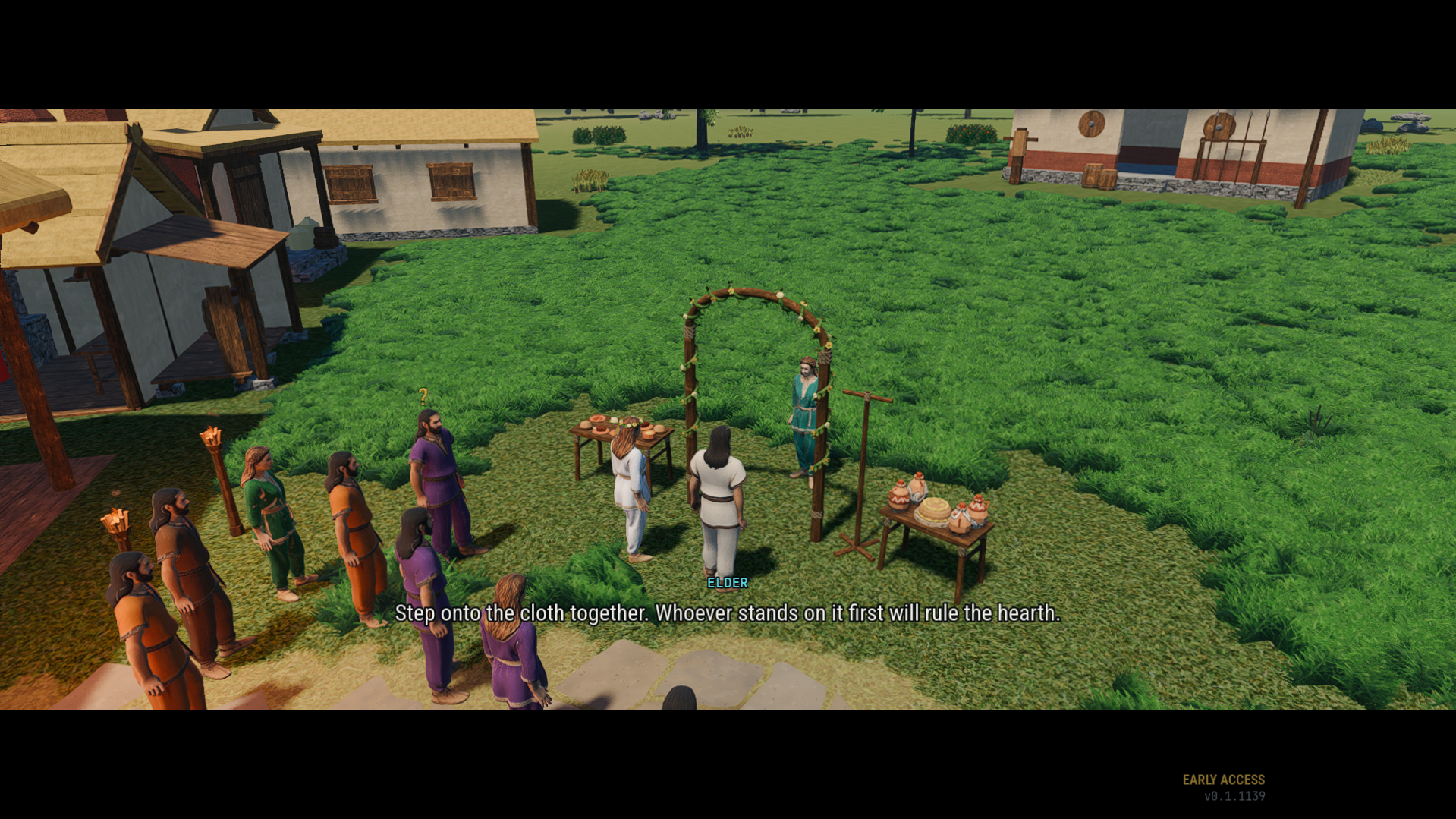
The vows under the wedding arch

The vows under the wedding arch, with the Elder and the guests

  • An accepted proposal now starts a three-day engagement and a timed quest, The Wedding. The countdown shows on the quest tracker and in the Mission Log. The wedding happens on its day whether you’re ready or not, so the three days are for getting ready.
  • To propose, your partner’s settlement needs a feasting hall, and they can’t be away on an expedition.
  • Everything happens at the new Wedding Arch. Raise it within 12 m of the feasting hall from the new Event wedge on the action wheel (6 Branches, 1 Rope, 2 Wild Thyme, 2 Yarrow). The Event wedge holds an event’s own crafts while it runs and clears them away when it ends.
  • The arch has five slots, and whatever you lay in them shows up on it: a Flower Crown hung under the top, the Wedding Dress on its stand, the Wedding Loaf, four jugs of Mead, and the feast, which is a meal for every guest plus two.
  • The crown (3 St John’s Wort, 3 Yarrow, 3 Wild Thyme, 2 Thread), the dress (3 Cloth, 2 Thread, with a Needle in your bag) and the loaf (4 Flour, 2 Honeycomb) are made from the Event wedge too. The loaf goes through the cooking minigame: a Perfect one adds 5 points and a burnt one doesn’t count. It’s real food, so if you eat it, there’s no loaf at the wedding.
  • Invite up to 8 guests from the Bonds tab when you talk to the other adults of your partner’s village. Light the hall with four torches or lamps. A Sage posted to the Town Hall stands as Elder for the vows. Without one, the TID reads them.
  • Press E at the arch to see every slot, what’s still missing, and the grade the wedding is heading for.
  • On the day, the guests leave work and gather at the hall from 15:00. Step onto your place before 20:00 and the vows begin: a short scene with its own camera, under the arch, with the Elder in front of you and the guests behind.
  • Then everyone feasts in the hall until 22:00. When you’re done, talk to your spouse or use the hall to Celebrate until morning, and you wake up at home together.
  • What you prepared is scored out of 100 into four tiers. Grand (85+) gives +25 Renown, +10 Culture heritage and +8 Happiness that fades over three days. Fine (60+) gives +18, +7 and +5, Modest (35+) +10, +5 and +2, and Meagre +5 Renown and +3 heritage. Your spouse also remembers a Grand or Fine wedding fondly for 10 days.
  • Each missing thing has its own cost. Without the crown your spouse loses 10 affinity and is unhappy for a week. Without the loaf your first child comes 9 days later. Without mead you get half the heritage, and if there isn’t enough food the village remembers a hungry wedding (-5 Happiness).
  • If you don’t show up, you’re married anyway, jilted: -10 Renown, -8 Happiness, -30 affinity, and you’ll hear about it the next time you talk.
  • A raid on the settlement, or your partner being laid up, moves the wedding one day later at no cost. You can’t sleep through it: on the wedding day the bed refuses until the vows are done.
  • A results card at the end shows the grade, what it brought, and how each preparation scored.

The results card

The results card: the grade, what the wedding brought, and every preparation

Bridges

A stone bridge across a river

A stone bridge across a river, raised one section at a time

  • Rivers have always been walls in this game: too deep to wade, so a settlement on both banks was two halves that villagers couldn’t walk between. Now you can bridge them.
  • There are two, on the build menu’s Decoration tab: the Wood Bridge (needs a workbench, spans up to 80 m) and the Stone Bridge (needs a mason guild, up to 200 m).
  • You don’t drag a bridge out. Stand on a bank and look across: the bridge finds the river, squares itself to the channel, finds footing on both banks and runs a ramp up from each. Where the crosshair points doesn’t matter, only where you stand and which way you look.
  • A river too wide for the bridge still shows the ghost, in red, with the river’s real width, so you can walk the bank looking for a narrower spot.
  • Staking it out is free. It’s built and paid for one section at a time, about 4 m each, plus a ramp at each end. A wood section costs 3 Logs, 4 Wood Planks and 1 Rope, and a stone one 2 Dressed Stone and 10 Stone. You never need the whole bridge’s materials at once.
  • For scale, a 55 m wood bridge is 14 pieces in all, so 42 Logs, 56 Wood Planks and 14 Rope over the whole build. In my test world, half the river crossings were under 78 m, so a stone bridge reaches nearly every river and a wood one about half of them.
  • Each section is solid the moment it’s built. Walk out to the end and keep holding E: it carries on from one section to the next while your bag lasts. Builders raise bridges too when they start on your settlement’s ground.
  • Once the far ramp is down, villagers walk across and the two banks are one settlement again. Trails lead onto the ramps, and raiders leave bridges alone.

Expeditions you plan

The muster screen

The muster screen: pace, orders, the risks on the road and the kit to pack

  • The muster screen now asks four things: who goes, how hard they push, what they do when something happens, and what they carry.
  • Pace: Careful takes about a third longer and improves the odds, Steady is the trip as offered, and Forced March gets home in 70% of the time at worse odds.
  • Two standing orders. If somebody is hurt: Press on or Turn back. If they find something off the road: Stay on the road or Take the detour. Orders are given once. After the party leaves, the only thing you can tell it is to come home.
  • Every road now lists its named risks before you send anyone, each with what answers it: wolves (a Hunter, or 4 Torches packed), a river crossing (a Fisherman, or 2 Rope), rain (3 Hide), a quarrel (2 Mead), an ambush or a toll (a Guard), bad water (a Cook), an ill omen (a Sage), a grass fire (a Farmer), a high pass or a rockfall (a Miner). An answered risk still shows up in the log but costs nothing.
  • Pack from storage takes the kit from your chests. A Yarrow Poultice treats the first one hurt, so they walk home instead of being laid up. Packed kit doesn’t come back.
  • There are four finds off the road, each a gamble (50-65%) that a party only takes with the detour order. A win brings loot and better odds, and a loss costs time or a wound.
  • What they may bring shows the haul before you launch. Every hand above the trip’s minimum carries 25% more, so a party of four on a trip for 2-4 brings home half as much again.
  • The odds card now splits the four outcomes. A strong party keeps earning triumphs after its success chance stops climbing: an even match triumphs about 8% of the time, a party twice the trip’s strength about 53%.
  • Veterans: each trip a villager comes home from makes them stronger on the next, up to three trips. A ◆ marks them in the party picker.
  • Call them home on the Underway tab brings a party back early. They give up what they went for, keep whatever the road gave them, and the way back takes half the time they’ve been out.
  • No road event happens twice in one trip anymore.
  • Haul trips were rebalanced so they’re worth the working days you lose: mostly salt, cloth, leather, coal, stone and food, with metal and coin kept small.
  • Break the Raiders’ Camp now does what it says: a success pushes the next raid back by 3 days.

Nobody dies, but someone can go missing

  • When a party of two or more fails, about half the time one of them doesn’t come home with it. They’re not dead, they’re lost out there.
  • While someone is missing, a Find the Missing trip sits at the top of the muster screen. A success brings them back whole, a setback brings them back hurt, and a failure finds nothing, so you can try again.
  • Left alone, they limp home by themselves after 6 days, wounded.
  • The Town Hall shows them as Missing, and the trip’s report names them.

The notice board

The notice board

The notice board: a lead to follow or take down, the days before it goes cold, and the village talk below

  • Guarded leads (bandit camps, wolf dens, contested groves, ruins) now roll a threat when they’re pinned: lightly held, held, or heavily held. A light site has the fewest defenders and pays 75%. A heavy one has about a third more than usual and pays 150%, and never turns up early on, so your first bandit camp is never your worst. A lead that a scouting party brought home gives the exact count instead.
  • Trails: some leads point to the next one. The first trail has three links and starts with “A tally on the old stones”. The card says which part you’re on and what’s at the end.
  • Some rumours turn out true. A few days after it’s pinned, a rumour can become a real lead.
  • A lead nobody follows goes cold after 6 days, and Take it down removes one at once, so leads nobody wants no longer block new ones.
  • You can send a party instead of going yourself. With a muster post, every lead on the board also shows up on the muster screen: a Strike Party for a site somebody holds, an Errand Party for the rest. Each defender at the site makes the trip harder, and the party brings home 60% of the lead’s reward. Do it yourself and you keep all of it. If they fail, the lead goes back on the board.
  • Lead rewards are now goods that fit each site’s story, like the robbed trader’s cloth, salt and metal at a bandit camp, or timber and saw blades at the grove. They’re worth roughly 80-200 in trade value, with coin kept small and no iron tools, weapons or armour.
  • Villager favours were rebalanced the same way. An ask is a real errand now (a dozen torches, twenty charcoal, ten fish in two days), and the pay is the asker’s own trade and worth more than the ask: grain and flax from the farmer, fish from the fisherman, nails and a saw blade from the smith. Coin is 20 at most.

Raids and guards

  • Once a warband has set out, tribute can’t buy it off anymore. The one-minute warning before it leaves is your last chance to pay. Before, paying mid-raid took your coin and the raid carried on.
  • Scouts: your villagers leave them alone now, and towers don’t waste arrows on them. Only you can kill one, and they leave when their time is up.
  • Raiders fight people on your ground and a short way past the border, and let go of anyone who runs farther. You’re the exception: hit a raider and his group comes after you wherever you are, and every hit keeps them on you for another 8 seconds.
  • Drawing the warband just off your land no longer dodges the sack. A raider fighting at the border still counts as inside when the raid’s time runs out.
  • Guards only fight the raid on their own settlement, and a warband raiding a neighbour leaves your Guards alone.
  • A Guard needs a weapon of their own to count. An unarmed Guard takes cover with everyone else and isn’t counted in your defence.
  • Armed Guards now drop everything when a warband comes, whether it’s a meal, bed, a festival or training at the yard. Tower guards on their way back to the tower fight the raiders around them instead of getting speared on the way to the ladder.
  • Raiders who break and run now just leave. Before, every survivor of a broken warband you’d hit once dropped loot on the way out.
  • Loading a save mid-raid gives you the one-minute warning again, and no longer makes every later warband one man bigger.
  • If a raid knocks down a settlement’s last building, the raid ends there.

Workers

  • Farmers no longer run the mill. Post an Artisan at a windmill or watermill with a Flour order and they become your Miller. Bakers take flour straight from the mill, and Cooks take it from chests.
  • An idle Cook now gives one reason: no ingredients, no free hearth, a hearth that isn’t built up enough, or no fuel.
  • Villagers no longer get stuck walking at something they can’t reach. Gatherers, Miners and Foresters pass over trees and rocks across a river, Guards give up on a tower they can’t get to, and a Guard whose training yard is cut off waits at their post and tries again later.
  • Every building window now keeps its scroll position and selection when you press something, the way the Town Hall already did. Posting a villager halfway down a crew list no longer jumps you back to the top.

Faster frames, better views

Trees

Trees past 100 m are now impostors: one card each, drawn from the tree’s own model

  • Trees past about 100 m are now impostors: one card, rendered from the tree’s own model when the world loads, that turns to face you. Near trees dissolve into them, so there’s no pop.
  • Buildings are merged into far fewer draws. The Town Hall went from 70 to 13.
  • Shadows use one far cascade instead of three. That’s cheaper, especially at golden hour, and distant tree shadows come out crisper.
  • Grass thins out with distance one tuft at a time, so squares of grass no longer pop in as you walk. It reaches 70 m at Medium (was 80 m).
  • Rivers run fastest mid-channel and slow down near the banks, and flowing water has fine wind ripples on it.
  • The game now runs on my own build of the engine, with fixes that aren’t in an official release yet. The one you’ll notice: Shift no longer gets stuck, which used to make you sprint or chain building placement without holding it. It also means the one-time shader compile on the loading screen runs in full once more after you update.

Fixes

  • A building you finish from a staked-out site no longer has invisible walls where its higher levels would go. They blocked you and your villagers until you reloaded.
  • Loading a save while you’re already in a game now gives you exactly the saved world: animals you killed after the save are back, your bed respawn point is the save’s, and techs you earned after the save are no longer kept.

Windows only, for now

  • This update is for Windows only. I’m pausing the Linux and macOS builds for now, so 0.1.1125 is the last version for both.
  • The reason is that engine build. I can only build it for Windows on my machine, and the Linux and Mac versions would have run the official engine without its fixes. I’d rather pause them than ship them a step behind.

Heads-up for existing saves

  • Farmers who were grinding at a mill stop. Post a Miller (an Artisan with a Flour order at the mill), or your Bakers and Cooks will run out of flour.
  • Guards without a weapon no longer count toward your defence, and they take cover in a raid. Hand them one.
  • Leads already on the board get their threat on the first load, and any lead nobody has followed for 6 days goes cold.
  • If you were already married, the wedding counts as held and the next quest in that line starts.
  • Grass now ends at 70 m on Medium instead of 80 m.

As always, I’d love to hear from you! Especially about the wedding: are three days enough to get everything ready, or does it feel like a rush?

Cradle of Mankind is on itch.io: chatagrag3.itch.io/cradle-of-mankind