what’s a primate to quantum mechanics? in conversation with daniel birnbaum and jacqui davies
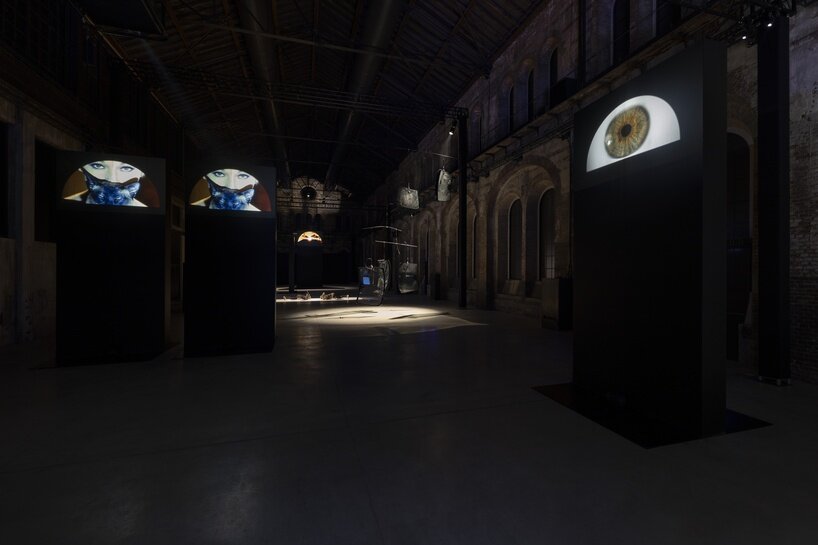
At OGR Torino, The Quantum Effect, an expansive exhibition on art and quantum theory, illustrates the seemingly unknowable principles of quantum mechanics with mirrors, monkeys, and monoliths. To enter the exhibition, one must pass through a series of mirrors that create a dizzying sense of disorientation. Turn a corner, and there’s a projection of those reflective halls being played back to the viewer. It’s a visual collapsing of perception that speaks to the uncertainty of the universe.
In conversation with designboom, curators Daniel Birnbaum and Jacqui Davies discuss how they connected Mark Leckey, Yayoi Kusama, and Tomás Saraceno with Heisenberg’s Uncertainty Principle and Dirac’s Equation. On the interdisciplinary nature of the show, Davies remarks, ‘By placing artworks, experiments and equations in dialogue, the exhibition affirms the validity of each of these languages while resisting their collapse into a single explanatory framework. The show operates – to quote the title of Ryan Gander’s installation – as a ‘school of languages.’ It unfolds across sign systems.’
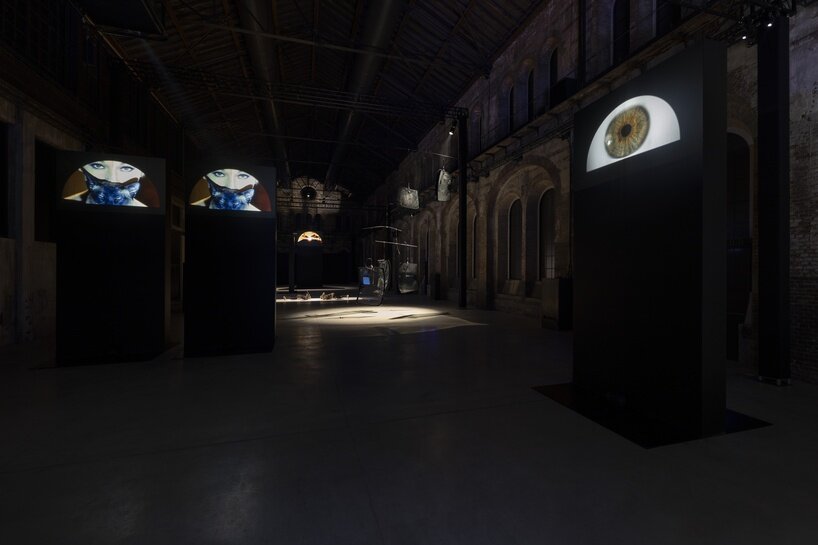
The curators for the show at OGR Torino consulted Professor Ulf Danielsson, professor of theoretical physics at Uppsala University and Secretary of the Nobel Committee for Physics, to highlight equations important to the field. On this collaboration, Birnbaum notes, ‘Our exhibition tries to stage the co-existence of these symbolic systems without privileging one over the other… [Danielsson] selected the equations that best capture the essence of phenomena such as entanglement, superposition, teleportation, parallel universes or the beginning of quantum computing. Most of us of course cannot read them but Ulf likes to emphasize their beauty.’
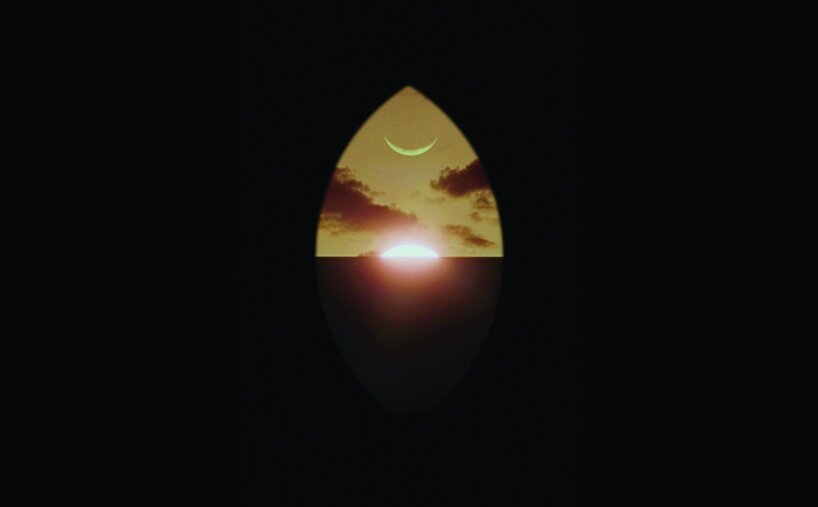
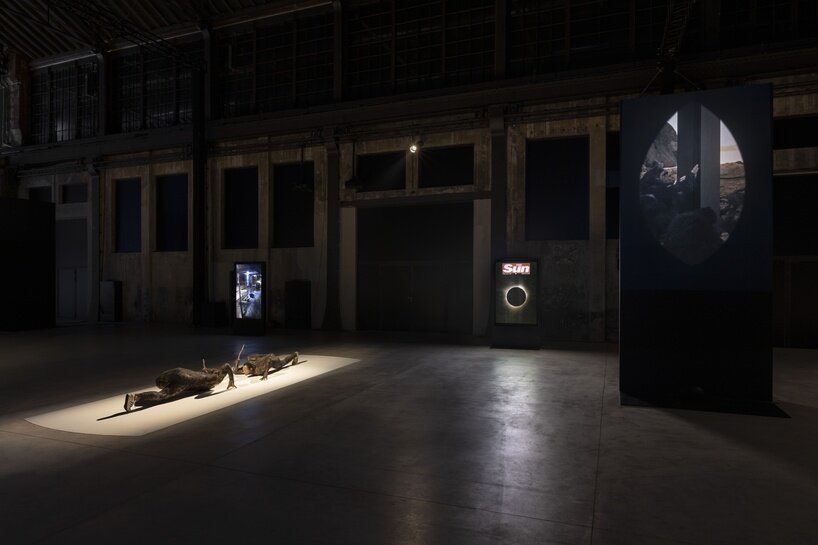
Within the exhibition, when staring up at the black monoliths – a wink to Stanley Kubrick’s 2001: A Space Odyssey – these equations appear on the screen as scenes from The Matrix, Star Trek, and footage of Schrödinger’s cat appear from towering heights. Davies, who created the monoliths in a series called Cinematic Blossomings, notes that she, ‘reassembled fragments [she remembers] from cinema, TV and pop culture to make new film-works which resemble ideas from quantum theory,’ in order to create the work.
Although they are not perfect reflections of these scientific principles, this media begins to hint at a shared understanding of the universe. ‘That is what we mean with the quantum effect,’ Davies emphasizes. ‘Even if they remain incomprehensible on an analytical level we are all familiar with some of these phenomena. In The Terminator, Star Trek, TRON, or Wonder Woman, or David Cronenberg’s The Fly we see bodies shimmer, dematerialize and re-materialize elsewhere. We all grew up with teleportation as something almost normal, happening every day on TV. Other films employ different ideas from quantum physics in imaginative ways.’
On the inclusion of pop culture, Birnbaum acknowledges that, ‘Clearly they have sometimes been simplified or even vulgarized, but we are all familiar with visually extremely powerful imagery,’ citing Kubrick’s film as a prime example. ‘One can find versions of the Many World Interpretation of quantum physics in any number of science fiction movies and speculative works of literary fiction, from Jorge Luis Borges to Philip K Dick or the Matrix. In that way some of the bewildering paradoxes explored by physicists have entered an imaginary that we all share.’
‘Although quantum concepts have become trendy in the artworld in recent years their aesthetic reverberations can be traced throughout the twentieth century.’ Birnbaum remarks, emphasizing that not just pop culture, by the fine arts, have been a site for this exploration. ‘Long before ‘quantum’ became a catchphrase, one finds moments in which science seem to converge in surprising ways. We think Marcel Duchamp’s Large Glass, with it’s exploration of many dimensions, is an example of such convergence.’
Within the exhibition is the persistent fanning out of Duchamp’s influence, pointing to his persistent use of repetition, breaking, and glass. There’s an explicit reference with the inclusion of a photo taken by Man Ray in 1923 of Duchamp holding his work Glissière Contenant un Moulin à Eau (en métaux voisins) (Glider Containing a Water Mill [in Neighbouring Metals], 1913–15). There’s also Sturtevant’s Duchamp descendant l’escalier (1992), a black-and-white photographic interpretation of Duchamp’s painting Nude Descending a Staircase, both of which depict the repetition of a body as it, frame by frame, moves across the canvas.