Homer High revises attendance rules as Aurora looks to grow

Under a revised approach intended to keep teenagers engaged in their education, an eighth absence at Homer High School now prompts an email home, while students who miss enough classes may be required to make up instructional time with administrators.
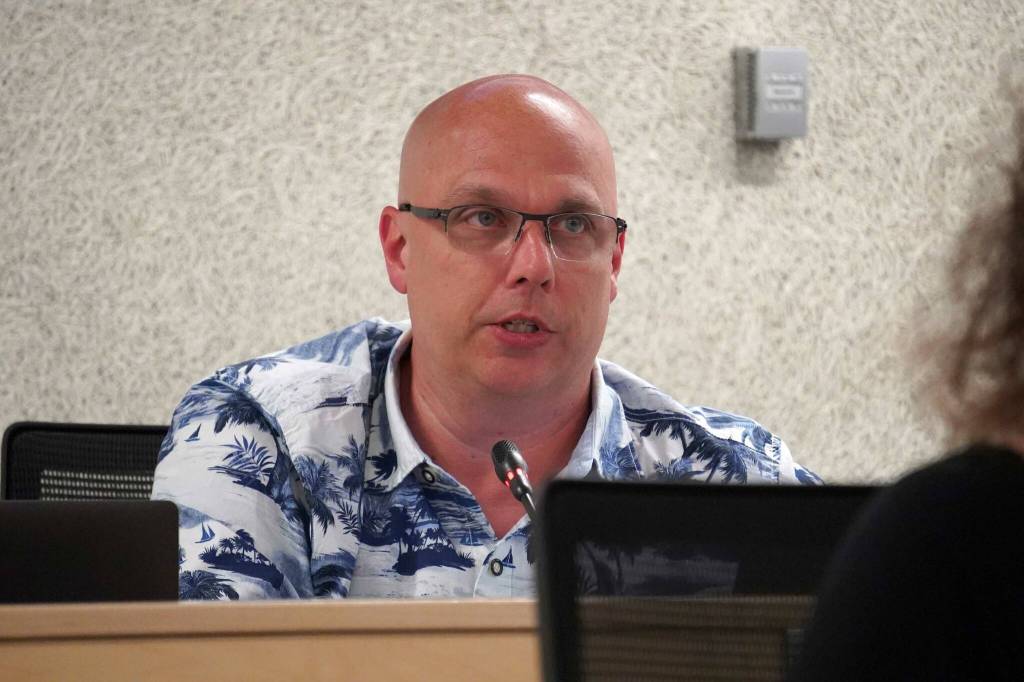
The changes were among several developments presented during the Kenai Peninsula Borough School District’s regular Board of Education meeting Monday, Nov. 2, when administrators from Homer High and Aurora Borealis Charter School discussed academic performance, enrollment and plans for the coming years.
Parents also pressed the district for clearer answers about possible school consolidations, while testimony from staff and students drew attention to library workloads, staffing shortages and opportunities in smaller communities.
Changes at Homer High
Homer High School Principal Eric Pederson said the school’s revised attendance procedures place greater emphasis on communication with families before missed classes begin affecting students’ academic progress, regardless of the reason.
Students reaching 15 to 17 absences must make up instructional time with an administrator and at 18 or 19 absences, they could receive a pass/fail grade, while reaching 20 may result in no grade for the course.
Another change has been the introduction of Anchor Time, a structured period offering academic assistance and opportunities for students to build relationships with school staff.
Administrators developed the program after finding that approximately half of students were choosing not to participate in the school’s previous intervention period.
The replacement divides students into three groups according to their needs. Those earning Ds or Fs can receive additional instruction in groups capped at 10, while a separate study hall accommodates up to 25 students who need to complete assignments, make up tests or review material missed during absences.
Student board representative Reid Rauch, a Homer High senior, said the smaller groups have helped him feel more connected to the school, crediting teachers and counselors with giving him confidence about his plans after graduation and encouraging him to participate in student leadership.
According to figures presented by administrators, Homer High recorded a net loss of 29 students through transfers in 2025.
That number narrowed to one in 2026, with 21 students leaving and 20 transferring into the school.
Pederson attributed the improvement partly to efforts by staff to make sure every student has at least one adult at school they can turn to.
Homer High has about 360 students, but administrators recorded 614 activity registrations, with many students participating in more than one sport, music program or extracurricular organization. The school’s homecoming dance drew 323 attendees.
Academically, Homer High offers 13 Advanced Placement (AP) courses, with administrators reporting that 91% of participating students achieved passing AP exam scores last year.
School leaders are considering whether moving from a six-period to a seven-period day could allow additional classes, although Pederson said staffing information will be needed before the school can finalize next year’s schedule.
The administration has also decided to preserve a graduation requirement that Homer High seniors must complete 40 hours of community service to earn their diplomas. Pederson said he had considered discontinuing the program because of staffing limitations, but teacher support prompted the school to establish a committee to improve it instead.
Aurora Borealis considers expansion
At Aurora Borealis Charter School in Kenai, administrators are exploring the possibility of expanding to a full high school after adding ninth and 10th grades for the 2026-27 school year.
Principal Cody McCanna told board members that the transition has gone well, but the school’s current building cannot accommodate a larger secondary program without additional space.
The charter school’s Academic Policy Committee has begun examining potential facilities in the community, although no location has been selected.
Aurora Borealis serves approximately 220 students from Kenai, Soldotna, Nikiski, Sterling and Kasilof, and its new high school program offers core academic classes, honors courses and electives such as personal finance, computer applications and Spanish. Eleven students have also participated in Educators Rising, a program introducing young people to teaching careers, with support from the district.
McCanna reported that some students entering the new grades had previously attended private or correspondence schools, bringing students into Aurora Borealis who had not been enrolled in its earlier grades.
On the 2026 Alaska System of Academic Readiness assessments, 91% of the school’s tested students achieved proficiency in mathematics, with 51% reaching the advanced level. English language arts proficiency was 73%.
Outside regular classes, McCanna highlighted the school’s robotics program, which has placed near the top of statewide competitions, along with arts instruction and athletics.
Its Science Olympiad team has repeatedly finished third in state competition, while the school’s robotics and extracurricular activities provide opportunities that McCanna said some students might not pursue at larger high schools.
Families seek consolidation timeline
While administrators described changes taking place within schools, several Homer parents questioned what might happen to their children’s classrooms next year.
During public testimony, a parent with children attending West Homer Elementary and Homer Middle School asked the board to clarify its intentions regarding further consolidations.
Superintendent Clayton Holland had previously recommended postponing additional closures while the district evaluates the effects of its recent restructuring, however, the parent said comments from board members had left families uncertain about whether another consolidation could occur as soon as the 2027-28 school year.
She urged the district to schedule community meetings, identify which proposals are under consideration and provide supporting information before decisions are made.
“A pause in consolidation should not mean a pause in communication,” she said.
Michael Spencer, a Homer parent with two children currently enrolled in the district, raised similar concerns about the potential consolidation of Paul Banks Elementary and West Homer Elementary.
He questioned how the district would account for building capacity, transportation expenses and special education services if students were moved between facilities.
Spencer also pointed to the possible consequences for Fireweed Academy, which currently shares a building with West Homer and could face displacement under some consolidation scenarios.
In response, Holland reiterated his preference for postponing additional consolidations and said the age and maintenance needs of the Paul Banks building have been major considerations in previous discussions, but acknowledged that families need opportunities to participate before any future decisions.
Board member Mica VanBuskirk later said the district should examine how parents and site councils can have a stronger voice in decisions affecting their schools.
“We keep hearing from parents and communities that they don’t feel heard,” VanBuskirk said.
Library workload and small-school challenges
Staffing pressures were raised during another public comment from Soldotna High School librarian Tamara Ware, who said library staff processed 6,117 new books last year, with each requiring cataloging and labeling before becoming available to students.
At an estimated eight minutes per book, the work amounted to more than 800 staff hours before accounting for shelving and circulation. District libraries also recorded 78,782 book circulations during the year, requiring additional time to check in, organize and return materials to shelves.
Ware emphasized that most district library employees work three and a half hours or less per day, leaving limited time for the many tasks required to maintain their collections.
Elsewhere in the district, Rauch’s student representative report identified substitute teacher shortages as a concern in Ninilchik and Seldovia, where smaller staffs can struggle to cover classes when employees are absent.
Port Graham School reported a 50% enrollment increase, allowing students to form a basketball team, while Seldovia administrators are exploring additional career-focused instruction, which could include short, intensive courses in electricity and heating, ventilation and air conditioning systems.
Three board members depart
The evening marked the final regular business meeting for Board President Jason Tauriainen and members Penny Vadla and Dianne MacRae, prompting tributes from fellow board members, district employees and community residents, who thanked them for their work during years marked by funding difficulties and difficult decisions about school operations.
Tauriainen completed nine years on the board, while Vadla served 10 years following an 18-year teaching career in the district and MacRae served three years.
Holland credited the departing members with bringing different perspectives to discussions and helping guide the district through financial and operational challenges.
Reflecting on his own service, Tauriainen said he had entered the board with many ideas about what he wanted to accomplish but spent much of his tenure responding to problems the district could not avoid.
He expressed hope that future members would have greater opportunities to pursue educational improvements rather than continually face decisions driven by financial shortfalls.
After thanking his colleagues, administrators and members of the public, Tauriainen closed the meeting with a final declaration.
“Jason Tauriainen signing off.”