Chapters and Choices: a story comes to Ultra Nebulum
Ultra Nebulum is coming soon. It’s a cosy, painterly medieval village sim set at the edge of the world, ringed by a drifting mist called the Ochlorion, with crafts, farming, friendships, folklore creatures at night, and multiplayer with friends. This dev diary covers everything added since November 3, and the theme is a big one: the game now has a story, and your choices stay with you.
[embedded content]
The main questline runs to five chapters and builds toward a mysterious enemy behind the creatures of the Wildmarch. Chapter 1 begins on day 3: Thomas comes to find you, the Ochlorion draws back, and you push into the Wildmarch. Chapter 2 sends you to the mist’s edge with Alfred, the knight. Chapter 3 is three quests, taken in any order — the Volcanic, the Savannah and the Tundra — and each ends in a named boss. Once all three are done, the road leads on.
When the story lifts a stretch of the Ochlorion, the mist pulls away from you in a widening ring and the land appears as it passes. Until then that ground is mist to you. A chapter may ask you to go somewhere, look at or touch something, bring down a creature, speak with someone, or hold a spot when creatures come out of the mist and march on it. Bosses are bigger than their kind, with a name of their own and a red health bar under the compass. Letters, orders, ledgers and carvings found in camps and ruins hint at who is behind it all.
In multiplayer each player has their own progress and their own lifted mist, so one friend may be deep in the Wildmarch while another hasn’t opened it yet.

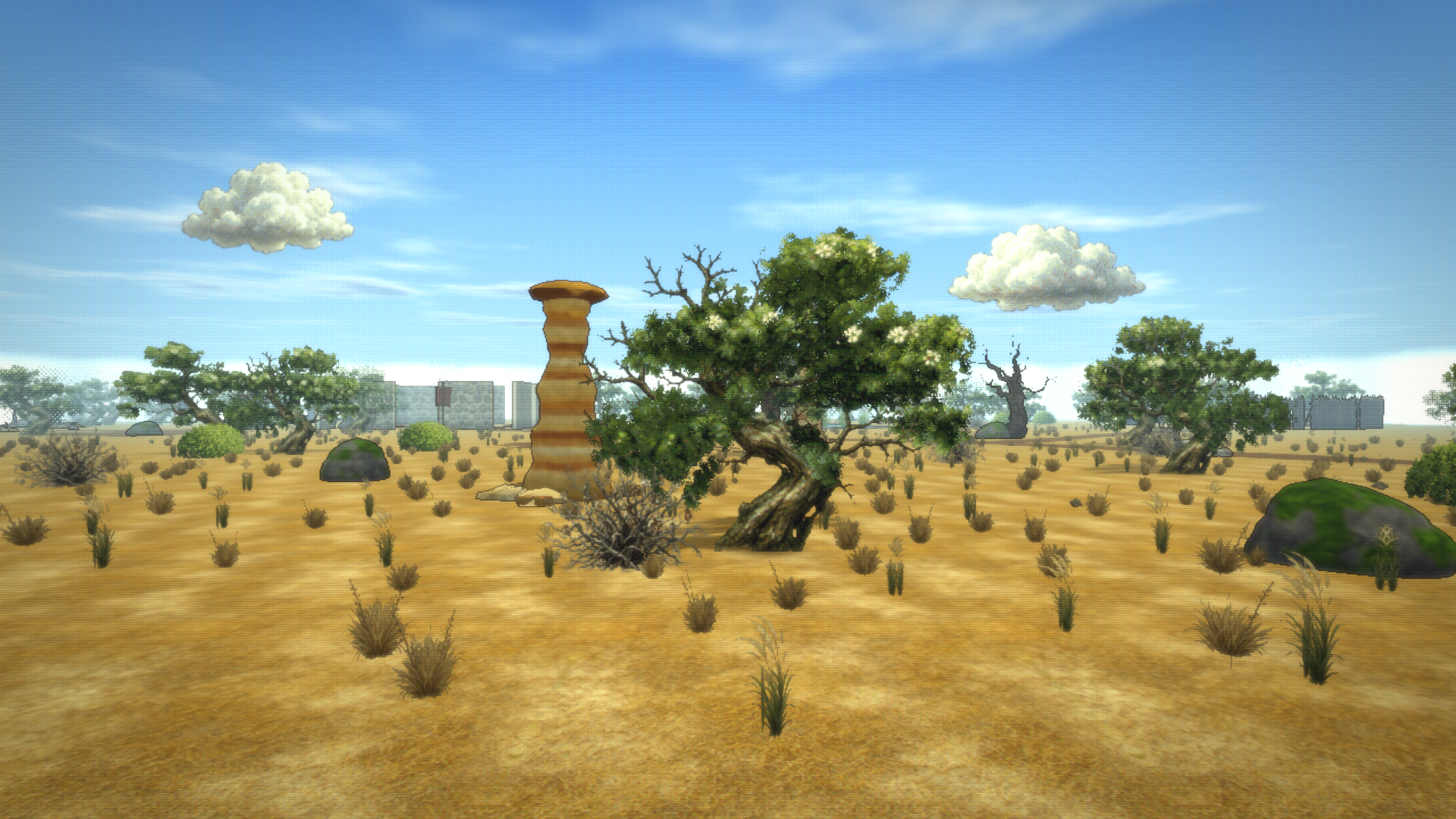
The world grew eastward. The Savannah is dry golden grass, dunes and thorn trees, with a ruined fort at its heart. The Volcanic is black ash, lava vents, tar pits and obsidian, with a roofless fire-temple and an Ettin’s throne. The Tundra is snow, frozen ponds and pine woods, with a hunter’s lodge and draugr barrows in a ring of standing stones. Each land has camps, loot and creatures of its own, and a waystone at its heart.
Beyond an old road in the north-east lie the ruins of a kingdom no one remembers: a ruined town round a cobbled square, a walled garden of withered roses, an old battlefield with broken trebuchets, and a great castle behind its curtain wall.
Side quests open more ground too: a rattling behind Constance’s house, a Wildmarch forming behind Grace’s home, a haunted wood east of the village. Over the first weeks the Ochlorion also gives up land quietly, and on day 10 Thomas asks which way the village should grow first.
As you grow close, each villager asks you three questions. Your answers move them a little — daring or cautious, open or reserved, generous or thrifty, trusting or questioning — and they remember. The village also keeps a reputation for you (generosity, courage, honesty and piety), and villagers talk about what you’ve done.
They bring you their quarrels to settle: twelve pairs want what can’t both be had. Side with one, side with the other, or stay out of it. Some night raids now fall on two hamlets at once, and you choose whom to defend. Speak to a Mignumi, and sometimes it asks something of you instead of grumbling. Answer one wrongly, and it turns into a Draug where it stands and attacks you.
Every villager also has two story quests of their own, one when you become friends and one when you become best friends: 66 in all, each in that villager’s voice. Some leave a mark on the village — a tapestry on the church wall, a banner on the green, a supper table set out, herb beds behind Grace’s house.
On your second morning, Thomas the priest comes to help you choose a way to earn your bread. There are seven Ways to Live — work the land, learn a trade, fish the waters, hunt the Wildmarch, trade at the market stalls, keep animals, or lend a hand at the notice boards — and your goal is shown under the clock. Nothing you choose binds you.
The journal, the Bestiary, the Herbal and the records are now one book, the Chronicle: your quests, trades, writings, the chapters you’ve finished and the choices you’ve made.
And much of the countryside, painted as flat pictures until now, is now real 3D. Trees fade from picture to 3D as you come closer; rocks, stumps, bushes, reeds, mushrooms, crystals and more are shapes you can walk around.
Villagers’ dialogue was rewritten, each in their own voice, and they now talk about what you’ve done. A new Party screen lets you kit out companions. Friendship no longer fades if you don’t talk to someone for a day. The first week of a new game has no rain, and night raids no longer send thieves to your stores. There’s a new night sky, 119 new sound effects, and plenty of bug fixes and speed-ups.
All footage was captured at the High preset, with the retro screen at 720 lines, scanlines and glow.
Ultra Nebulum isn’t out yet. Hit Follow on this page to get every update and the launch news here on IndieDB: Indiedb.com
You can also follow it on itch.io (Ultranebulum.itch.io), subscribe on YouTube (Youtube.com), and follow along on X and Instagram.
Thanks for reading, and questions are very welcome in the comments!
— Patrick · Ultranebulum.com