Democrats’ Blue Wave Carries Several Union Members To Congress

Labor unions that helped power the ground game behind a Democratic takeover of the House and Senate this week have a lot to cheer about. Not only will they see a vastly more union-friendly Congress take their seats in January, they will get to watch a few of their own sworn in at the U.S. Capitol.
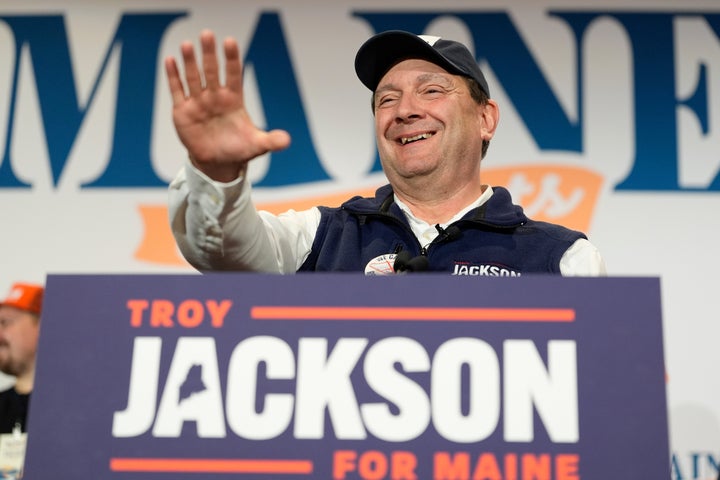
Among the union members who prevailed in Tuesday’s midterm elections were Sen.-elect Troy Jackson, the Maine logger-turned-politician who unseated the once-indomitable Sen. Susan Collins (R); Rep.-elect Sam Forstag, the smokejumper and local union president who flipped a GOP seat in Montana; and Rep.-elect Brian Poindexter, the union ironworker and former labor organizer who took out Republican Rep. Max Miller in Ohio.
Advertisement
Even the political earthquake in Texas had its own union story. Gov.-elect Gina Hinojosa, whose historic defeat of Republican Gov. Greg Abbott ended 30 years of GOP control in the state, started her career as a labor and civil rights attorney and remains a member of the Communications Workers of America.
“Everybody got the memo on the issues that really matter to workers.”
– Liz Shuler, AFL-CIO president
Liz Shuler, president of the AFL-CIO, the federation of 65 unions, argued that organized labor’s infrastructure was a key ingredient in what became a historic blue tsunami. And she said the candidates with union backgrounds were perfect for an election cycle that revolved around the rising cost of living and overly stretched paychecks.
Advertisement
“Everybody got the memo on the issues that really matter to workers,” Shuler told HuffPost. “Everywhere we went — gas, groceries, rent, the high cost of living and the fact that paychecks aren’t keeping up. So we felt just absolutely strong with how the campaign went.”
Unions are a pillar of the Democratic Party and steer not just money but bodies to mostly Democratic campaigns. In many unions, leaders and members take leave from their normal jobs to work as organizers during the campaign season. Unions also spend a lot of money on targeted advertising to boost their favored candidates.
The AFL-CIO said it had its political program running in 35 states for this year’s midterms, with digital advertising that featured union members and was aimed at union households. All told, union canvassers knocked on an estimated 15 million doors since Labor Day, according to the federation.
Advertisement
via Associated Press
Exit polling found that 60% of union households voted Democratic this year, compared to 57% in 2022, the last midterm election. However, there was an even greater shift toward Democrats among non-union households, from 46% in 2022 to 54% this year.
Most unions have opposed the biggest pieces of Trump’s agenda, from his Big Beautiful Bill to his immigration crackdown. His second term has been existential for federal unions: The president has tried to eliminate collective-bargaining rights for hundreds of thousands of government employees, a move that’s been described as the biggest act of union-busting in U.S. history.
Advertisement
The historic blue surge should benefit organized labor not only in Washington but in statehouses across the country.
Democrats ended up taking complete control of state governments in Michigan, Minnesota, Nevada, Pennsylvania and Wisconsin. They also picked up statehouse chambers in Georgia, North Carolina and Texas, which could make it easier for labor groups to push pro-union legislation and beat back anti-union bills.
Shawn Fain, president of the United Auto Workers, said Wednesday that his union had 50 members across Michigan working as full-time political organizers in the run-up to the election, promoting the union’s chosen candidates. He called the overall program “our biggest in decades.”
Advertisement
“We have hundreds of thousands of UAW household voters, and in ’26 we moved the full weight of our union to throw down for our endorsed campaigns,” he said on a call with reporters.
He added, “I’m really proud of the fact that the people said loud and clear that Michigan’s not for sale.”
The UAW was a prominent backer and defender of Sen.-elect Abdul El-Sayed, the progressive who triumphed in an ugly battle with former GOP Rep. Mike Rogers. The UAW jumped out and endorsed El-Sayed in his competitive primary against fellow Democrat Rep. Haley Stevens, and Fain later campaigned alongside El-Sayed in the general election. As Election Day neared, the union released video of an hourlong conversation between El-Sayed and Fain.
Advertisement
El-Sayed, who has a background in public health, has been a member of four unions, including the American Federation of Teachers and the Service Employees International Union, according to his campaign.
For some candidates, their union backgrounds became central to their campaign narratives.
Forstag’s campaign website defined him first as a “smokejumper and union leader.” He served as vice president of his union, Local 60 of the National Federation of Federal Employees, as Trump’s Department of Government Efficiency was hacking indiscriminately at the federal workforce last year — an experience he said inspired him to run for office. He will now be Montana’s first Democratic member of the House in more than three decades.
Jackson, a fifth-generation logger who talked about his father going on strike when he was a kid, made a point of thanking union organizers in his victory speech early Wednesday.
Advertisement
“You understood what it would mean to send one of your own to the United States Senate,” he told the crowd to cheers. “I will be a union member when I walk into that Senate chamber.”