golem’s ariel andré on reimagining architecture beyond the human

As a child, whenever I woke from one of those recurring nightmares that haunt the little ones, I would close my eyes again and imagine myself as a bee asleep with its wet nose nestled among the pistils of a flower; a young bird huddled against its siblings in a nest of twigs lined with feathers from their father, tucked into the hollow of a tree trunk; a snake free of predators, slithering across a carpet of moss in a world it claimed as its own. To this day, no other thought experiment, glass of alcohol or pill, prescribed or otherwise, has ever given me that same intensity of pure pleasure and well-being, the kind that starts in the belly and spreads to the very tips of your hair.
Looking back, I am convinced that this was the beginning of my path towards architecture, a practice capable of giving physical form to a world of fantasy guided by pleasure. An alternative to the nightmare of the built world we are compelled to inhabit.
Indeed, from apartments designed to constrain souls according to the ideals of the society that builds them, to sofas that fix bodies in front of televisions and airports that process crowds as fluids to be channelled and travellers as commodities to be exploited, the built world dictates how we live, down to the dimensions that govern the standard furniture at which we eat and work and sleep. All this feels like a bad dream, a terror by night and day.
My escape-dream is that of a world built to adapt to those who inhabit it and not the other way around. Through architecture and design, I aspire to build the flower in which to fall asleep, the nest in which to huddle against one’s siblings, the carpet of lichen across which to slide. To give these imaginary realities physical form, where the widest possible range of beings can find pleasure and fulfilment.
The premise is simple: use architecture’s transformative potential to produce an alternative reality guided by pleasure. And the best path to somewhere else is to start from a different standpoint. Therefore, the strategy follows: change perspective to design a world beyond conventions, one shaped around the full expression of people’s lives in their singularities.
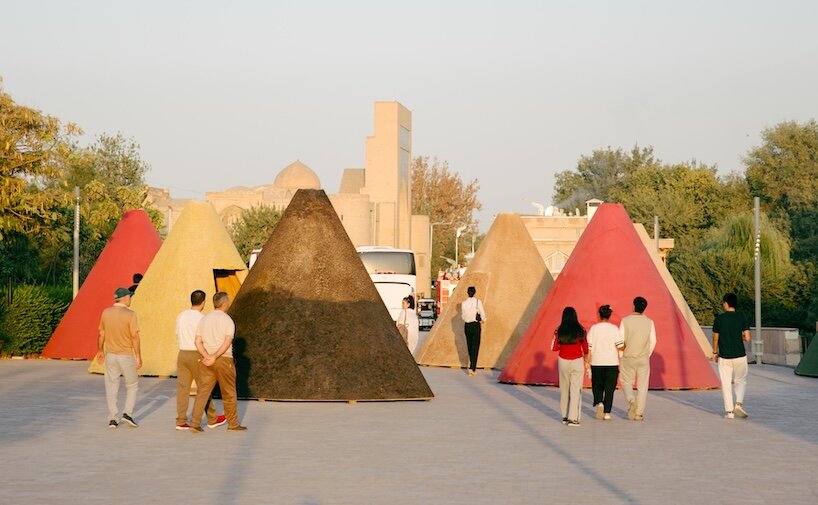
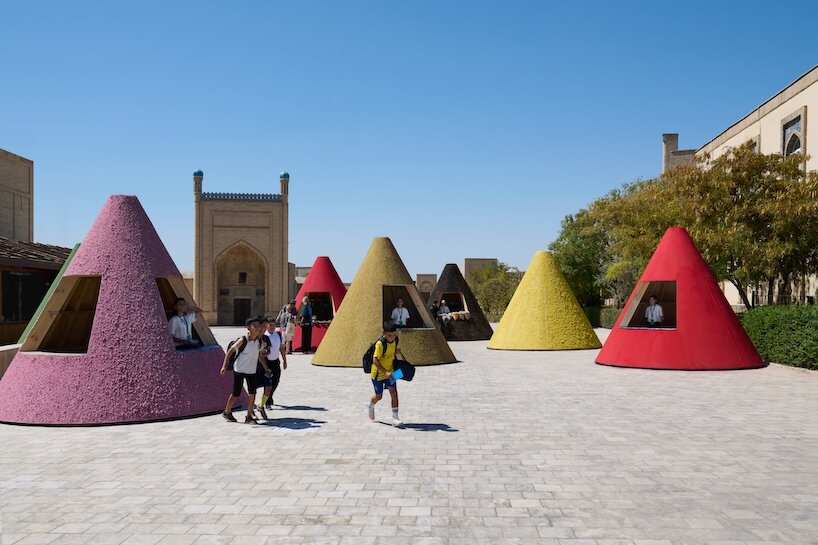
Broken Hearts Bazaar offers a direct example of this approach. We designed and built it for the inaugural Bukhara Biennial, commissioned by Gayane Umerova and curated by Diana Campbell. Diana asked me to develop the Biennial’s entrance and the kiosks distributed across the city as a food market, making arrival a convivial experience pulling it away from the trade-show atmosphere that so usually greets visitors to traditional biennials.
Within Bukhara’s historic centre, a UNESCO World Heritage Site, I approached these kiosks from the perspective of those who do not see architecture: people who cannot see, and beings whose encounter with a building is free of our distinction between nature and culture (man-made) such as cats or wasps, of which the city is full. Smell became the starting point. An architecture to be discovered through the nose before it is seen.