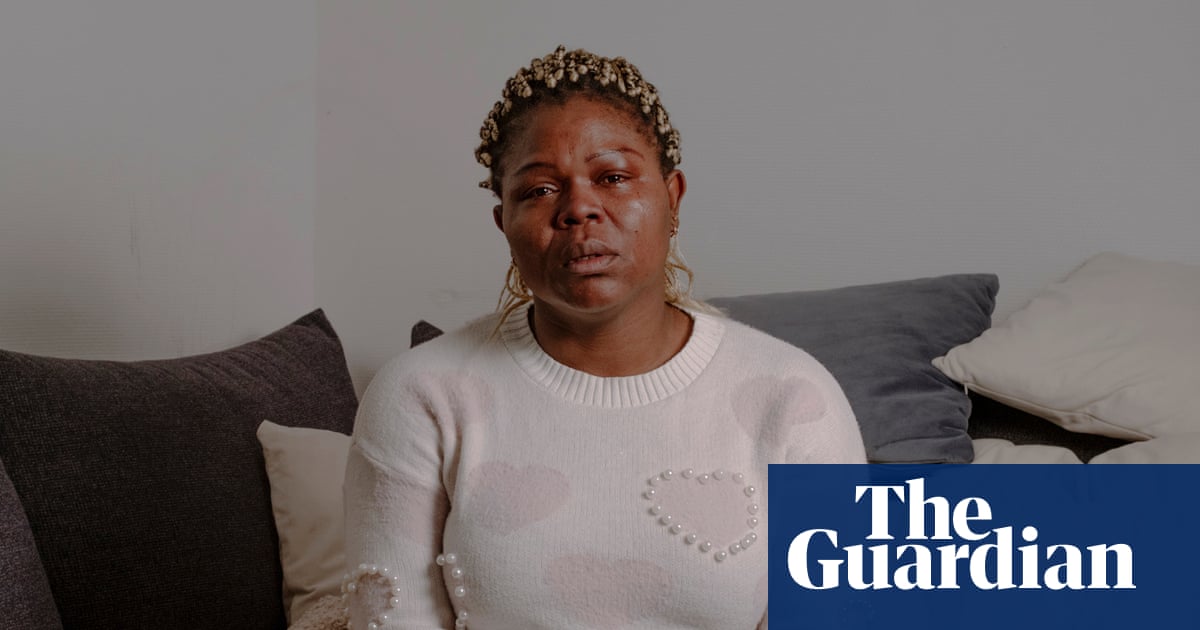
The time of 4pm on 28 July 2024 will be etched into Claire Mireille N’Djosse’s heart for the rest of her life. That was the moment she knew that her then three-year-old son Laurys had been kidnapped by his father. She has not seen him since, and his whereabouts – with a man a British court has described as a “dangerous threat to his son’s emotional and physical welfare” – are unknown.
For more than two years, she has kept Laurys’ bedroom as he left it. His clothes, which he will have outgrown, still hang in his cupboard. Some still have the price tags affixed because N’Djosse had just bought them and her son had not yet had a chance to wear them. “I’m lost without him,” she says. “I no longer know what the difference is between night and day. I’m haunted.” This is the story of a broken mother, a lost son, and a child abduction involving three countries – France, the UK and Nigeria – all of which have so far failed to protect Laurys.
N’Djosse had been waiting in her home town in the south-east of France for Laurys’ father, Ifedayo Adeyeye, 58, a British-Nigerian engineer who travelled between different countries for his job, to return the child after his first overnight contact visit. But 4pm came and went and there was no sign of either of them.
While N’Djosse was distraught, she was not entirely surprised. Adeyeye, with whom she had had a brief and turbulent relationship before her son’s birth, had been granted limited contact with Laurys just over a year before by a French court. From that moment she had feared he might take him out of France without her permission. She had asked the court to issue an order preventing this, but it had not been granted.
On 10 August 2024, two weeks after the kidnapping, Adeyeye confirmed he was in Nigeria with Laurys. He casually said he had taken him there for a holiday. She later found out that Adeyeye had taken Laurys to the Nigerian embassy in France to get him a Nigerian passport. The following day they flew to the UK and from there on to Nigeria. Father and son both have dual British and Nigerian citizenship. N’Djosse had fled an African country to live in France, where she has leave to remain.
The abduction has not only caused devastation to N’Djosse and Laurys, but raises profound questions about how one man has managed to evade justice in three countries, and cross borders with apparent ease to return to Nigeria, despite an international arrest warrant, an Interpol Red Notice and a spell in an English jail. “He considers himself to be above the law,” says N’Djosse. “He was reckless in so many ways. He did not respect the courts at all.”
During a video call, she howls with anguish. “I’m fallen without Laurys, I’m a lost mother. I’m pleading with three governments to find my son,” she says. “I beg them to hear my screams.” As one of the UK judges who have made rulings about this case described it: “Her pain is visceral and unbearable to watch.”
Child abductions by a parent across borders are not rare – according to the organisation Reunite International, more than 500 children are abducted from the UK each year, with France recording 661 similar cases in 2023, more than half involving children under five.
This international kidnapping is unusual, though. Not only does it involve three countries rather than two, but, in a legal first, a British judge decided an English court had the authority to rule on matters relating to France and Nigeria because Laurys is a British citizen. While the kidnapping happened in France, an international arrest warrant was issued for Adeyeye on 9 September 2024. When he travelled alone to the UK that December, leaving Laurys in Nigeria with members of his family, the warrant flashed up at the border and he was arrested.
N’Djosse first met Adeyeye in France in 2019, at a restaurant specialising in African cuisine where she was a regular customer. Adeyeye was keen to talk to her after discovering that she spoke English. “I remember he ordered baked fish,” says N’Djosse. “I don’t like to say his name because doing so makes me want to be physically sick.
“He asked me to sit with him while he was eating and said it was refreshing for him and quite rare in that part of France to be with someone he could speak to in English. He explained that he was working in France and had no social life there, just sitting in his hotel room when he wasn’t working. We exchanged phone numbers. He started messaging me but I didn’t respond.”
Over the next few months she thought little about him, but then he turned up again at the restaurant. This time he was very direct.
“He told me that he was looking for a girlfriend. I said I wasn’t interested. He is much older than me. At the time I was 39 and he was 52. But he kept asking and told me he was a nice man, a serious man. He also kept asking if I had any children – I didn’t. He said he wanted a wife he could live with in France and have a serious relationship with.”
While N’Djosse kept refusing Adeyeye’s advances, he continued calling her, texting her and turning up at her home. Eventually something shifted within her. “My heart softened towards him,” she says. At the end of 2019 they began an on-off relationship. It lasted eight months and they never lived together. She claims he was physically and sexually violent towards her. He has denied this. In July 2020, she became pregnant with Laurys. By this time the relationship had ended.
“I let him know I was pregnant. He said he didn’t want the baby and told me to have an abortion. He said he did not want a child with a woman of my type as I was lower than his level in society. He blocked me,” she says.
She did not see him at all during her pregnancy. He was abroad for much of the time, but she believes he asked her neighbours to let him know when she had given birth. Laurys was born on 2 April 2021.
“From the time of Laurys’ birth until the end of 2022, this man never ceased to persecute me with threats on my phone – to the point where my lawyer advised me to change my phone number,” she says. But despite this, Laurys thrived. “He was calm and polite and he listened to what I said to him. He started walking at eight and a half months – not really walking: he literally hit the ground running.”
When Laurys started attending nursery his teachers told N’Djosse he was advanced for his age and should move up a grade. “He was so intelligent and he was a real character. When we travelled on public transport people were so impressed by his behaviour. One time when the bus was crowded he said to a male passenger who was sitting down: “Would you kindly let my mum sit down?”
But while Laurys was flourishing in his mother’s care, Adeyeye was becoming an increasingly forceful intrusion. N’Djosse was by this time in a relationship with another man. Adeyeye demanded a DNA test to confirm whether Laurys was his biological child. After the test confirmed he was, he went to the French family court to obtain a parental responsibility order. This was granted on 30 June 2023. A few months later the court made an order granting N’Djosse full custody of her son. But the request to bar Adeyeye from leaving France with Laurys was denied.
Adeyeye was initially granted supervised visits at a family contact centre. Then he progressed to being allowed to take Laurys out for unsupervised daytime visits. However, the centre recorded that Adeyeye’s behaviour was problematic.
One of the court judgments in the UK referenced notes made at the contact centre about “ongoing difficulties with Adeyeye’s cooperation and behaviour”, and added that “the father was arrogant, dismissive and rude to the contact staff”. Meanwhile, according to the judgment, “the mother cooperated fastidiously with the orders of the French court”.
N’Djosse was praised in the English court as a “warm, empathetic and loving mother with whom her son had a healthy and secure attachment. There is compelling evidence that he has been removed from a loving environment into one which is not likely to have met his emotional needs.”
“Laurys came back from contact visits with his clothes soiled,” says N’Djosse. She believes he was not properly cared for by Adeyeye during these unsupervised visits.
Speaking of the day after Laurys’ first overnight contact visit with Adeyeye, in July 2024, when he was due to be returned to N’Djosse by 4pm, she says: “When I found out his father had taken Laurys, I didn’t want to live.” But after the initial shock she vowed to do whatever it took to get Laurys back.
The UK courts became involved in 2025 when N’Djosse’s UK lawyers applied for an order for Adeyeye to return Laurys. The court ordered there should be contact between N’Djosse in France and Laurys in Nigeria via WhatsApp video calls, which were facilitated irregularly by Adeyeye’s family. At that point N’Djosse still had hope that her son would be returned to her, although she was desperately concerned about his welfare.
“Every time he spoke to me he was checking to his right and his left to see if he was being overheard. He kept saying: ‘Mummy, when are you going to come and get me?’ One time he said: ‘Mummy, I want to tell you something. Auntie said to me I should agree not to go back to France because you are not a good mother.’”
In March 2025, a Nigerian court appointed relatives of Adeyeye, Emmanuel Adebiyi Olukoya and Victoria Chikodi Olukoya, as Laurys’ legal guardians after Adeyeye misled the court with false information that N’Djosse supported his own application. “I knew nothing about this application, had received no documentation from the court about it and would never give consent for someone else to take on parental responsibility for my child,” she says.
In January 2026, Adeyeye was sentenced to six months in prison in the UK for breaching the court’s orders to return Laurys to his mother. The court extended the sentence for a further year on 20 April owing to Adeyeye’s ongoing failure to comply.
In one of the Ministry of Justice’s early-release blunders, Adeyeye was mistakenly let out of Pentonville prison the next day. According to Ministry of Justice data, he was one of 179 prisoners wrongly released between April 2025 and March 2026 in England and Wales. In evidence heard by the court, after his release he strolled around London, enjoyed a very nice dinner and had quite a lot to drink in a pub before flying via Spain to Nigeria. The prison took three days to notify the police and N’Djosse’s lawyers of their error, making it much easier for Adeyeye to leave the UK.
N’Djosse was dumbfounded. After the multiple system failures that had assisted Adeyeye, the one hope she was clinging on to was that while he was locked up in a British jail he would be compelled to reveal Laurys’ whereabouts. That last hope was crushed.
“I do believe that it is the UK prison that sabotaged everything,” she says. “I am absolutely certain that if he had not been released in error, Laurys would have been returned to me in France.” A court judgment following Adeyeye’s release agreed: “It requires to be stated unambiguously that Adeyeye’s detention in custody is the best, perhaps the only hope, for reunification of this boy with his mother. This release has devastated her.”
At his hearing, the court had described Adeyeye as “arrogant and manipulative” and “cold and calculated” and said the abduction of Laurys was “an act of cruelty that even this court rarely sees”. The crime, it said, “involved the brutal severance of Laurys’ loving relationship with his mother and his complete deracination from every aspect of life as he knew and understood it. It involved complex, sophisticated, long-term planning and deception of the courts, the contact centre, the mother and most importantly the child himself.”
On 1 July 2026, N’Djosse applied to the Nigerian court for the guardianship order to be lifted. This was granted the same day. Laurys attended school the next day, after which Adeyeye appears to have fled with his son. With the whereabouts of father and son unknown, N’Djosse’s fears for her son’s safety are growing daily.
Tara Mulcair of Birnberg Peirce solicitors, which is representing N’Djosse in civil matters in the UK, is calling for the government to help. “This concerns the international abduction of a British child and a series of devastating failures by the state,” she says. “The British government has previously intervened, successfully, to assist British nationals facing grave injustices overseas. The same determination and diplomatic effort should now be directed towards helping to reunite Laurys with his mother.”
N’Djosse used to pray for Laurys’s return, but not any more. “I used to have faith. I asked God not to let his father take my child away. Now I no longer believe in Him.
“I have missed out on years of his development. I can’t imagine what pain he is going through. I will never give up fighting to get my child back. I am calling on Nigeria, France and the UK to work together to bring Laurys back to me. I cannot live without my son.”