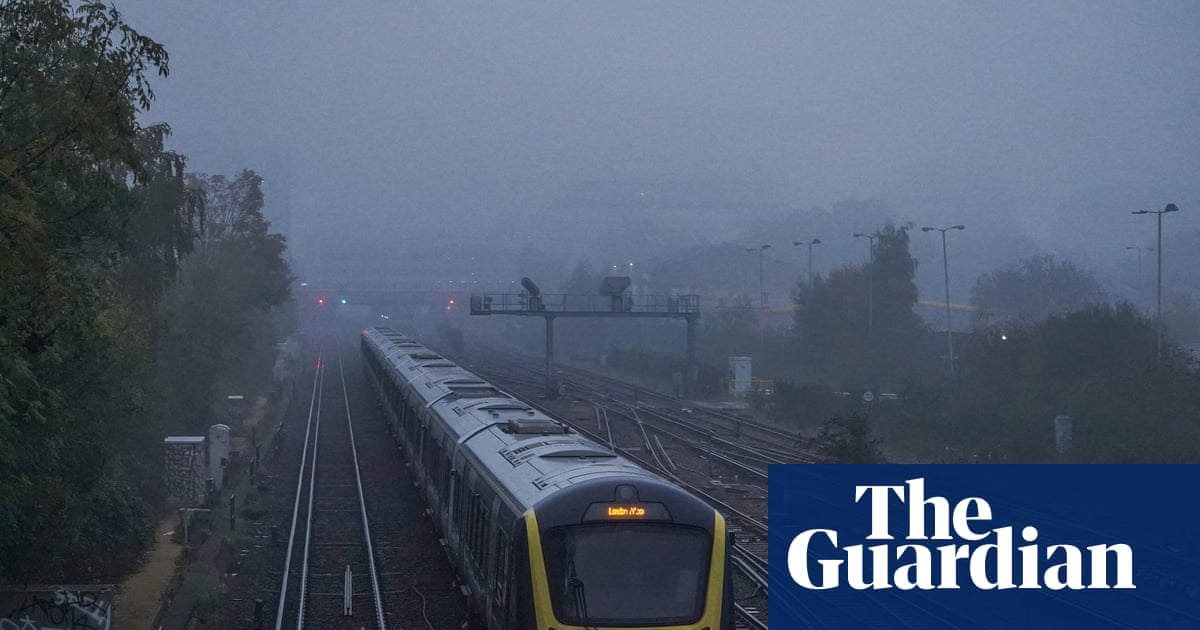
One remarkable feat of transport systems is making passengers all but forget, whether crossing the air bridge for a flight or stepping through the sliding doors for a tube journey, that they are trusting their lives to thousands of tonnes of speeding metal.
It might have felt barely imaginable to rail passengers that, for example, the 14.24 London to Eastbourne service could come off the tracks – until in August, the carriages overturned near Lewes. And then another commuter train derailed the next day in Essex.
Top safety officials admit the country’s railway network has been fortunate to escape far worse – not least after three incidences of potentially catastrophic overspeeding through junctions on the east coast mainline in a year. Meanwhile, level crossing deaths have returned and assaults on staff and passengers have risen year on year. Is Great Britain’s railway still safe?
It had, until recently, a record unparalleled in Europe: an entire decade without a fatal collision or significant derailment of a passenger train. That ended with the Stonehaven crash in 2020, when a train hit a landslip at speed and overturned, killing three people. Since then, on three occasions passenger trains in service have collided – twice, at Talerddig and at Bedford this year, with fatal consequences. Three derailments of passenger trains have occurred in the last year.
The two disasters in Spain this year on the same line from Madrid to Seville, which together killed 115 people and hugely damaged public trust, were a grim reminder of just how dangerous faults can be. The last mass tragedy to scar Britain’s railway was the Potters Bar crash in 2002, in a run of horrific crashes over five years whose factors ranged from degraded tracks to missed danger signals.
The railway closely monitors risk and precursors, as well as any near-misses. The crash at Bedford came after a driver sped up past a red light, and Office of Rail and Road (ORR) data shows incidences of trains passing red signals have been rising to the levels of a decade ago.
The moment that prompted Britain’s chief inspector of railways to call an emergency meeting just before last Christmas was when a third train in a year oversped through junctions on the east coast mainline. The risk was not unknown: in 2022, a Lumo train inadvertently went more than three times the speed limit over a junction – so fast, accident investigators found, that some of its wheels were in the air.
“There’s lots of things that keep me awake,” says Richard Hines, the chief inspector and director of safety at the regulator, ORR. Overspeeding had left him “genuinely concerned”, although he said there had been a positive response from the rail industry. But the risks, he says, are constantly evolving. They now include what he terms digital safety as well as the physical issues that can come from the changing climate.
What exactly caused the two derailments in 24 hours in August – the Lewes incident followed the next day by the rear of a C2C London-bound train coming off the rails near Wickford, Essex – remains under investigation, though kinks in the track were seen after a sustained heatwave.
“Let’s be clear,” says Hines, “the outcomes at Lewes and Wickford could have been materially worse.” Injuries seen in similar incidents in the past have been “engineered out by design” in modern trains, he says.
Carriages have stronger windows, and interiors contain fewer ashtrays and other hard objects, says Christian Wolmar, the rail historian and author of Fast Track. “If that happened 30 years ago, there would be lots of fatalities. Those carriages stood up to it really well: they tumbled down an embankment and didn’t kill anybody.”
There is, of course, no comparison to the death toll on roads – about 1,500 people a year in Britain, and an astonishing 100 every day in the US. It has, Wolmar says, “been a very long time since a major accident, and so people don’t have that memory. Although there’s a real focus on safety still, it just might be there’s that little edge of complacency that has crept in. We’ve kind of forgotten about the sheer risk of things running at around 125mph.”
The resilience of modern rolling stock has minimised casualties, from Bedford to Lewes. But, Hines says, it should only ever be an “end control measure. For me, it’s all about making sure that the infrastructure is fit for purpose and maintained in a safe condition.”
Climate tops the railway’s list of evolving safety concerns. The Stonehaven crash was partly caused by a drain that could not cope with extreme rainfall, but fears of wetter winters are now almost overtaken by those of hotter summers.
“I think of climate change as a risk multiplier,” says Hines. “It is testing some of the margins of safety, some of those limits, in a way that wasn’t envisaged.”
Martin Frobisher, Network Rail’s group safety and engineering director, concurs: “We’re facing a real challenge. Climate change is happening right now. Every measure of heat in summer, rainfall in winter. It’s getting worse.”
After Lewes, Frobisher says, they instructed engineers to identify similar sites – an embankment built on London clay liable to dry up and shift – and do “as much engineering work as possible to strengthen those sites … or impose speed restrictions when the weather hits certain thresholds”.
Network Rail is halfway through a five-year £2.6bn budget for climate resilience work alone, and the state-owned body is about to negotiate for a sum that will probably need to be considerably further north. The ORR has warned that financial pressures have already “affected the delivery of renewals and other planned work”.
Frobisher says Britain’s railway remains among the world’s safest, despite the chequered record of the 2020s. Looking at the significant incidents that have occurred, he says: “It’s a struggle to identify a common theme running through them. They were very different in terms of their technical cause. And we’ve got a very thorough response to each of them.”
Frobisher admits that the railway was “fortunate” to escape recent overspeeding events without casualties. But the most recent tragedy in Spain, when a signalling issue and error led to two trains colliding last month, could not happen in the UK, he maintains. “Signalling equipment can fail, but our operating procedures are different,” he says. “There isn’t a mode of operation that we would have, where our system failed and we were running at such speeds.”
For the same reason, a cyber-attack against an ever more computer-controlled, remote-signalled railway should not pose a direct risk to passenger safety, he says. Any hacking attempt would “involve getting into a location and coding that is not internet-based” – and trains should come to a halt rather than keep moving.
The increasing threat of a cyber-attack from foreign state actors “needs to be taken seriously – but it’s a very different proposition to hack into a fridge in a supermarket”.
In fact, official data shows that a passenger on a moving train is the safest person on the railway. Accidental deaths are far more likely to occur getting on or off the platform. And deaths have surged again at level crossings, with 11 pedestrians and vehicle drivers killed in 2025-26, after a year without any accidental fatalities.
Network Rail’s procedures have not changed, and although the data is thin it has “forced us to think”, says Frobisher. Hypothesising that more people are walking while wearing ever more efficient noise-cancelling headphones, the railway has managed to get level crossing safety on to schools’ national curriculum, and allotted £33m for measures including much clearer visible warnings.
On other indices, there is a bleaker picture. Reported assaults on Great Britain’s railways hit a record high of almost 25,000 incidents last year, including nearly 2,500 physical assaults on workers, an average of seven a day. Rail staff speaking to the Guardian described the reality of abuse as “off the scale” and unions have called for more policing.
The data may reflect increased reporting: the notorious “see it, say it, sorted” campaign marked its 10th anniversary this month. The Department for Transport has promised to spend another £80m for the impending Great British Railways to have more police and CCTV.
And what might be perceived as lower-level issues such as verbal abuse or harassment have a corrosive, cumulative effect on overall safety, the experts warn. The lessons from inquiries after Britain’s worst rail disasters emphasised the culture and stresses leading to human error. Things such as fatigue, passenger safety and worker welfare “should not be trivialised”, Hines says. “Having a clear handle on precursors is so important to deliver safe railways.”