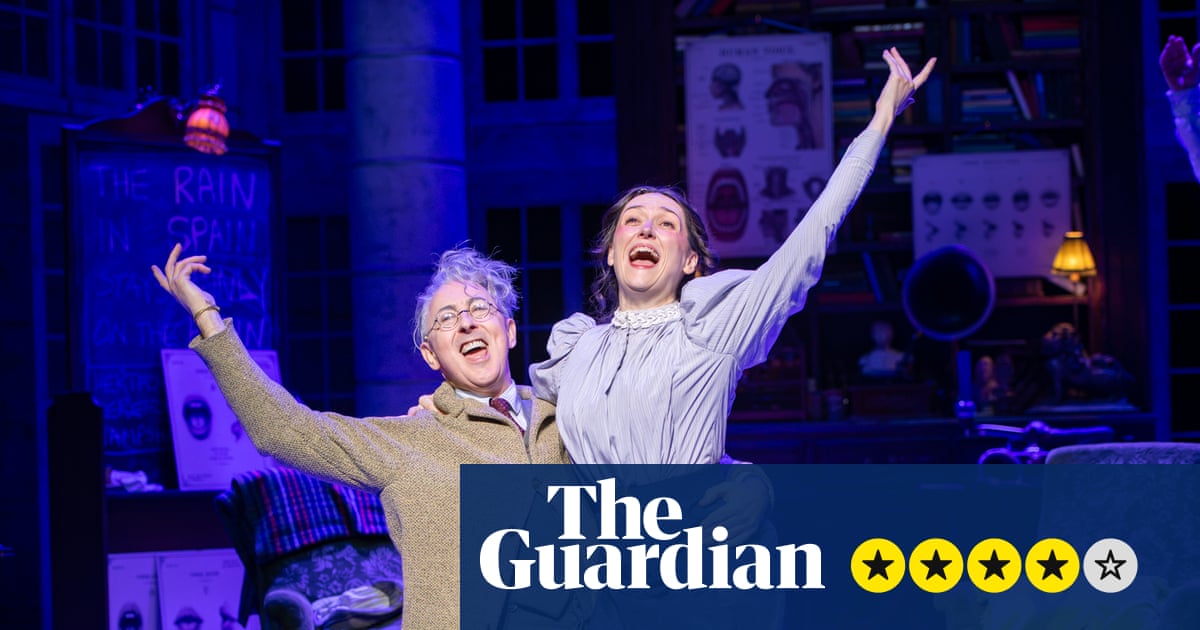
When Mrs Higgins remarks that her son Henry, a professor of phonetics, and his companion Col Pickering are “a couple of babies playing with [their] live doll,” you know exactly what she means. Played by Julie Legrand – an amusing mixture of the haughty and perceptive – she has seen right through them. Not so much Pickering who, in the hands of Martin Ball, is the bluff, avuncular figure you expect. But as Henry Higgins, Alan Cumming is disarmingly playful.
With an eccentric riot of grey hair, John Lennon glasses and a single button clasping his cardigan, he slips behind the Covent Garden columns of Tim Hatley’s set like a naughty toddler trying to make himself disappear. He emerges with a flash of teeth and a boyish giggle. You would think such frivolity would diminish his authoritarian streak, but it only makes it more sinister.
When he berates Eliza Doolittle, the cockney flower girl he has plucked like an exotic specimen from what he regards as the gutter, he goes from quirky to callous. Is it a blinkered upper-class upbringing that leads to his calling her “this baggage” or something more sinister? Cumming sings I’m an Ordinary Man with a Jekyll and Hyde mix of tenderness and vitriol.
Streetwise Eliza can give as good as she gets and, played by a delightful Verity Power, she ranges, vocally and emotionally, from the gutsy to the dulcet. She will be nobody’s doll.
As a threesome, she, Higgins and Pickering make an uneasy alliance. As ever, that makes the ending more ambivalent than happy, especially with Eliza’s cautious relationship with her young suitor Freddy (Alex James-Hatton). We can thank George Bernard Shaw for such knottiness. Filtered by Alan Jay Lerner and Frederick Loewe, his original play makes Eliza’s Cinderella transition across the class divide contentious at every turn. The story needles the audience’s prejudices as much as it does those of the men who think they can fashion her to their liking.
The songs, of course, are sumptuous and are gloriously sung to Ben Kubiak’s offstage band, playing with chocolatey warmth. Especially good are the ensemble numbers, robustly choreographed by Ashley Nottingham and joyfully performed. Briskly directed by Maria Friedman, it makes for a spirited and spiky evening.