Devblog #41. Adaptations – Making Each Origin Unique

Hello everyone.
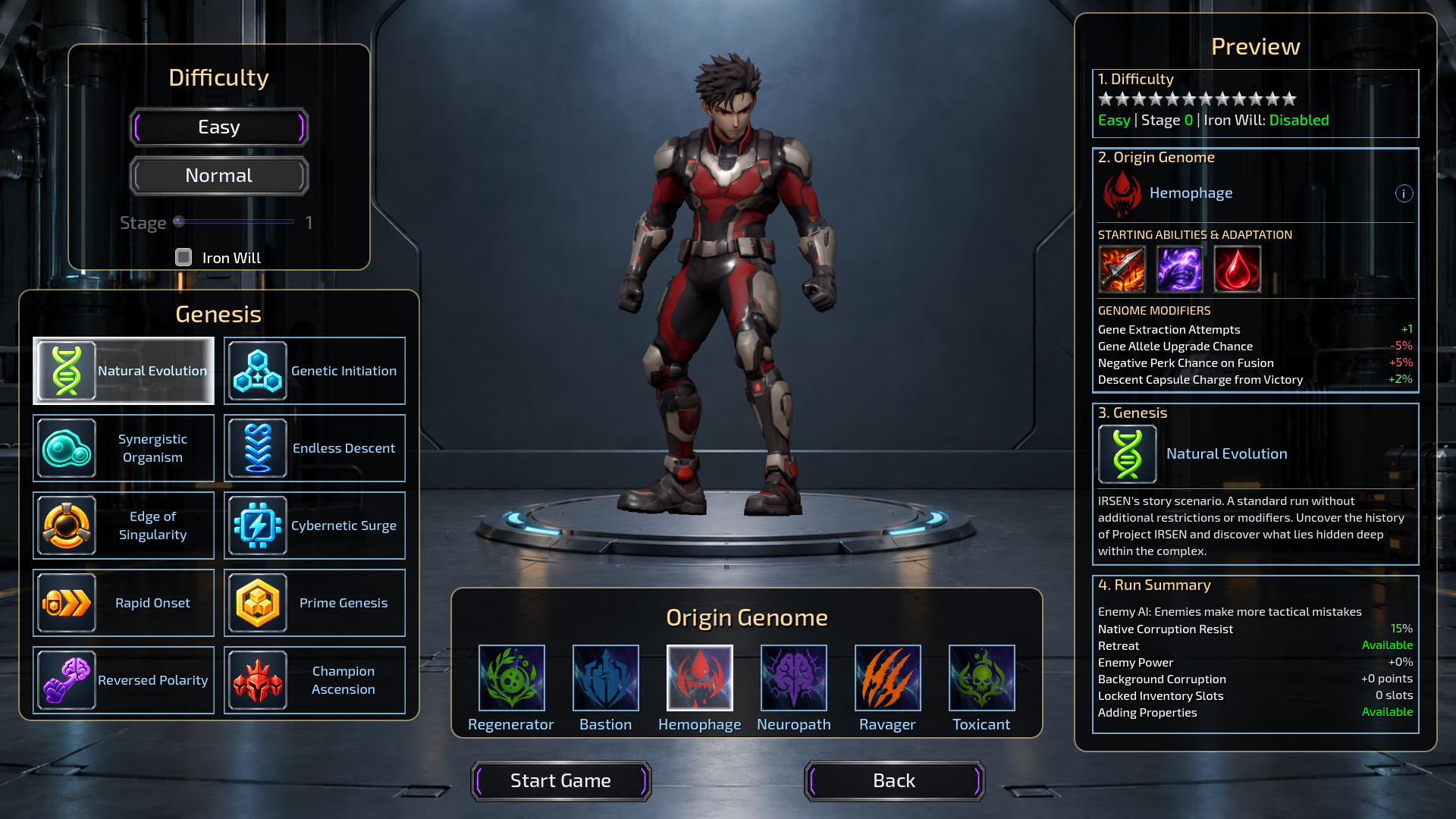
Today, I’d like to discuss one of the features introduced in October and included in the latest version of the game released on Steam. This time, we’ll be talking about character origins. I’ve already touched on the subject of classes in previous devblogs. In the earliest versions of IRSEN, there were no classes at all. Later, I introduced an alternative to traditional classes: character origins.
The main reason for this was that playtesters initially struggled to understand how to build gene chains. To demonstrate how genes could be combined into abilities, I decided to place several prebuilt chains on the player’s Gene Map. However, I couldn’t decide which ability to give the player, so I introduced different starting origins, each with its own starting ability.
The second rework of origins took place when I was redesigning the 3D models of the playable characters. At that point, I had already started thinking about the game’s story, and I liked the idea of giving each origin a distinct visual identity. As a result, each origin received its own character model.
The third rework came when I redesigned the adaptation system. This system had been introduced quite some time ago, but I had disabled it in the demo. I returned to it roughly six months after its initial implementation.
Adaptations are similar to talents in other games. They form an interconnected tree of perks that players can unlock as they progress through the game. However, I wanted to create more than just stat bonuses. I wanted a system in which key adaptations could change the player’s playstyle. This system fit naturally with character origins. Before adaptations, an origin determined the character’s model and starting gene chains. The differences between characters gradually disappeared after clearing a few sectors. The further the player progressed, the less significant the initial gene chain became.
Starting Adaptations
I designed the adaptation tree with six starting points, one for each origin. The entire tree contains 42 adaptations, divided into six sectors with seven adaptations each. Each character begins their journey from a different starting point. Each of these points contains a unique adaptation that cannot be unlocked by characters of other origins. The character receives it at the beginning of the run and retains it throughout the entire run. The starting adaptation reinforces the characteristics of each origin and helps define its playstyle.
For example, Bastion begins every battle with Fortify equal to 15% of maximum health. This particular effect can only be removed by absorbing incoming damage.
Neuropath has a different ability. Its starting adaptation allows the player to target any enemy regardless of their position on the battlefield. This means Neuropath can attack enemies in the back row, ignoring the usual restrictions imposed by combat formations. However, Provocation still affects this character.

The Shared Adaptation Tree
I designed the shared adaptation tree so that all six starting points lead deeper into the tree, toward its center. Since each character starts from a different point, they initially follow their own development path. However, the sectors are interconnected through lateral connections. Even when starting from Bastion’s initial adaptation, the player can follow these connections to reach adaptations associated with other origins.
For example, when playing as Neuropath, you can move into Bastion’s sector and gain additional defensive capabilities. At the same time, you retain your unique ability to target enemies in the back row.
Final Adaptations
Each sector contains one final adaptation. Unlocking one of these nodes can significantly change the way a player builds their Gene Map.
For example, Bastion’s final adaptation combines physical defense and psionic resistance. Both stats become equal to their combined total. However, the player can unlock only one final adaptation per run. It can be any of the six available options, regardless of the character’s origin. Overall, this system resembles talent trees found in many other games. However, when implementing it, I decided to move away from traditional talent points and integrate adaptation research into the existing character development systems.

The Cost of Progression
To unlock adaptations, players use the same Gene Residue resource. I decided not to introduce a separate currency or talent point system. This resource is also required for modifying gene properties, adding new properties, and upgrading existing ones. Players use the same Gene Residue to develop their skill forms.
As a result, players must choose between developing specific abilities, unlocking adaptations, or improving their stats through gene modifications. I hope the adaptation system will help preserve the individuality of each origin without restricting character development. Multiple runs with the same character can now lead to completely different combinations of genes, abilities, and adaptations.