a review of midcentury kinetic environments: when artists turned entire rooms into moving machines
Throughout the 1950s and 1960s, an international network of artists began to explore the possibilities of kinetic art at the scale of architecture. Motors and electrical circuits found their way into museum galleries, where entire interiors could be animated with moving structures and artificial light. In some cases, the machinery responded to the viewer’s presence.
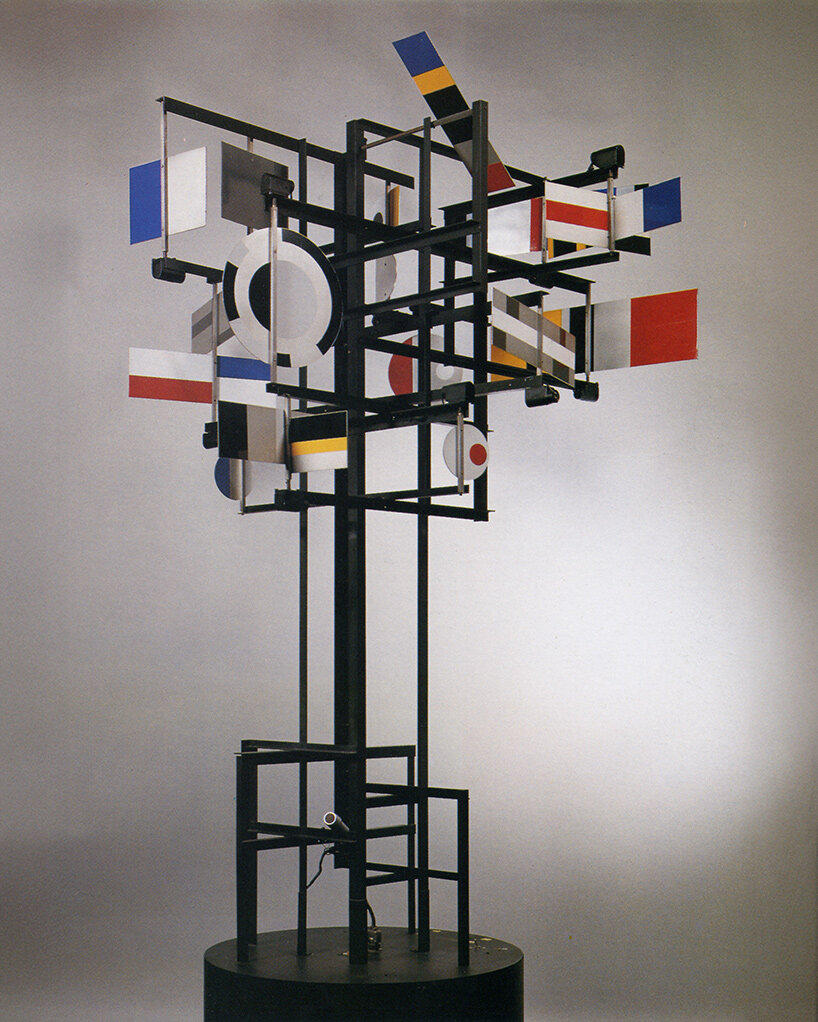
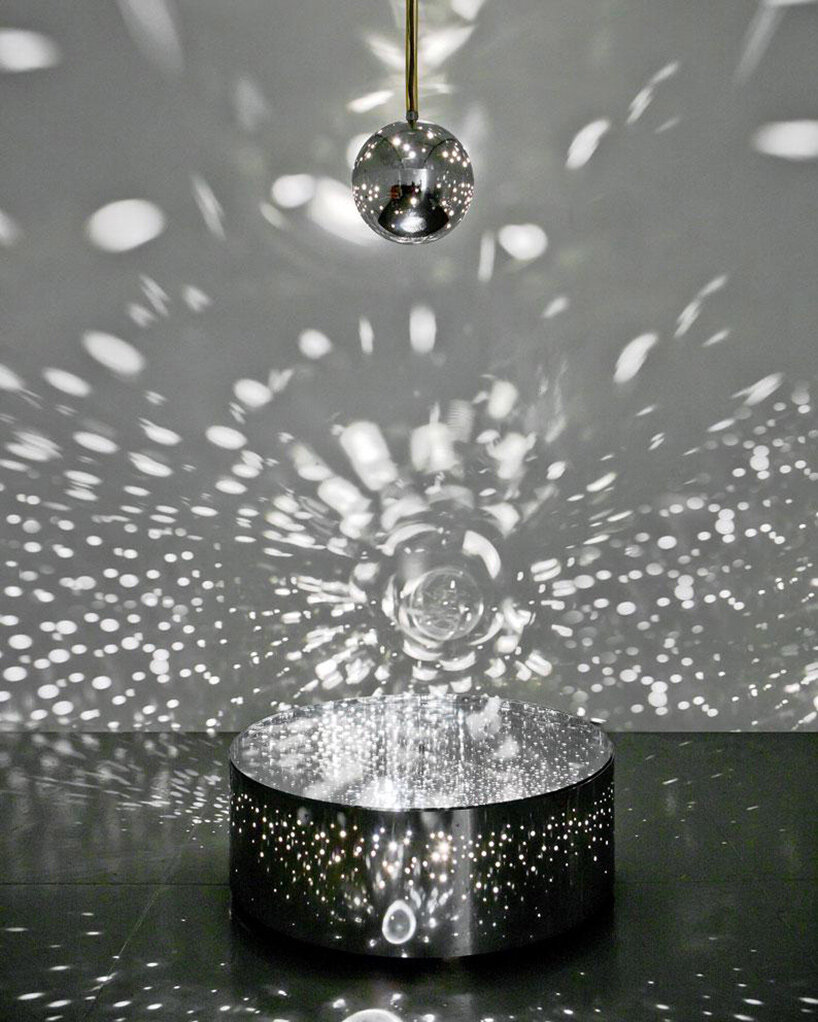
An early precedent for these experiments came from the Bauhaus. In 1930, Hungarian artist László Moholy-Nagy introduced his Light Prop for an Electric Stage, also known as the Light-Space Modulator, at an exhibition in Paris. As the machine’s metal components rotated, light passed through perforated surfaces and bounced off reflective elements. Its movements generated a second composition across the surrounding walls. Here was a sculpture whose physical dimensions accounted for only a fraction of the space it occupied.
By the time Galerie Denise René staged its landmark exhibition Le Mouvement in Paris in 1955, movement had become the subject of a budding international art movement. Artists were experimenting with industrial technologies at a moment of renewed interest in the relationship between art and engineering. Over the following decade, some of the most ambitious projects in kinetic art would take the form of environments that visitors could physically enter.
László Moholy-Nagy, Light Prop for an Electric Stage (Light-Space Modulator) | video courtesy SFMOMA
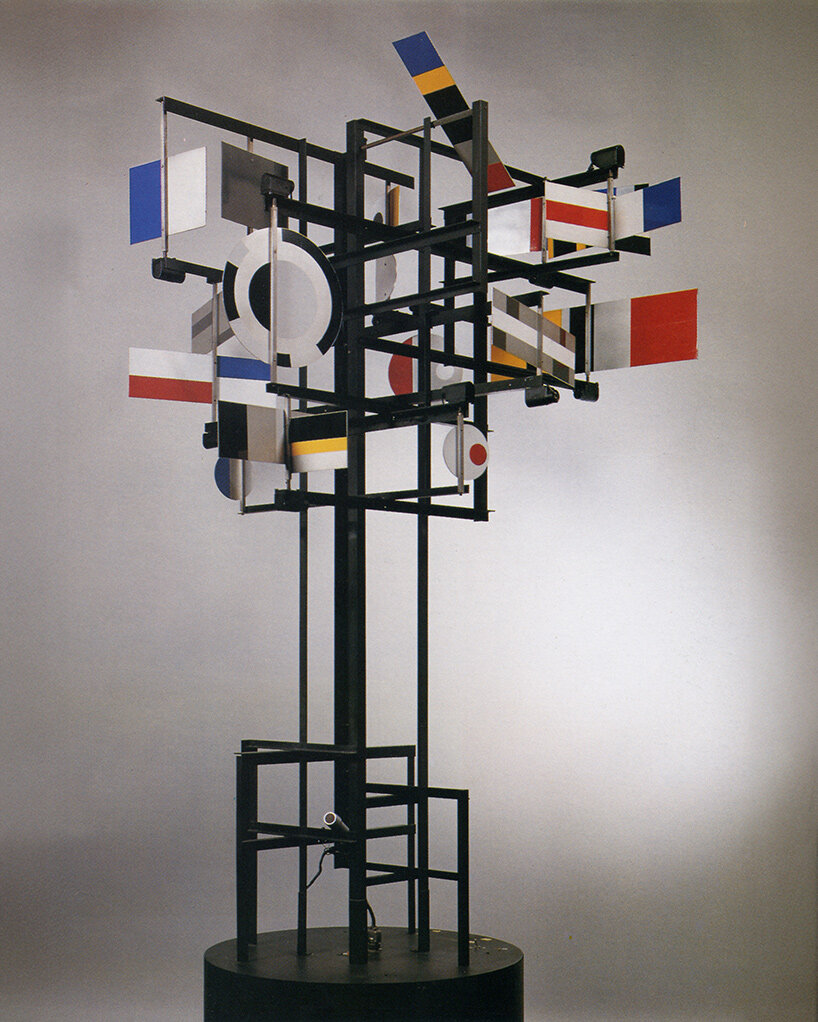
In 1961, a 52-meter steel tower by Franco-Hungarian artist Nicolas Schöffer rose beside the Palais des Congrès in Liège, Belgium. An arrangement of rotating reflective panels occupied its open framework, while an electronic control system coordinated its movements with light and sound. Schöffer also developed an animated light wall for the neighboring building. After dark, the project extended across the riverfront as reflections appeared on the surface of the Meuse.
Schöffer had been studying cybernetics, a field concerned with systems of communication and feedback. His earlier robotic sculpture, CYSP 1 (1956), incorporated sensors through which it could respond to changes in its surroundings. With the Liège project, the artist could begin to imagine how these relationships between machines and their environments might operate at an urban scale.
At the third Paris Biennale in 1963, the Groupe de Recherche d’Art Visuel (GRAV) constructed a labyrinth of its own. The collective, whose members included Julio Le Parc and François Morellet, assembled a series of experiments with light and physical movement. Visitors encountered works that required their participation. GRAV would eventually take these experiments beyond the museum and onto the streets of Paris in 1966.
For Documenta III in Kassel in 1964, the German artists Heinz Mack, Otto Piene, and Günther Uecker of the ZERO group collaborated on Light Room (Homage to Fontana). In the darkened gallery, seven kinetic sculptures and a projected image formed a single installation. Electric motors and timers governed the activity of its individual components. As reflective surfaces turned and the distribution of light changed, the room took on a rhythm of its own.
The work built upon experiments that Piene had begun in the late 1950s with his Lichtballett (Light Ballets). The artist initially manipulated light sources by hand, before developing motorized devices that could perform their own sequences. For ZERO, the ephemeral qualities of light offered a way to work at an architectural scale without the construction of a permanent structure.
[embedded content]
1963 Paris Biennale | video courtesy OAM
What might be one of the most compelling environments of the period emerged from the Italian artist Gianni Colombo‘s research into spatial perception. A co-founder of Milan’s Gruppo T in 1959, Colombo had developed a series of kinetic works before turning his attention to installations large enough to accommodate the human body.
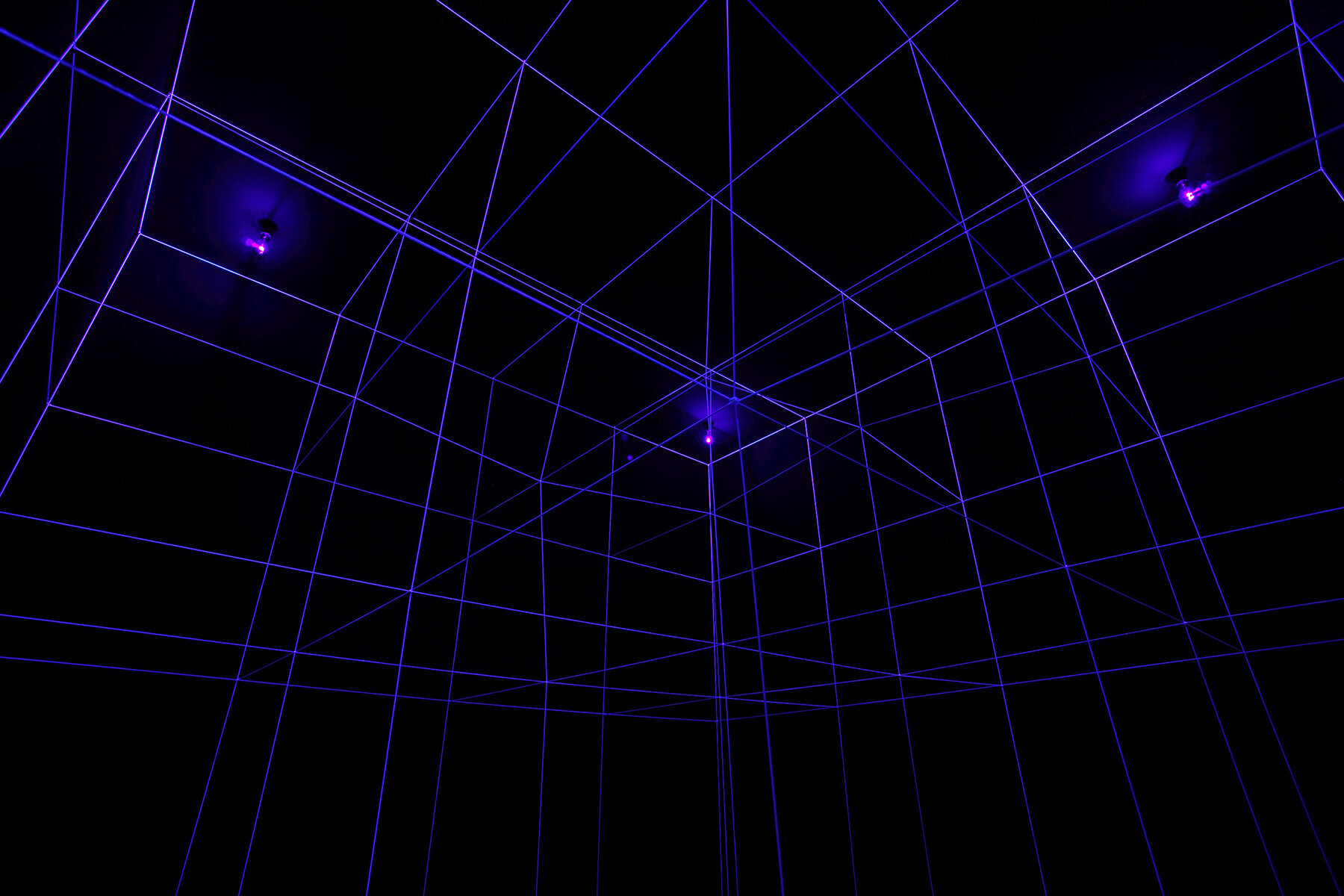
At the 1967 Trigon exhibition in Graz, Austria, he presented Spazio elastico (Elastic Space), a darkened interior filled with a three-dimensional network of elastic cords. Under ultraviolet light, the cords appeared as luminous lines suspended in space. Two motors occasionally stretched the grid out of shape, so that the seemingly regular arrangement of cubes gradually lost its symmetry.
There’s something especially architectural about Colombo’s approach. With very few materials, he could manipulate the perceived proportions of an interior and interfere with the body’s sense of orientation. The familiar logic of an orthogonal space gave way to a geometry that shifted as visitors navigated it. In 1968, the work earned the artist first prize in painting at the Venice Biennale.
In Vienna, the experiments of the Austrian avant-garde collective Haus-Rucker-Co brought a new dimension to kinetic environments through the use of inflatable architecture. Founded in 1967 by architects Laurids Ortner and Günter Zamp Kelp alongside artist Klaus Pinter, the group explored how unconventional architectural forms could alter the sensory experiences of their inhabitants.
Their 1968 project Gelbes Herz (Yellow Heart) took the form of a pneumatic capsule just large enough for two people. Occupants entered through a series of inflatable rings before settling onto a transparent plastic mattress inside a spherical chamber. The surrounding air-filled cushions periodically swelled toward their bodies and receded, so that the interior seemed to breathe around them.
Across the translucent membranes, brightly colored dots shifted in appearance as the plastic expanded and contracted. Haus-Rucker-Co had effectively designed a room with its own pulse. The project belonged to a wider body of architectural experiments in which lightweight synthetic materials and air pressure offered alternatives to the rigidity of conventional construction.