Same Nickname, Two Very Different Men — Part 5

AUTHOR’S NOTE: Two men with the moniker “Beluga Joe” plied the waters of Cook Inlet in the 1900s. Both Joseph Magill and Joseph Schneller became associated with the Beluga River on the inlet’s west side, and both were noted for commercial fishing. Most of the similarities end there.
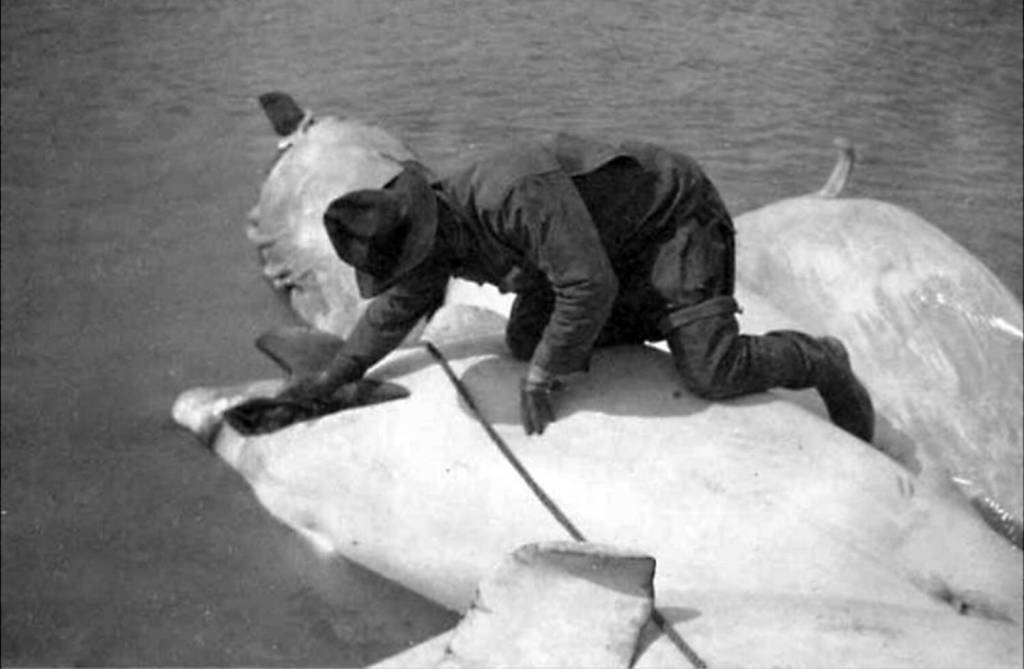
Joseph Andrew Magill told journalists in 1920 that Cook Inlet contained about 10,000 beluga whales, which were considered important economically because their oil and other body parts were valuable and because limiting or reducing their numbers was considered crucial for the conservation of salmon.
Despite this, according the Pacific Fisherman, a fishing-industry journal, little effort had previously been made to harvest the “exceptionally wary” marine mammals because of the difficulty of capturing them at sea. Joe Magill solved that problem by deciding to stay ashore and let the belugas come to him.
Once he realized that belugas regularly traveled up the Beluga River and other streams on the inlet’s west side in pursuit of salmon, he developed a strategy for keeping them in the stream and killing them. This strategy was laid out clearly in a 1921 Pacific Fisherman article entitled “A Remarkable Whaling Development.”
At tidewater, where there is a large maximum high tide, Magill and his crew laid a 1,550-foot-long net — made of extra-heavy cotton seining twine — with one end staked on the mud flats that comprised the banks of the river mouth. The bottom edge of the net was anchored to the river bed, and a two-and-a-half-inch air hose ran the length of the top of the net, which terminated at an onshore air compressor and tank attached to the hose.
With the net lying on the ground on high tide, the whales easily passed into the river and traveled upstream. Before the tide began to ebb, however, Magill started up the compressor and filled the hose with air, thus increasing its buoyancy. The top of the net floated to the surface of the water, creating a barrier that the whales could not pass back into the inlet.
Men in dories then slipped into the river above the net, attached keg buoys to the top of the net to stabilize it in the “up” position, and then attempted to drive the whales into too-shallow water or onto the mud flats, where a single bullet fired into the brain from a .30-30 rifle usually resulted in a kill shot.
Dead belugas were lassoed by their tails and towed to the rendering plant similar to the way a raft of logs might be towed to a sawmill. At the plant, a steam-powered winch skinned the whales from head to tail, and the hides were salted in preparation for shipment. The blubber, head and jaws were rendered for oil. Some of the meat was cut and dried, while the rest was either cut or ground to make burger meat or steaks.
Ironically, by the time Magill’s beluga-killing methodology — and his nickname — were rising in public prominence, he was getting out of the business and focusing more on salmon canning. Through 1920, though, he was becoming widely known as “Beluga Joe” or the “Beluga King.”
He trapped and killed belugas at the mouths of three westside streams — the Beluga and Theodore rivers and Threemile Creek. His Beluga Whaling Company’s efforts weren’t always trouble-free, but he was reasonably successful for about six years.
In August 1918, the secretary of the Beluga Whaling Company issued an announcement that Magill was no longer employed as company manager and that any future debts or contracts connected with Magill would no longer be honored.
Evidence from the National Oceanic and Atmospheric Administration indicates that the company went bankrupt in 1919 and was “taken over” by its former manager, who renamed the business the J.A. Magill & Company in 1920.
It is unclear how he managed these maneuvers, but contemporaneous news articles show him traveling to Chicago, New York, Los Angeles and Seattle for business purposes. As the 1910s drew to a close, Magill stayed positive, at least in the eyes of the press, frequently talking of “bigger” and “better” and “newer” things to come.
Magill had first incorporated his business with $25,000 in capital and in the company of influential Anchorage entrepreneurs. Between each year’s whaling and commercial salmon seasons, he and his wife Helen spent most of their winters in Washington; however, as he had done throughout his adulthood, he rested only briefly on his laurels. He remained in perpetual motion, seemingly always in pursuit of another deal.
Despite all the wrangling and finagling, Magill’s time as a Cook Inlet whaler ended in 1920, when his time as an Anchorage cannery man began. Before the end of the preceding decade, he also acted as the proprietor of a Los Angeles apartment building, used fish traps for salmon harvests that he sold by the salted barrelful, and operated a passenger-and-freight launch in Cook Inlet to test out a business model for the Anchorage Chamber of Commerce.
Magill’s last hurrah was his cannery business. The Anchorage Daily Times, on Jan. 27, 1922, reported, “In a telegram to Attorney Arthur Frame, J.A. Magill announces that he is ready to proceed with the work of financing a salmon cannery plant at Anchorage, provided he can secure a spur [railroad] track to a site selected while in Anchorage, and the right to construct the plant at that point, with a lease for a reasonable number of years.”
He also requested that the city agree to supply his plant with electricity and water at cost, and that an ordinance be passed to that effect. It was believed that he had secured promises of $100,000 in capital to fund construction and begin operations. By mid-summer, Magill’s cannery, known as the Anchorage Packing Company, was a reality, processing, at its peak, 1,200 cases of mostly sockeye salmon per day. By autumn of the following year, however, legal problems were already arising.
In October 1923, the Seattle Post-Intelligencer reported that Warren H. James, the vice-president and general manager of the Anchorage Packing Company, had filed a petition in superior court for a receivership. James claimed that he represented 450 of the 585 shares of the company’s capital stock.
According to Magill, the packing company was in danger of bankruptcy unless a receiver was appointed. James blamed Magill, in part, for the company’s financial turmoil, stating that Magill had “failed to construct certain fish traps according to contract, thereby entailing a great loss in the company’s operations during the recent salmon run.”
A receiver was appointed, and Magill, while still hoping the problems with the Anchorage could be fixed, began exploring other opportunities. He claimed to have secured a seven-year lease from the Tyonek Indian Reservation and announced plans to erect a new cannery there. He also investigated the hard-smoking of salmon bellies to produce beleke, for which he believed there was a ready market.
Additionally, he told a reporter in 1924, he was considering restarting his whaling operation.
Frequently changing his plans or announcing the possibility of new businesses — the packing of fruits and vegetables; new cannery operations; expanded salmon fishing — Magill stayed on the move in succeeding years.
Some might have perceived all this action as persistence and ingenuity, others as flailing and a slow spiraling downward.
TO BE CONTINUED….