Behind the Scenes: How A Night With August Was Created
Behind the Scenes: How A Night With August Was Created
A look behind the development of an independent horror game — from its earliest prototype to its final release.
A Night With August began with a passion for horror games and the horror genre. The original concept was much larger and more story-driven, but over time, the project evolved into a first-person atmospheric horror and puzzle game.
August himself existed as a character long before the game was conceived. The idea was to create someone who could appear elegant while remaining deeply unsettling — a character built around the contrast between sophistication and horror.
The central gameplay idea was simple: the player must find a way out of a house while August is somewhere inside, waiting for an opportunity to catch them.
From the beginning, the goal was to turn ideas drawn on paper into a real, playable experience. Creating an unsettling atmosphere was especially important. Environmental details were not treated as simple decorations; considerable time was spent shaping individual areas, effects, and sounds.
The development of A Night With August took approximately 9 to 12 months, and the entire project was developed independently by me.
There was no development team behind the project. I handled the programming, environment creation, modeling, animations, sound implementation, and the other systems required to bring the game together.
The game was developed using Unity 6, with gameplay systems programmed in C#. All of the game’s 3D models were created using Blender.
I built many of the game’s systems manually. This gave me control over how different parts of the game worked, but it also made development considerably more time-consuming.
The house was not created all at once. Rooms and environmental details were added gradually throughout development.
One of the most time-consuming parts of environment creation was the basement and its tunnels. Building these areas was only part of the challenge; connecting their routes and implementing the necessary logic also required considerable work.
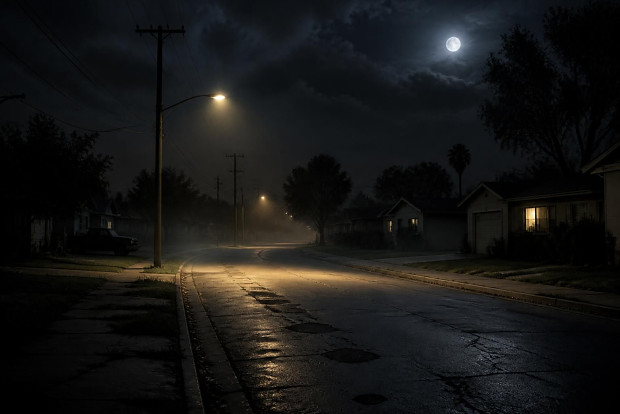
Another important part of the atmosphere was the sky. I created and positioned a 3D sky environment containing stars and a moon. It was a time-consuming process, but I wanted the world outside the house to contribute to the overall experience rather than feel like a simple background.
Rain was another major undertaking.
Instead of using a basic rain effect, I spent several days working on a more advanced Particle System to make the raindrops look and behave more naturally. I could have used a much simpler effect, but environmental atmosphere was one of my priorities.
The environmental audio also required careful attention. Sound effects and individual audio systems were configured separately to make the environment feel more convincing.
Some early ideas, including Dark Mode and environmental Fog Zones, were eventually removed as development progressed and the direction of the game became clearer.

August was arguably the most technically demanding part of the entire project.
His movement system uses manually designed Node Paths. I spent a considerable amount of time creating and debugging paths throughout the environment.
His vision system also evolved during development. What began as a relatively simple field of view became a more advanced 3D detection system, with an expanded detection range and improved player recognition.
His character rig and animations were also created manually. This included the skeleton, rigging, and animations such as standing, breathing, and walking.
The character’s animation controller, movement, vision, and AI behavior all required extensive programming and testing. Working on these interconnected systems took several months.
At one point, I considered upgrading August’s original model. However, changing the model would have meant rebuilding or adjusting several connected systems, including the rig, animations, Node Paths, and vision system.
That could have added several more months of work and significantly delayed the project. Eventually, I decided to keep the existing model and focus on improving the systems around it.

The puzzle and interaction systems were written in C#.
Each puzzle and interactive object required its own tags and corresponding logic. Making everything work correctly was not simply a matter of adding an interaction button.
A significant amount of time went into fixing item-related bugs, making interactions consistent, and organizing the underlying logic so that different systems could work together reliably.
In fact, preventing bugs in the puzzle and item systems was one of the most time-consuming parts of gameplay development.
The player controls and camera system were also implemented specifically for the game, although they were not among the most difficult development challenges.
Lighting was implemented using Unity’s built-in lighting systems, including Point, Directional, and Spot Lights.
I wanted the game to remain accessible to players with different hardware capabilities, so graphics settings were included in the game menu.
Higher quality settings use more detailed textures, including 4K textures, more shadows, and more demanding shaders. Lower settings use lighter shaders and lower-resolution textures to reduce the performance requirements.
The goal was to offer different visual quality levels without making the game unnecessarily difficult to run on weaker systems.
However, visual quality was never just about textures or lighting. The overall atmosphere depended on how the environment, effects, sounds, and lighting worked together.
The earliest prototype was extremely simple.
It contained the environment and August’s basic behavior, but it did not yet have the puzzle systems that would become part of the final game. It also suffered from numerous technical issues and unfinished features.
The older demo was another important stage of development, but it did not represent the experience I ultimately wanted to deliver.
Compared with the final release, the demo had weaker lighting, atmosphere, graphics, and AI behavior. August’s vision system was also less developed.
I eventually decided to remove the old demo because I did not feel its quality accurately represented the completed game.
The final version introduced significant improvements:
Better graphics and environmental detail.
Improved lighting and a stronger atmosphere.
More developed AI behavior and vision for August.
Improved puzzle and interaction systems.
Graphics settings for different hardware capabilities.
Fixes for many of the problems found during early development.
The difference between the original prototype and the final release was the result of many months of gradual development and refinement.

I tested the game repeatedly, playing from beginning to end to identify problems and fix as many bugs as possible.
After release, I also read and reviewed the feedback and criticism from players.
Some players reported bugs related to August. Unfortunately, certain issues involving his complex systems are expensive and difficult to repair. I fixed the problems that could reasonably be addressed without excessive development costs, but some more complicated issues remained.
Other players praised the atmosphere, and that feedback genuinely meant a lot to me.
I do not want to decide what the game’s greatest achievement is. I believe that is something the players should judge for themselves.
The original plan was to develop an Android version.
However, due to several technical limitations, that approach was not possible, so I eventually moved toward a web version instead.
I also wanted to make the game more accessible on mobile devices. The idea was to provide a version that players could access through a browser without needing to install the full Windows game.
Unfortunately, the limitations of Unity’s web build made it difficult to preserve the same visual quality and atmosphere as the Windows version.
As a result, the web version has noticeably reduced graphical quality compared with the Windows release. It is an alternative for accessibility, but the Windows version remains the recommended way to experience A Night With August.
If you want the intended graphics, lighting, and atmosphere, I strongly recommend playing the Windows version.
I am currently working on another game that will explore August’s past and reveal his complete story through a more structured, story-driven experience.
There is still a lot I want to create, and I intend to approach future projects with even more experience, ambition, and improvements.
Thank you to everyone who played A Night With August, shared feedback, reported bugs, and supported an independent developer.
Every review and every bit of feedback matters. Even criticism helps me understand what needs to improve, and the positive comments about the atmosphere have been especially meaningful.
I will continue working on new games and pushing my future projects further.
Thank you all for being part of this journey.
The game is available here:
Developed independently by A.R.GH.Y.
Released: September 16, 2026