Inside the American Girl Empire
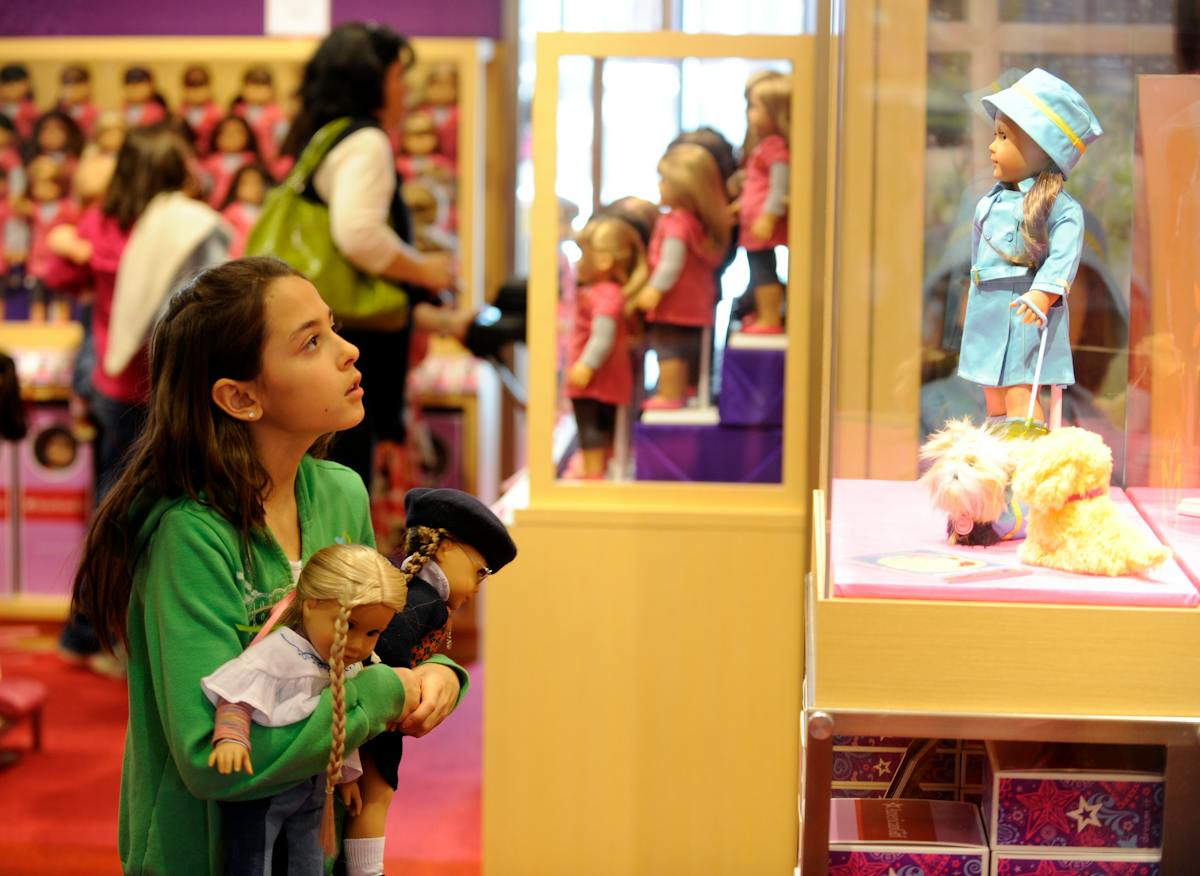

The corporate-written history tells a quintessentially American story: the ascent of Pleasant Company. Through products that offered a window into a whole world, American Girl created new and empowering experiences for American girls who were old enough to read and young enough to crave role models who were kids like them. Yet Amanda FitzSimons’s often critical book may make a more convincing case for the importance of American Girl, showing how it reached its young customers’ deepest needs: not only to collect but also to connect, to belong, and to aspire.
The Making of American Girl is big. Seriously, it’s huge. My copy broke the American Girl–branded bag handed to me by a smiling cashier. Its size allows the book to include, as the subtitle lists, “photos, sketches, swatches, artifacts, and early designs,” as well as 282 pages of text. Each of the original six dolls—Samantha Parkington (representing 1904, released in 1986), Kirsten Larson (representing 1854, released in 1986), Molly McIntire (representing 1944, released in 1986), Felicity Merriman (representing 1774, released in 1991), Addy Walker (representing 1864, released in 1993), and Josefina Montoya (representing 1824, released in 1998)—has a full two-page portrait, reminiscent of the original mail-order catalogs. The colors are vibrant, literally including swatches from each doll’s color palette. The carefully curated images douse the reader in nostalgia.
We begin at the start not of American history but, rather, of American Girl. Around Christmas 1983, Rowland sat in her family’s cottage in rural Wisconsin and scribbled a business plan: for characters, products, a magazine, and eventually, a store “that would have historical displays like little museums.” Originally, she chose periods around a half-century apart, conveying the scaffolding of American history as her education taught her to imagine it: a European immigrant in the mid-nineteenth century, a girl from the Progressive era, and a girl from World War II. The book describes the first six dolls’ lore and associated merchandise in loving detail. Felicity, for instance, proudly wears pants and stands next to a horse in the center of a page. According to canon, both the pants and the horse are stolen, from her father’s apprentice and the local tanner, respectively. She “borrowed” the pants to rebel against traditional gender norms and “freed” the horse from abuse, promptly naming her Independence, or Penny for short.