Razorback Report Card: Texas Postgame
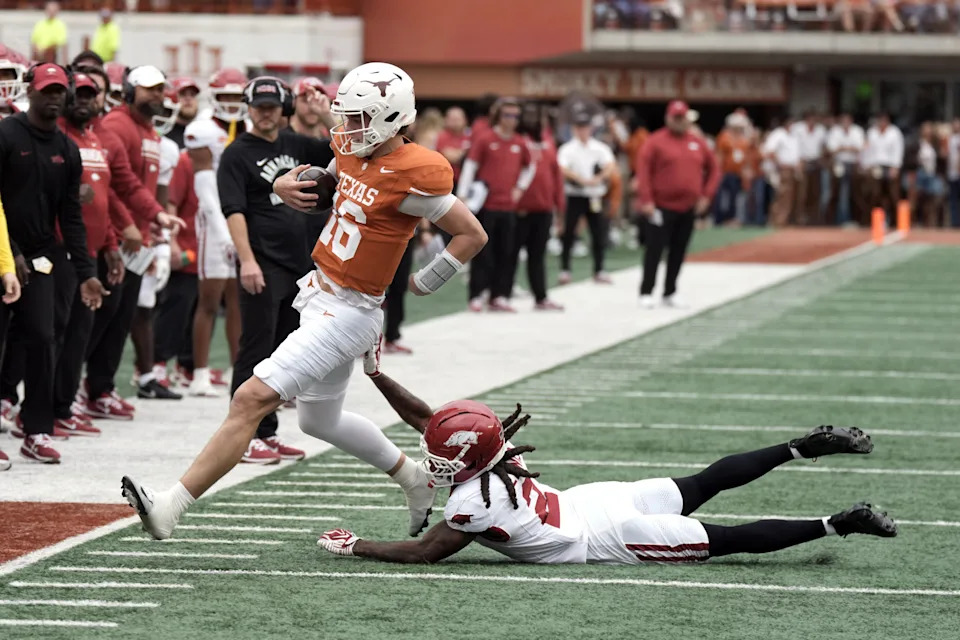
The rushing defense met its statistical targets. Almost everything else unraveled as Texas turned Arkansas’ mistakes and empty possessions into a 42-point defeat. Arkansas did not need to beat Texas to prove that every encouraging moment against South Carolina was genuine. It did need to make the Longhorns work considerably harder than this.
Texas won 45-3, dropping the Razorbacks to 4-7 overall and 2-6 in SEC play. Arkansas scored with 3:32 remaining in the first quarter and never scored again. The Razorbacks gained 363 yards, possessed the ball for 31:21, and finished with only one fewer first down than Texas. None of those numbers made the game close.
They described an offense capable of moving between problems without solving enough of them—and a defense that allowed Arch Manning to operate with extraordinary efficiency. The pregame report card established specific standards. The postgame evaluation will not replace those standards with whatever makes the result easier to explain.
Here are the grades.
The pregame requirements were to hold Texas below 140 rushing yards, limit the Longhorns to less than 4.0 yards per carry, and allow no rushing gain of 25 yards or more. Arkansas met all three. Texas finished with 116 rushing yards on 30 attempts, averaging approximately 3.9 yards per carry. Its longest run covered 13 yards.
That deserves credit. Camouflage would be pretending it means the entire defensive performance was acceptable. The Longhorns scored three rushing touchdowns, including Manning’s three-yard run on their opening possession. Michael Terry III and Derrek Cooper added scoring runs after halftime.
Those touchdowns belong in the finishing evaluation, too. They don’t change the fact that Arkansas met the published run-defense benchmarks. This was the strongest category on the report card because the Razorbacks prevented the ground game from becoming an explosive, high-volume source of production. Texas found a much easier route through the air.
The requirements were to hold Manning below 60% completions, keep Texas below 250 passing yards, and allow no more than two passing touchdowns. Arkansas met only the touchdown limit. Manning completed 21 of 25 passes for 287 yards and two touchdowns without an interception. That is an 84% completion rate.
Texas finished with 332 passing yards after KJ Lacey added three completions on three attempts. The Longhorns did not need a quarterback to make a series of desperate, improbable throws. Too often, the passing game provided straightforward answers against a defense that couldn’t disrupt its rhythm.
The closing stretch of the first half was particularly damaging. Manning threw a 21-yard touchdown to Emaree Winston with 2:20 remaining. After Arkansas missed a field goal, Texas traveled 74 yards in four plays and 26 seconds, finishing with a 17-yard touchdown pass to Emmett Mosley V. A 17-3 game became 31-3 before halftime.
That was not merely a talented quarterback winning a difficult matchup. It was a defense failing to make the assignment difficult enough. Hunter Osborne supplied Arkansas’ only sack. The Razorbacks produced no takeaway. The previous week’s disruptive performance didn’t carry over.

Photo Credit: Scott Wachter-Imagn Images
The standard required Texas to finish below 40% on third down and convert no more than once on third-and-seven or longer. The Longhorns converted six of 11 third downs, approximately 54.5%. Arkansas missed the primary requirement by a substantial margin.
The Razorbacks did limit the long-yardage damage: Texas’ third-and-11 completion to Mosley on the opening possession of the second half was its only conversion on third-and-seven or longer. That distinction belongs in an honest evaluation. It also shows how often Texas avoided needing an extraordinary answer.
The Longhorns converted third-and-one, third-and-two, and other manageable situations because their offense kept creating them. Arkansas could not consistently win the earlier downs or finish the later ones. On that opening second-half possession, Texas converted third-and-11, then fourth-and-one, before scoring another touchdown. Halftime presented an opportunity to respond. The first possession after it instead extended the same problem.
The pregame targets were at least 140 rushing yards, an average of at least 4.0 yards per carry, and successful conversions on at least two-thirds of short-yardage rushing attempts on third or fourth down. Arkansas finished with 110 rushing yards on 33 attempts, averaging 3.3 yards per carry. It missed both overall production requirements.
Cam Settles supplied the best individual work with 63 yards on 14 carries. His 4.5-yard average demonstrated that the running backs were not entirely without useful opportunities. Jackson added 39 official rushing yards, including several productive scrambles. But the team’s longest run covered only 13 yards. There was no explosive gain comparable to those that helped Arkansas compete at Auburn.
The short-yardage results were better. Arkansas converted two of its three qualifying third- or fourth-down rushing attempts with two yards or fewer to gain. That met one benchmark. It did not establish a dependable ground attack that kept the passing game from carrying too much responsibility. The pregame standards explicitly said they would count sack yards, and there is no reason to remove them now.
The requirements were at least 62% completions, 200 passing yards, no interceptions, and no more than two sacks allowed. Arkansas reached the yardage target. It missed everything else. Jackson completed 15 of 28 passes for 190 yards and an interception. Hank Hendrix finished six of 10 for 63 yards and another interception.
Combined, the Razorbacks completed approximately 55.3% of their passes for 253 yards, with no touchdown. Texas recorded three sacks. Chris Marshall deserves individual recognition for nine catches and 106 yards. His production was one of the few useful offensive contributions sustained across the afternoon. It also illustrated the difference between a productive receiving line and a productive offense.
Arkansas finished drives with punts, unsuccessful fourth downs, a missed field goal, and interceptions. Marshall’s catches did not become enough points because the broader operation could not complete the work. Jackson’s interception also requires context. The ball came off Jaden Platt’s hands after a hit before Jelani McDonald returned it 31 yards for a touchdown. That was not simply a quarterback throwing directly to a defender. It remained a failed passing play with a disastrous consequence. The grade belongs to the operation, not just the person throwing the ball.
The pregame standards allowed no more than one turnover, required a positive turnover margin, limited Arkansas to five accepted penalties, and prohibited personal fouls or unsportsmanlike-conduct penalties. Arkansas committed two turnovers and forced none. The penalty total—four for 49 yards—fell within the numerical allowance.
The timing and type did not. A holding penalty damaged the opening possession. Kick-catch interference improved Texas’ starting field position after the punt. A personal foul then helped the Longhorns on their opening touchdown drive. Before Arkansas could establish anything useful, it was assisting the opponent.
The next Razorbacks possession ended with McDonald’s interception return, and Texas led 14-0 with 9:01 remaining in the first quarter. The final interception came on fourth-and-18 late in a game already decided. It should not receive the same weight as the early pick-six. But even with that distinction, the central failure remains. Arkansas entered with a clear instruction not to supply the favorite’s advantage. It promptly helped supply it.
The requirements were to score on every red-zone possession, finish at least 60% of those trips with touchdowns, and produce at least 24 offensive points. Defensively, Arkansas was supposed to hold Texas to touchdowns on no more than half its red-zone trips. None of those standards were met.
The Razorbacks went 1-for-2 in the red zone, finishing with one field goal and no touchdown. Texas scored on all five red-zone possessions, producing four touchdowns and a field goal. That is an 80% touchdown rate against a target of no more than 50%. Arkansas also converted only two of six fourth-down attempts. Its first possession after halftime consumed 13 plays and nearly six minutes, advanced only 37 yards, and ended without points.
Movement was not the same as control. Possession time was not the same as effectiveness. Max Gilbert made a 30-yard field goal and missed from 44. The miss cost an opportunity, but a successful attempt wouldn’t have fixed what happened immediately afterward. Texas still drove 74 yards in 26 seconds. Finishing belonged to the Longhorns on both sides of the ball.
The overall grade is an editorial judgment, not an arithmetic average. Arkansas satisfied the run-defense targets. Settles produced useful carries. Marshall delivered a 100-yard receiving performance. Those contributions deserve to remain visible. They cannot rescue an afternoon when the Razorbacks scored three points, surrendered 45 and failed to make their opponent sustain much uncertainty.
The South Carolina victory was real. So was this response to it. Ryan Silverfield’s team did not simply lose to a better opponent. It helped Texas establish an early advantage, failed to capitalize on its momentum, and let the game become effectively settled before halftime. The pregame question was whether progress could travel. In Austin, Arkansas supplied an answer it cannot afford to soften.
Main Photo: Scott Wachter-Imagn Images