Late goals, narrow wins – and back on top
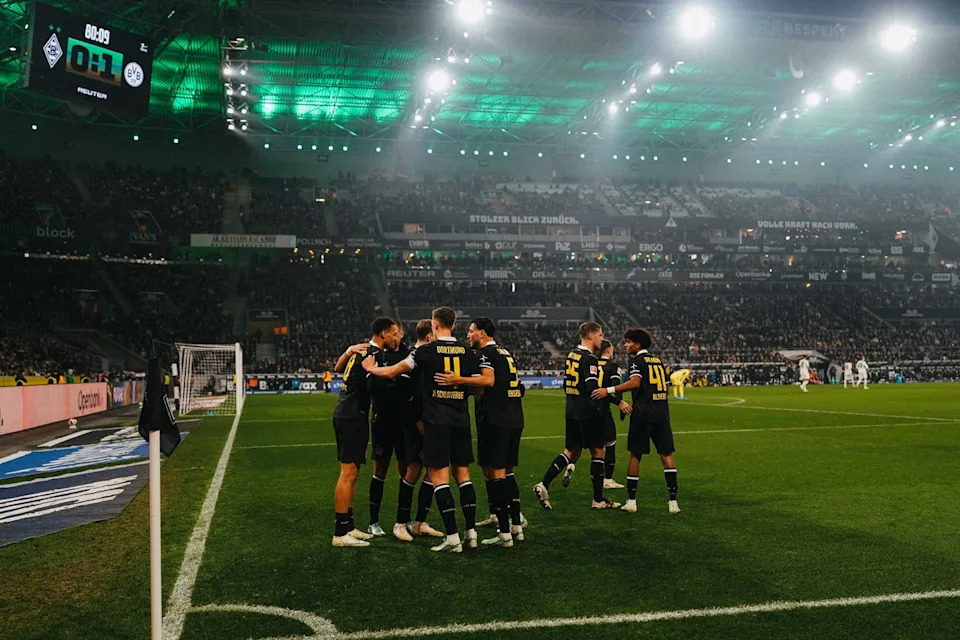
The win in the Lower Rhine region was no footballing masterclass, but it was further proof of the resilience of Niko Kovac’s team. Gladbach put BVB under pressure with aggressive pressing, particularly in the first half. The Black & Yellows made technical errors, misplaced passes and found few ways to stretch the opposition defence. Although Felix Nmecha had a chance to put them ahead after just five minutes, BVB generally lacked pace and precision.
“We weren’t sharp enough in the first half,” admitted the eventual goalscorer. Sporting director Ole Book also noted unnecessary losses of possession that could not be attributed solely to the hosts’ aggressive approach.
The picture changed after the break. Borussia Dortmund increased the tempo, took more risks and pushed Gladbach increasingly deep into their own half. Once again, Niko Kovac showed a deft touch with his substitutions. Joey Veerman, Mathis Albert and Marcel Sabitzer were all involved in the build-up to the decisive goal. Albert played in Sabitzer, who laid the ball off for Nmecha. The Germany international unleashed a powerful shot from 19 metres to make it 1-0.
It was Nmecha’s fifth goal of the season, already a personal best. The timing is also notable: the midfielder has scored three of his five goals in the final 15 minutes. BVB clearly have the patience and the physical reserves to make a decisive impact even in the closing stages.

“We’ve scored late goals a lot now because we have the energy to keep playing our game right to the end,” explained goalkeeper Gregor Kobel. In fact, eight of the Black & Yellows’ 17 Bundesliga goals so far have come in the final ten minutes of matches. Almost half their goals have therefore come at a point when other teams are often already running out of energy and concentration.
The fact that BVB left it late in Gladbach did not, however, mean the victory was undeserved. After a laboured first half, the Black & Yellows created considerably more chances. They finished with 2.5 expected goals to Gladbach’s 0.7. “Not spectacular, but deserved — in the manner of a top team,” was Book’s apt assessment.
Nine narrow wins in total, including seven consecutive victories by exactly one goal: this has long since become more than a passing coincidence. Their last more comfortable victory was the 3-0 win over Paderborn. Since then, Borussia Dortmund have come out on top in seven of eleven tight encounters — in both the Bundesliga and the UEFA Champions League — alongside three draws and one defeat.
Asked whether winning tight games had now become a particular Dortmund strength, Book replied: “If it is, we’ll certainly take it.” Of course, the team would prefer to put games to bed earlier. But individual quality can decide matches late on too, sometimes precisely through substitutions. “I think top teams are more likely to win games at the end than lose them.”
Their real quality, however, lies not just in scoring late. The key is to stay in the game until then, get through weaker spells without suffering too much damage and then make the most of the chances that come. That is exactly where BVB have made clear progress under Niko Kovac. The team kept their sixth clean sheet of the season. With just seven goals conceded, they boast the Bundesliga’s best defence and are the only team whose goals-against tally is still in single figures.
In attack, however, there is still room for improvement. Seventeen goals after ten matchdays is not an outstanding return for league leaders. Yet their goal difference of plus ten shows just how much defensive solidity underpins their success. BVB do not currently need to score many goals to win games. Often, one is enough.
Twenty-four points from ten games; seven wins, three draws and no defeats: for only the third time in their Bundesliga history, BVB are unbeaten at this stage. The last time they had more points after ten matchdays was 13 years ago, with 25 in the 2013/14 season.
Nevertheless, nobody wanted to read too much into being top of the table after the final whistle. After all, not even a third of the season has been played. Book explicitly warned against focusing solely on Bayern Munich. Leipzig, Freiburg and Leverkusen are also among the challengers chasing them.
“We’d be well advised not to focus only on a battle with Bayern, but simply to say that we want to win our games,” stressed the sporting director. The team, he said, gave the impression that they could remain very solid. At the same time, there was still room for improvement, particularly in finding ways for BVB to impose themselves more in the first half, even in difficult away games.
The players also struck a cautious note. Nico Schlotterbeck pointed out that the first priority was to stay in touch at the top until March or April. Gregor Kobel noted that, despite their good results, the team had yet to find their best rhythm on the pitch.
There is little time to dwell on being top of the table anyway. After the members’ meeting on Sunday and the KGaA’s annual general meeting on Monday, the trip to London for the Champions League match at Arsenal is already looming. “There isn’t much time to enjoy it,” Book observed. Boris Rupert
This article was translated into English by Artificial Intelligence. You can read the original version in 🇩🇪 here.