Inventor hopes inflatable warning balloon can save lives on Alaska roads
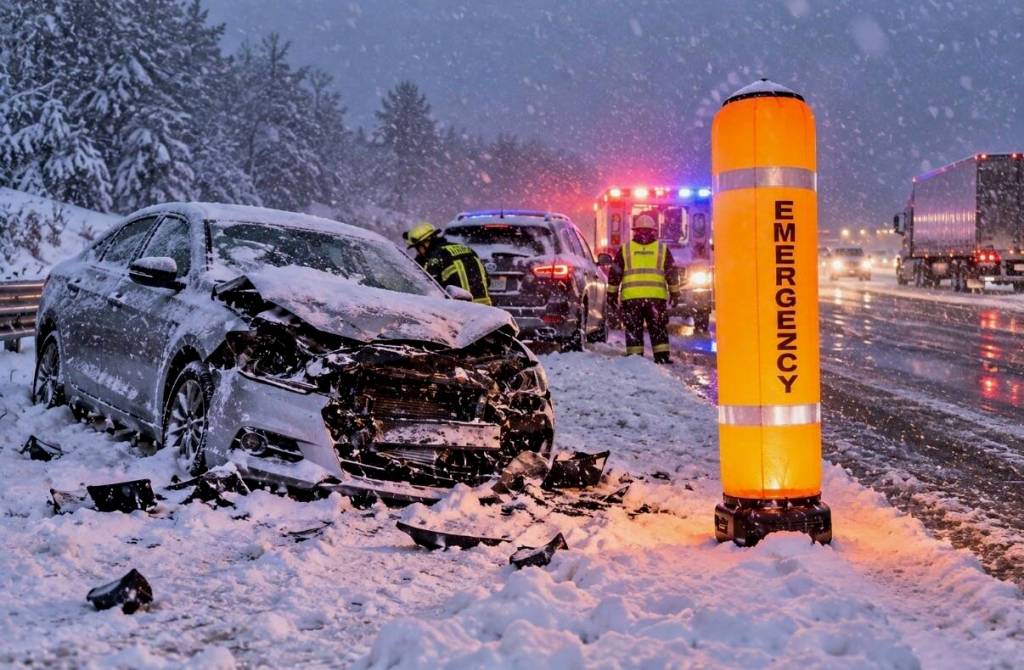

Decades after losing his best friend in a roadside accident, inventor Jose Perez has developed an inflatable warning device he hopes will help protect stranded motorists, including those travelling Alaska’s remote, icy highways.
Perez has developed the Emergency Road Balloon System, or ERB, a portable device designed to make disabled vehicles more visible to approaching traffic.
The invention uses an electric fan to inflate a bright orange balloon equipped with reflective bands and internal lightning. Drivers would place it near their stopped vehicle to warn passing motorists of a potential hazard.
For Perez, the project grew out of a tragedy that has stayed with him since he was 19.
A friend had pulled off the road after his vehicle broke down and was working underneath it when another motorist struck the car, causing the vehicle to shift and fall on top of him.
“That traumatized me,” Perez told Homer News.
Over the years, seeing stranded motorists along busy highways brought back memories of the accident and convinced him that more could be done to protect people waiting for roadside assistance. His invention received a patent in January 2015.
Since then, Perez has built several prototypes and explored commercial production.
The balloon is intended to offer something different from traffic cones or vehicle hazard lights. Standing above the pavement, its illuminated structure and reflective material are designed to catch the attention of approaching drivers.
“When it’s very dark and somebody isn’t paying attention, you can hardly see those little cones,” he said.
According to Perez, motorists can remove the device from its carrying case, position it near the rear of their vehicle and inflate it in approximately 10 to 15 seconds.
Power would come from a rechargeable battery or a vehicle’s 12-volt accessory outlet, with battery-powered models designed to operate for approximately 10 to 12 hours.
Although the invention originated in California, Perez believes it could be particularly useful in Alaska, where winter conditions and long distances between communities can make roadside breakdowns extremely hazardous.
The Alaska Department of Transportation and Public Facilities advises drivers to carry emergency supplies in case they become stranded during winter, while Alaska 511 cautions that cellphone service is unreliable along many of the state’s highways.
Along rural highways, snow and darkness are another obstacle for drivers attempting to spot disabled vehicles.
Perez said his team has already conducted preliminary nighttime and snow testing, with encouraging results.
“As far as the snow, it worked perfectly,” he said, while acknowledging that further testing is planned to determine how the inflatable structure performs in gusty conditions.
For motorists on the Kenai Peninsula, where coastal winds and storms occur frequently in the winter months, those results will be especially relevant.
Another feature in development would integrate GPS technology with a smartphone application. When deployed, the balloon could eventually send a motorist’s location to designated family members or roadside assistance providers.
No commercial release date or retail price has yet been announced, although Perez hopes to make the device affordable enough for the everyday motorist.
Although the device still faces several hurdles before reaching the market, Perez said his motivation has not changed since losing his friend.
“If it saves one life, it will have served its purpose,” Perez said.
With further testing and manufacturing decisions still ahead, he hopes the invention will eventually give stranded drivers another way to make themselves visible before approaching traffic reaches them.