When will Dylan Harper bounce back? A local orthopedic surgeon explains sports-related hip strains
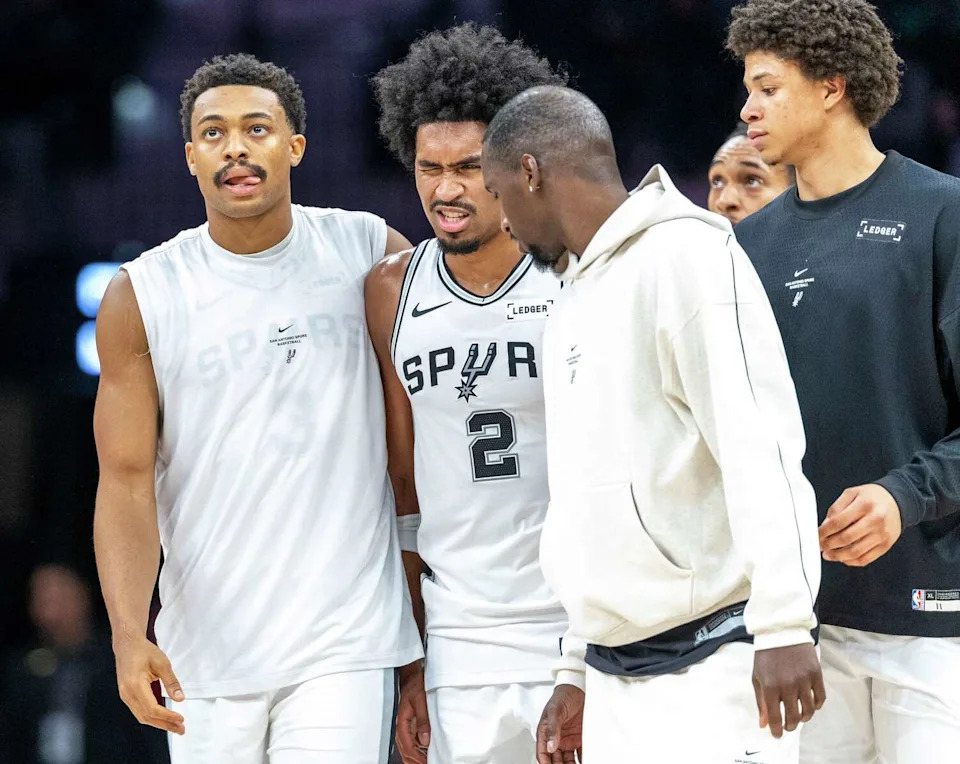
A local orthopedic surgeon and sports medicine specialist said it’s a good sign that San Antonio Spurs guard Dylan Harper was walking without a limp two days after suffering a nasty slip.
On Tuesday night, Harper went down with 53.6 seconds left against the Detroit Pistons while attempting to catch a pass from Stephon Castle. He was on the court writhing in visible pain before being helped to the locker room by teammates and staffers.
He was diagnosed with a left hip external rotator strain, and the team said his recovery will take around two to three weeks before he returns to the court.
RELATED:
Spurs ‘very lucky, fortunate’ Dylan Harper’s injury wasn’t more severe
Two days after the injury, Harper was spotted at shootaround walking without a limp during the portion of the workout open to reporters. The 20-year-old New Jersey native ranks second on the team behind Victor Wembanyama in scoring with an 18.4 per-game average.
We spoke to Dr. J. Cuyler Dear, orthopedic surgeon and sports medicine specialist at Methodist Hospital | Stone Oak, to get more insight on this type of sports-related hip injury:
QUESTION: Can you explain exactly what a left hip external rotator strain means in layman’s terms?
ANSWER: It’s basically just a pulled muscle in the back of the hip. Hip external rotators are a small set of muscles. Their main function is to turn the thigh and the femur outward, but they also keep the hip stable and keep the pelvis level. A strain basically means that those muscles or even their tendons were overstretched or even partially torn. It’s an injury to the muscle itself, not to the bone or the joint or the ligaments of the hip.
QUESTION: What does “strain” tell us about the severity of the injury?
ANSWER: It’s pretty common to get the term strain and sprain confused. A strain just tells us that it’s an injury to the muscle or tendon. In general, that is more favorable compared to a fracture or joint injury, like a labrum tear or a ligament tear. As far as severity, we have a grading system of one to three for strains. One is a mild stretch; two is a partial tear; and three is a complete tear.
From what I’ve seen, I don’t think they’ve disclosed a grade of Dylan’s injury, but the fact that they gave a one- to three-week estimate leads me to believe it’s more on the mild to moderate end.
READ MORE:
Spurs’ Dylan Harper could miss two to three weeks with hip strain
QUESTION: What basketball moves rely on the hip’s external rotator muscles?
ANSWER: Obviously, basketball, and especially NBA basketball, is incredibly challenging to an athlete’s musculoskeletal system. The muscles do a lot of their work when the athlete’s on one leg. They’re constantly working for planting, cutting, pivoting and even landing from a jump. Every time a player stops hard or changes direction on one leg, those muscles are working like crazy to keep the hip and the pelvis stable.
QUESTION: How can a slip like Dylan Harper’s strain those muscles?
ANSWER: It’s what we call unplanned movements. When he slips, one leg gets pushed out into an awkward position, and the muscles react. As a fast-twitch athlete, his muscles are constantly reacting when they become overstretched. That sudden stretch to a position where the muscles aren’t used to being, while the muscles are trying to compensate by contracting hard, generally leads to overload of the muscle and injury.

San Antonio Spurs guard Dylan Harper (2) walks off the court during Tuesday’s game against the Detroit Pistons at Frost Bank Center. (Andrew J. Whitaker/San Antonio Express-News)
QUESTION: How does a patient typically recover from a hip strain like this?
ANSWER: Well, fortunately for all of the Spurs fans, a lot of these heal without surgery. The recovery typically goes in phases. First, you want to protect the muscle, let the swelling and pain go down, and encourage gentle motion that doesn’t irritate the muscle.
Then it’s all about progressing. First, you want to restore motion, and then rebuild strength, especially in the hip and the core muscles. Then finally, running in basketball-specific movements. You just have to see how the muscles respond and progress as able.
QUESTION: What would rehabilitation typically involve, from the first few days through a return to basketball?
ANSWER: You have to tailor it to the athlete, but I think sometimes we overlook rest. Early rest is really important to let the swelling and inflammation die down. You don’t want to over-rehab somebody who’s still in a lot of pain. That first phase is always about protection, rest and getting a gentle range of motion back, like normal walking. The middle phase typically includes band work or low-impact cardio, like stationary bikes, treadmills or aquatic therapy, to rebuild strength. Once you clear that, you can focus on more hardcore work, like sprinting, cutting, defensive slides and contact.
A lot of these athletes are used to playing through pain, so you want to monitor them and see how they do with recovery.
MORE SPURS NEWS:
With Dylan Harper out, Spurs turn to familiar face to fill the void
QUESTION: Do you think two to three weeks is a plausible recovery window for this type of injury? What factors could make it shorter or longer?
ANSWER: Dylan’s obviously young and an elite athlete. He has a lot of access to excellent physical therapy and trainers, so for a mild to moderate strain, two to three weeks seems very reasonable.
Several things can make this go quicker. A milder strain, obviously, makes him progress more quickly. If this is his first injury to that hip, then typically healing is faster. More severe strains, repetitive injury or even older athletes tend to have a longer recovery.
QUESTION: Is being cleared to play the same as being back to full effectiveness? What might still be difficult for Harper when he’s getting back on the court?
ANSWER: We obviously want him back, but we want him back to full speed. In the sports medicine world, clearance means we’re trying to determine if he’s capable of returning without a high risk of reinjury or if he can compete safely. That’s what his doctors will be looking for. It can take a little bit longer to get back to full conditioning level, where he’s able to trust his hip and know that he can plant confidently. That can lag a few games to a few weeks before he feels 100%.
QUESTION: Was it a positive sign to see that he was walking without a limp two days later?
ANSWER: It’s absolutely a good sign. Walking pain-free is an excellent first milestone. But a five-on-five competitive NBA basketball game takes a lot to get back. He’s going to have to be sprinting, cutting and having contact. I think it’s a sign that he’s headed in the right direction, but it might not tell us that he’s quite ready.
GAME PLAN:
Spurs bracing for life without Dylan Harper after injury against Pistons
QUESTION: What could be the risks of returning too soon, and how common are setbacks or reinjury with this type of strain?
ANSWER: Muscle strains tend to do well without surgery, but they’re also prone to reinjury. The biggest risk is re-straining the muscle or turning it into a bigger tear if you go back too soon. That’s why we go in these progressive phases to make sure that at every phase, he’s cleared and showing good signs of progress before rushing him back by a certain date. That’s what a lot of people need to keep in mind: one to three weeks is a guideline. There’s no deadline. It’s about Dylan being able to compete pain-free and confidently.
These athletes have to be in such amazing condition to play 160 games and also have the dynamic movements and explosiveness. The nice thing is it’s a long season, so we need him back for the majority of the season, not just rushed back for a few games.
Tom Orsborn contributed to this report.
There’s more to San Antonio with the Express-News. Subscribe today for just 25¢.
This article originally published at When will Dylan Harper bounce back? A local orthopedic surgeon explains sports-related hip strains.