Same nickname, two very different men — Part 4
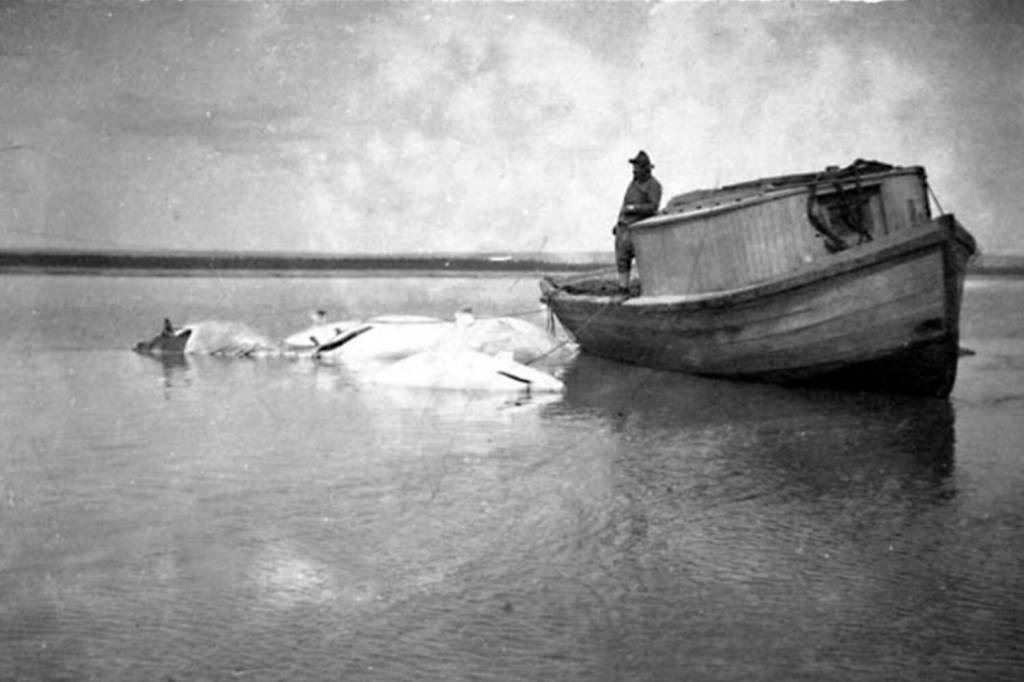

AUTHOR’S NOTE: Two men with the moniker “Beluga Joe” plied the waters of Cook Inlet in the 1900s. Both Joseph Magill and Joseph Schneller became associated with the Beluga River on the inlet’s west side, and both were noted for commercial fishing. Most of the similarities end there.
When his trial for burglary, larceny and arson began in mid-December 1933, Joseph Schneller objected to the burglary charge, and the judge sustained the demurrer. The case of the United States versus Joe Schneller continued afterward with jury selection, which occupied only the morning of Day One.
Schneller stood accused of stealing commercial-fishing gear from the Sandvik cannery at the mouth of Swanson Creek (now known as the Swanson River) north of Kenai and of then burning down the nearby log cabin of area homesteader Martin Johnson. Both offenses had occurred in the springtime of this same year, and he had been arrested in Kenai on Aug. 10.
The arson trial, which preceded the trial for larceny, began Dec. 13 and wrapped up with the judge’s instructions to the jury just after 2 p.m. on Dec. 15. According to the Anchorage Daily Times, jury deliberation required “about two hours,” after which time the jury delivered a verdict of guilty.
His second trial followed a few days later, and before the month was out, Schneller was found guilty of larceny. Judge Cecil H. Clegg announced a sentencing date of Jan. 5, 1934. On that date, Judge Clegg sentenced Schneller to serve eight years and one day at McNeil Island federal penitentiary in Washington.
After his sentence was imposed, Schneller’s only comment was that he had been convicted of crimes for which he was not guilty. Under law-enforcement escort, he was sent to Washington the next day.
Under the terms of his sentencing, he would be released from prison on Jan. 5, 1942. If he exhibited good behavior, he could become eligible for release as early as Nov. 17, 1939.
When he entered the prison system, he was 39 years old. His intake paperwork stated that he was a white male with dark hair, a dark complexion and grey eyes. He stood 5-foot-10 and weighed 188 pounds.
He was listed as an unmarried Anchorage resident who had no children. He claimed to be temperate, meaning that he drank alcohol only in moderation, and nonreligious. His occupation was trapping, and his inmate number was 10740.
On Nov. 17, 1939, Joe Schneller’s good behavior got him out early. The paperwork concerning his release was marked “XTRA C.G.T.,” referring to the “good time” conduct he had exhibited during his incarceration.
It is currently unknown how quickly Schneller made his way back to Alaska; however, by at least 1942, he was living in the Beluga River area, across Cook Inlet roughly west of Anchorage.
It is also unknown when he came to be known as — or began to refer to himself as — “Beluga Joe.”
Aiming for Beluga
Joseph Andrew Magill, on the other hand, probably gained the nickname “Beluga Joe” in the late 1910s. For a short time before that, he had been known as “Diamond Joe.”
In the years immediately after his 1910 marriage to Helen Isabella Evans, Magill worked as a labor agent, then as the Alaska representative of the Swift (Meat) Packing Company of Chicago, and, simultaneously, as a diamond broker.
A Juneau newspaper called the Daily Alaska Dispatch reported in December 1914 that Magill, as a representative of “the largest eastern diamond-importing concerns,” regularly carried on his person more than $10,000 worth of diamonds. And he did so without fear, said the paper, because he also carried a derringer, which he claimed could fire six shots in just six seconds.
It also appears that Joe and Helen Magill first began making Alaska their home in June 1914 when they moved into a Juneau apartment. Then, while Helen settled in, Joe almost immediately took passage westward to ply his sales trade for the Swift company.
By June of the following year, he had resigned from Swift, and it was probably around this same time that he also left diamond sales behind, choosing to focus on commercial salmon fishing and, soon, the activity that prompted his nickname, commercial whaling.
In September 1915, the Dispatch reported on Magill’s plans for harvesting beluga whales in northern Cook Inlet. That summer, Magill and some associates had established the beginnings of a beluga fishery. In the spring, they had purchased the gear Magill believed he would need to bring his plans to fruition, and then, in his gas boat called the Magna, he had departed Juneau for Cook Inlet.
That fall, he told the Juneau newspaper, “Since I left Juneau [in the spring], I have established two fishing stations, built three buildings and made a start on the fishing end of my project…. I expect next season [1916] will be a big one for me.”
According to Nancy Lord in her book Beluga Days, Magill, in 1916, incorporated his beluga fishery efforts as the Beluga Whaling Company. By 1917, he had a dozen employees, and in 1918, she wrote, his company processed 41 of the white whales at its main plant on the Beluga River. The hides alone from those whales had an estimated value of $1,250.
The main market for beluga leather was in Europe, primarily in Scotland, Holland and England.
In 1921, the Pacific Fisherman, a fishing-industry journal, analyzed the market potential for beluga hides and the many other valuable parts of the marine mammal. Adult belugas, said the journal, averaged 12 to 14 feet in length, weighed about a ton and produced 70-100 square feet of hide, “from which is made one of the strongest leathers known.” In Europe the hides were processed into razor strops, belt lacing, sporting goods for hunters, waterproof leather items, and so forth.
Magill claimed that the blubber from a large adult beluga could produce about 75 gallons of oil. The belugas also produced two other, higher grades of oil — from the jaw and the head, “the latter being practically unfreezable,” according to Pacific Fisherman. The jaw oil, rendered by the heat of the sun, was used by jewelers in the lubrication of clock and watch mechanisms.
The dried meat of the belugas was typically sold for sled dog food. The ground bones could be used as chicken feed. The ivory teeth were sold to jewelers, and Magill began to explore the notion that undried beluga meat could one day be marketed as a premium product for human consumption.
Despite all this marketability potential, the news that most captured the public’s attention was Magill’s method of harvesting the belugas. Previously, anyone seeking the white whales would do so on the inlet’s open water, but not Magill. He quickly became known as the first land-based whaler.
TO BE CONTINUED….