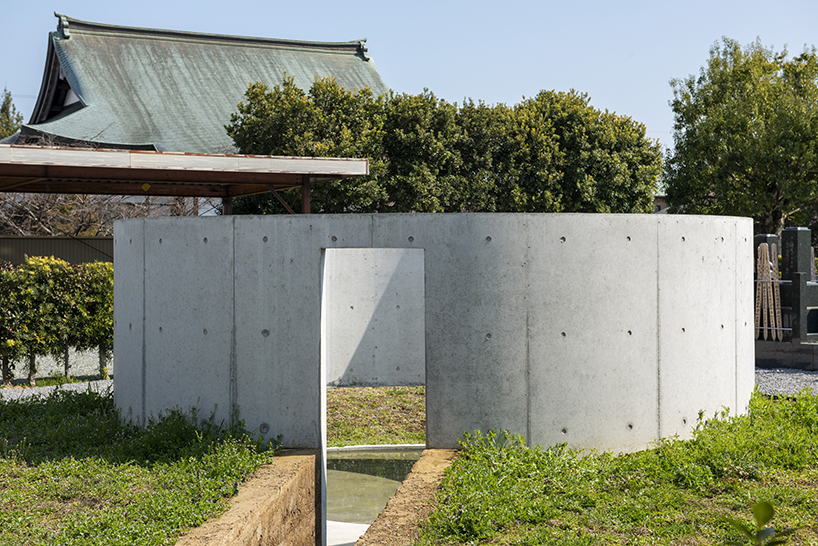
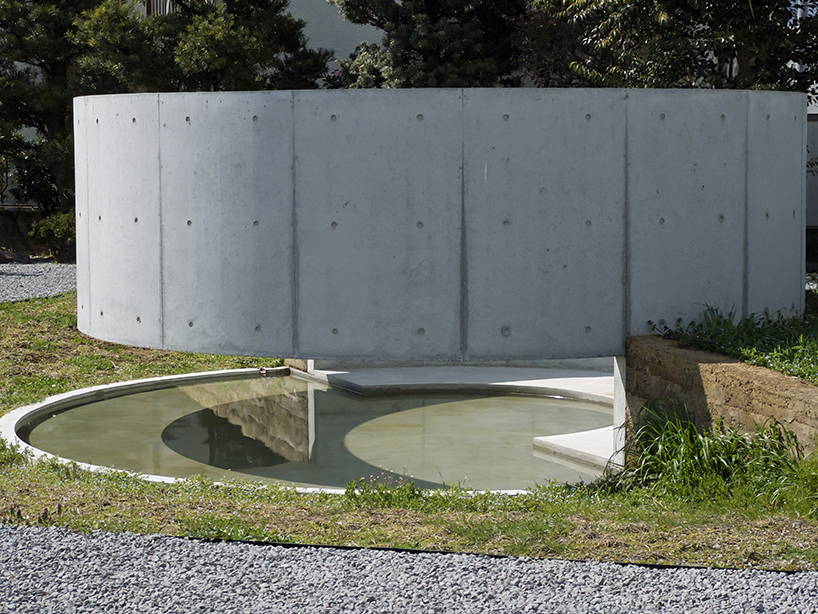
floating concrete cylinder suspends over water basin for buddhist memorial in japan
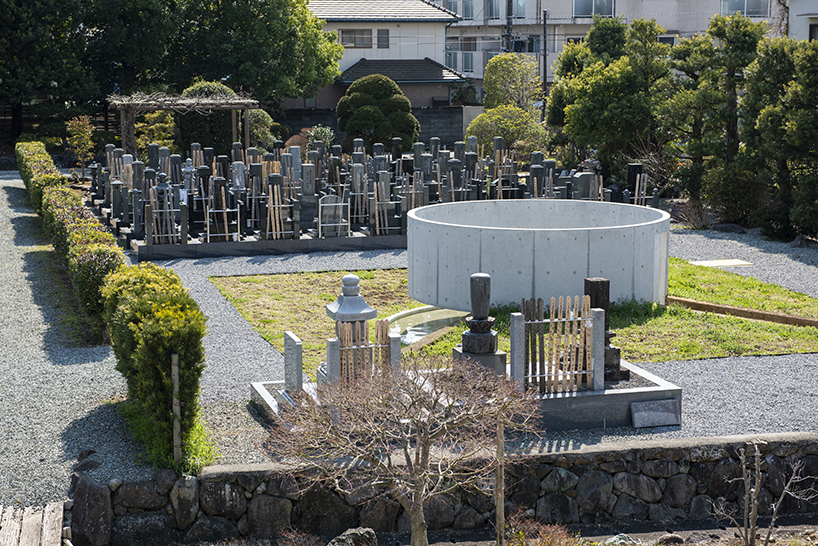
Located within the grounds of Fukuden-ji, a Shingon Buddhist temple founded in 1136 in Odawara, Japan, The Perpetual Care Grave (Eitai Kuyo Bo) is a memorial structure designed by Japanese architecture practice ASSISTANT. Positioned at geographic coordinates 35°29’09.9″N 139°14’43.7″E, the monument gives physical form to the Buddhist boundary between Shigan (the realm of the living) and Higan (the realm of the departed), serviing as an architectural threshold for contemplation rather than a conventional grave marker.
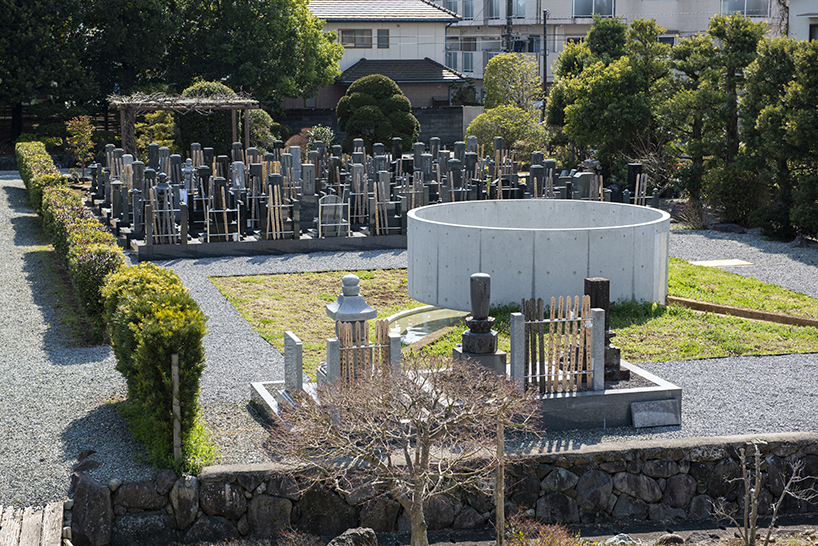
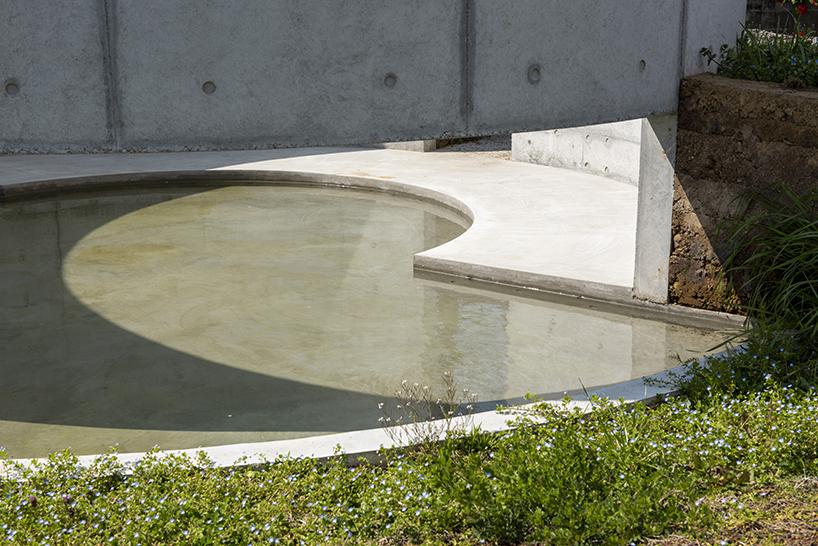
The spatial composition by architectural studio ASSISTANT relies on elementary geometric forms. A square plot bisected diagonally by a triangle and anchored at its center by a cylindrical concrete volume references the Five Elements (Gorinto) of Esoteric Buddhism. Suspended over a shallow reflecting basin fed by Odawara’s groundwater, the cast-concrete drum appears to hover between the water plane and the sky. Visitors enter along a narrow approach framed by layered rammed-earth walls (Hanchiku), passing through a compact aperture into an open-top interior chamber that frames a circular oculus of sky. Pairing industrial concrete with compacted earth highlights material weathering over time, translating the concept of returning to the earth into built form.