Kill the Senate’s “Bipartisan American Affordability” Bill

My own objections arise from the historic preservation part of the bill, which is significantly more slapdash than the environmental policy part, because it was kind of an afterthought added at the insistence of Senator Mike Lee, who is a Republican of Utah and (until January 3) chairman of the Senate Energy and Natural Resources Committee. Lee’s interest arises from his long-standing efforts to reduce environmental protections for Utah’s Grand Staircase-Escalante National Monument. The monument is protected to some extent by the National Historic Preservation Act because it contains some significant historic and archaeological sites. Heinrich, who’s ranking on Energy and Natural Resources, waged a parallel fight to build SunZia Wind and Transmission, a massive green-energy project, in the face of historic preservation–based opposition from tribal communities who sought, for similar reasons, to get New Mexico’s San Pedro Valley listed as a historic site.
When I raised preservationists’ complaints about BAAJA with Heinrich (Whitehouse’s office didn’t reply to my query), he told me (again, via email): “I have listened to Tribes’ concerns and worked to codify in statute the federal government’s obligation to consult with Tribes under Section 106.… Still, I recognize there is more work to do, and I am committed to continuing to worsk with Tribal leaders and my colleagues to strengthen consultation beyond this bill.” Heinrich is right to suggest that such discussions can’t be conducted on the fly while the bill is days away from Senate passage. But Native Americans are hardly the only preservation-minded groups opposed to BAAJA. The National Trust for Historic Preservation said last week in a prepared statement that it “remains strongly opposed to” BAAJA, which “retains provisions that give federal officials broad discretion to subordinate historic preservation to other considerations.” If, as Heinrich says, “there is more work to do,” why not do it before BAAJA is allowed to become law, rather than at some unspecified future date?
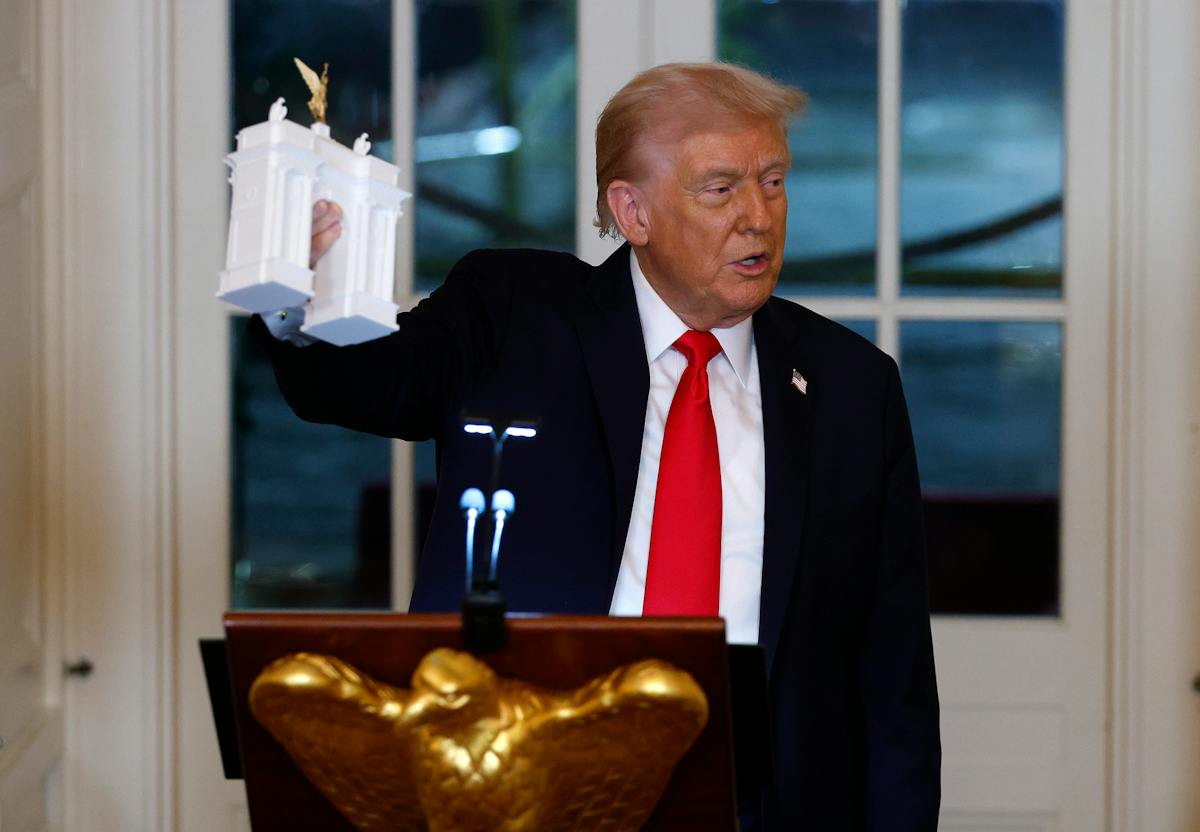
How would BAAJA affect Trump’s D.C. makeover? Consider what’s been nicknamed the Arc de Trump. Current legal challenges cite a National Park Service finding that sight lines for at least 39 historic sites would be adversely affected by the arch. The new bill, however, excludes from consideration “any visual, atmospheric, or audible element” unless “it would have a direct impact on a historic property that would significantly diminish the eligible characteristics of the historic property.” In a webinar, the deputy general counsel for the National Trust for Historic Preservation, Elizabeth Merritt, said that this language “would exclude from consideration most adverse visual effects.” The precise extent is hard to pinpoint because the bill never defines what “significantly diminish” even means. That will have to be hashed out in new litigation—never mind that one of the bill’s purposes is to reduce litigation.