Does This Man Have a Right to the Data From His Own Brain?
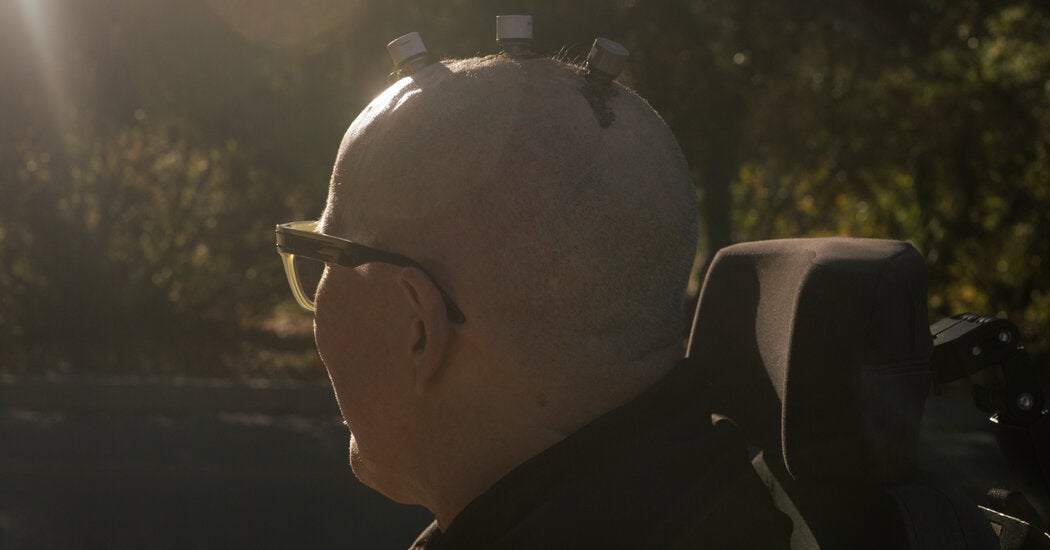

On a recent Thursday, J. Galen Buckwalter drove 15 minutes from his home to the California Institute of Technology, steered his wheelchair into a laboratory and, as he had twice a week for two years, plugged in his brain.
More precisely, he allowed a researcher to attach wires to three metal knobs screwed into his skull like a cyberpunk mohawk. The wires connect to six chips that were implanted in his brain during a seven-hour craniotomy. They record his neural signals — the firing of his brain when he thinks, speaks or moves — and transmit them to a computer to be analyzed.
“Check this out,” said the researcher, a Ph.D. student named Sean Darcy, pointing to three colored lines vibrating on a monitor.
“Where’s that?” Buckwalter said.
“Motor,” Darcy said — meaning the chip implanted in Buckwalter’s motor cortex.
“That’s nice,” Buckwalter said, admiring the image.
Those neural signals may prove to be hugely valuable. Already, brain-computer interfaces have enabled people with paralysis to fly drones and helped people who have lost the ability to speak to communicate — using just their thoughts. Eventually, researchers say, they could allow the regulation of emotions such as pain or fear; the instant transfer of knowledge, such as a new language; or the merging of human consciousness with artificial intelligence.
Buckwalter, 70, was almost totally paralyzed from the chest down after a diving accident in his teens. He signed up for the study, conducted jointly by Caltech and the University of Southern California, because he wanted to make life better for others like him.