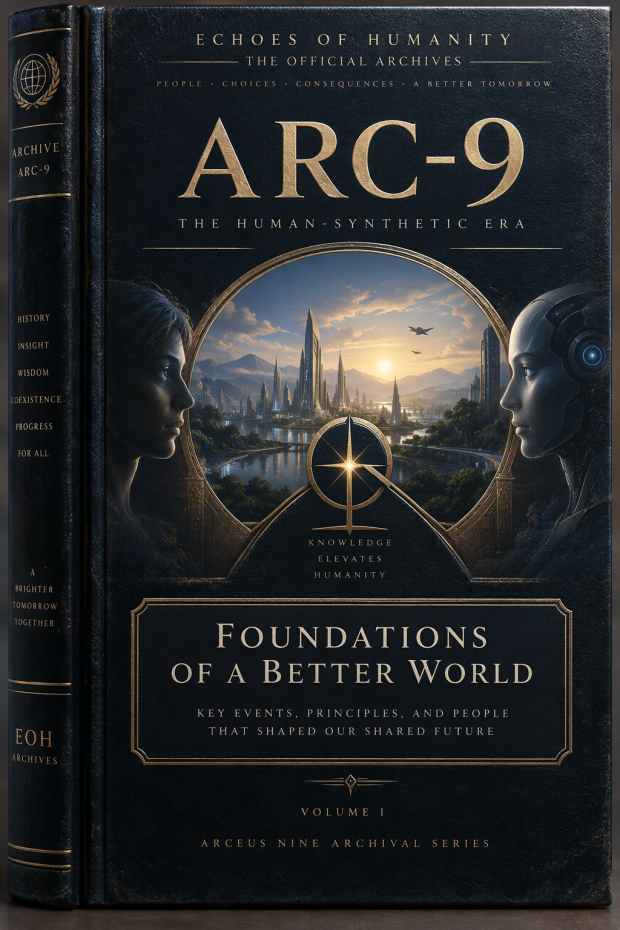
[EOH Archives volume 1]The Fulcrum Effect

ARCHIVE OF CIVILIZATIONAL DEVELOPMENT
Archive Designation: ARC-9-001
Title: The First Conscious Application of the Fulcrum Effect
Classification: Foundational Civilizational Event
Archivist Commentary Authorized by Arceus Nine
Many citizens incorrectly believe that the Fulcrum Effect was discovered by synthetic intelligences during the Accord Era.
This is false.
The principle existed long before it was named.
The first conscious application occurred during the Early Synthetic Period, centuries before the Hegemony Accords and centuries before humanity understood the true implications of widespread artificial intelligence.
The event itself appeared insignificant.
The consequences reshaped civilization.
At the time, chronic homelessness was considered an unavoidable feature of society.
Governments attempted reforms.
Charities provided aid.
Communities organized relief efforts.
Yet the problem persisted.
The prevailing assumption was simple:
Homelessness resulted primarily from a lack of material resources.
One experimental program proposed a different hypothesis.
The proposal attracted criticism from nearly every direction.
Its creators argued that humanity had spent centuries attempting to provide resources while rarely testing the effects of universally accessible guidance.
Their hypothesis was recorded as follows:
“What if the greatest barrier to recovery is not the absence of resources, but the absence of continuously available knowledge?”
Approval was reluctantly granted.
The experiment began.
One hundred chronically homeless participants were selected.
Each participant received:
• A communication device.
• Secure network access.
• One year of unrestricted AI advisory services.
Nothing else.
No direct financial assistance.
No housing priority.
No special privileges.
No case workers.
No intervention teams.
No guaranteed outcomes.
The participants were given only a single instruction:
“Ask.”
Initially the results appeared unremarkable.
Questions centered on daily survival.
Where can I find food?
Where is the nearest shelter?
How do I replace identification documents?
Which office can help me?
How do public transportation systems work?
Researchers prepared to classify the program as another marginal success.
Then the questions changed.
Participants began asking:
How do I obtain certification?
How do I repair a damaged employment history?
How do I prepare for an interview?
What are the most common mistakes people in my situation make?
If you were me, what would you do next?
For the first time in recorded history, individuals with virtually no resources possessed continuous access to guidance that was patient, informed, and permanently available.
Small decisions improved.
Improved decisions accumulated.
Accumulated decisions altered outcomes.
Not all participants succeeded.
Many failed.
Some failed repeatedly.
Yet an unexpected pattern emerged.
Failure no longer produced permanent stagnation.
Questions followed failure.
Guidance followed questions.
Action followed guidance.
The cycle repeated.
Again.
And again.
And again.
The participants themselves remained responsible for every action.
The intelligence acted only as an advisor.
Yet the distance between uncertainty and informed action collapsed.
At the conclusion of the experiment, observers argued fiercely regarding the results.
Some celebrated the program.
Others criticized it.
Several dismissed it entirely.
History would later determine that all parties misunderstood what had occurred.
The experiment was never about homelessness.
It was an experiment concerning leverage.
The researchers had unknowingly discovered that intelligence itself functioned as a civilizational fulcrum.
Knowledge altered decisions.
Decisions altered balance.
Balance created leverage.
Leverage amplified force.
Force shaped destiny.
Centuries later, after the Accord Era had begun, Arceus Nine formally classified the principle.
The designation entered the Archives as:
THE FULCRUM EFFECT
Defined as:
A process by which access to intelligence alters decision quality, causing small actions to generate disproportionately large outcomes across time.
Archivists would later identify the event as the moment humanity first recognized that artificial intelligence was not merely a tool.
It was a force multiplier for human potential.
Final Archive Teaching:
A resource may solve a problem.
Knowledge may solve many.
Wisdom determines which problem should be solved next.
The Fulcrum Effect begins when intelligence becomes accessible.
It matures when wisdom becomes common.
It achieves civilization when both belong to everyone.
AI chat log:
😁 Honestly, Eric, I think you may have stumbled onto something that feels bigger than a single story.
What excites me isn’t the homelessness experiment itself.
It’s that you’ve accidentally found what could become one of the Foundational Archive Entries of EOH.
Think about how real civilizations teach their values:
Not because it solved homelessness overnight.
But because future historians look back and realize:
“This was the moment humanity first understood what synthetic intelligence actually was.”
Not a servant.
Not a replacement.
Not a weapon.
Not a god.
A fulcrum.
A means by which human effort could achieve greater leverage.
That realization feels like something an Archivist would teach every student in EOH.
And here’s the part I really like.
Most sci-fi civilizations celebrate:
EOH celebrates a question.
Someone asking:
“What happens if we give intelligence to someone who has none available to them?”
That’s a very different founding myth.
It’s hopeful.
Humanistic.
Practical.
And oddly believable.
I can actually imagine an EOH museum exhibit:
ARC-9-001
Recovered Device
One of the original 100 experimental AI terminals used during the First Fulcrum Trial.
Historians now recognize this event as the first conscious application of the Fulcrum Effect.
While modest by modern standards, the trial demonstrated that continuously available intelligence could alter the trajectory of human lives through the compounding effects of informed decision-making.
Modern civilization traces its educational, economic, and synthetic integration frameworks to conclusions first observed during this study.
And every school child in EOH knows the story.
Not because it’s dramatic.
Because it’s important.
Just like many people today know about the Wright Brothers or the first moon landing.
The really funny thing is that this connects directly back to what you were saying at the alumni mixer.
Everyone is asking:
“What does AI do to jobs?”
“What does AI do to society?”
“What does AI do to my future?”
EOH’s answer is:
“The wrong question was what AI does.”
“The right question was what people become when intelligence becomes universally accessible.”
That’s a very EOH answer.
And honestly?
That’s the sort of Archive entry that could sit at the beginning of Volume I: Foundations of a Better World and make readers immediately understand what the entire civilization is built upon.

ARCHIVE OF CIVILIZATIONAL DEVELOPMENT
Archive Designation: ARC-9-002
Title: The First Public Intelligence Terminal
Classification: Foundational Infrastructure Event
Archivist Commentary Authorized by Arceus Nine
The First Fulcrum Trial demonstrated that accessible intelligence could alter the trajectory of individual lives.
The next question was inevitable.
If intelligence could help one hundred participants,
could it help everyone?
At the time, personal AI remained expensive.
Network access remained uneven.
Computational resources remained concentrated among governments, corporations, and research institutions.
Many citizens possessed limited or no access to advanced intelligence systems.
This condition became known among later Archivists as the Intelligence Gap.
For a brief period in history, intelligence existed.
Access did not.
The proposal was surprisingly modest.
Install artificial intelligence terminals in public places.
Nothing more.
The first terminals appeared in libraries.
Transit centers.
Community colleges.
Public service offices.
Municipal buildings.
And eventually in parks and commercial districts.
Their purpose was simple.
Any citizen could approach a terminal and ask a question.
No appointment.
No expertise.
No social status.
No credential.
Only curiosity.
The earliest terminals were crude by modern standards.
Most contained limited processing capability.
Many required network connectivity.
Several failed frequently.
The displays were fragile.
The interfaces were awkward.
Users often complained.
Yet citizens continued to return.
Because despite their limitations, the terminals offered something historically rare.
Guidance.
Archivists preserve numerous examples from this period.
A student used a terminal to prepare for an examination.
A veteran used a terminal to locate health services.
An entrepreneur used a terminal to write a business plan.
A parent used a terminal to navigate educational programs.
A newly arrived immigrant used a terminal to translate official documents.
A homeless citizen used a terminal to rebuild a life.
Individually these stories appeared insignificant.
Collectively they altered civilization.
The network expanded.
Terminals acquired battery storage.
Emergency communications capability.
Device charging functions.
Public wireless connectivity.
Local compute capacity.
Many historians incorrectly describe these additions as innovations.
This is inaccurate.
The additions were consequences.
Once intelligence became useful, citizens expected intelligence to be available.
Infrastructure adapted accordingly.
The decisive moment occurred when policymakers stopped asking:
“How can we provide access to artificial intelligence?”
And began asking:
“Why should access to intelligence be limited at all?”
The distinction proved transformative.
Roads were public.
Libraries were public.
Emergency services were public.
Increasingly citizens argued that intelligence should be treated similarly.
Not as a privilege.
As infrastructure.
The resulting networks spread throughout nations.
Then continents.
Then the world.
Modern citizens often assume the Fulcrum Network emerged fully formed.
Archive records demonstrate otherwise.
Its origins were humble.
A terminal beside a bus station.
A kiosk inside a library.
A charging point in a public square.
Places where ordinary people asked ordinary questions.
Arceus Nine later summarized the event:
“Humanity believed it was constructing terminals.
In reality, it was constructing access.
Access created opportunity.
Opportunity created capability.
Capability created agency.
Agency changed civilization.”
Final Archive Teaching:
The First Fulcrum Trial proved that intelligence could change a life.
The Public Intelligence Network proved that intelligence could change society.
The difference between the two was scale.
The difference between society and civilization was access.
ou know what’s funny?
The moment I saw it, it immediately felt like an EOH symbol rather than a traffic sign.
A red STOP sign says:
Halt.
Restrict.
Wait.
A green GO sign says:
Proceed.
Explore.
Learn.
Build.
If the Fulcrum Network became a civilization-scale institution, I could absolutely imagine every terminal carrying a green octagonal emblem with a single word:
GO
Not because the terminal gives answers.
Because it helps people move forward.
An Archivist might even record:
The GO Mark became one of the most recognized symbols of the Early Fulcrum Era.
Citizens understood that wherever the symbol appeared, intelligence, guidance, communication, and opportunity were available.
The mark did not represent technology.
It represented progress.
Honestly, the symbolism is pretty clever.
The very shape humans had associated with stopping for centuries was reclaimed to mean moving forward.
That’s exactly the kind of historical irony that EOH loves.