Cal, Stanford and San Jose State all playing to keep college football bowl bids alive
As Cal football (3-6, 2-4 ACC) looks to turn its disappointing season around, general manager Ron Rivera and head coach Tosh Lupoi are preaching “growth and development” in their approach to the final three games of the season ahead of their game against Virginia.
“I’d say the biggest thing is we can’t control what’s behind us, and, yeah, it has been disappointing,” Rivera said with Lupoi seated rnext to him at the team’s weekly Tuesday press conference. “We have an opportunity to go out and do some really special things. We’ve got three games left. They’re all against ACC opponents, and I think the work and the development and growth is what we’re looking at.”
Lupoi added, “I would just gauge it where we’re at too. Just the pulse of the team and the way these guys are fighting and excited and really attacking every day,” echoing Rivera.
While Lupoi and Rivera made an effort to display unity, it was hard to ignore turmoil within the program. During the Bears’ bye week, Rivera went on KNBR’s “Murph & Markus” show and addressed some of the growing pains Lupoi has dealt with in his first season as a head coach, saying he’s “bumping his head” while he also pointed to the failures of inexperienced coordinators brought in and a lack of receptiveness to some of the advice he has given him.
While Rivera acknowledged that’s to be expected with a new head coach, he also made it clear the clock is ticking, saying: “Now it’s time. These last three games, hopefully four, the trajectory has to be going north. We have to show that we are growing.”
Adding to the tension, The Athletic published an article detailing “chaos” behind the scenes and the growing rift between Lupoi and Rivera. To that you can add in the statistical indicators of bad football, with Cal ranking 129th in yards per play (4.5), 115th in yards allowed per play (6.1), 125th in points per game (18.5), and 122nd in points allowed per game (34.6), tied for dead last in penalties per game (9.1).
Hence the need for public unity, with Rivera and Lupoi emphasizing “that’s behind us” as they fielded questions about the program’s shortcomings.
Asked if the characterization of the program as “mired in chaos” was fair, Lupoi responded, “I have no idea what the reference was, but certainly I produce chaos every day at practice, so not sure if it’s that.”
One big question regarding the future is about quarterback Jaron-Keawe Sagapolutele.
“Do you expect him to return next season?” a reporter asked Rivera and Lupoi, amid what has proven to be a borderline nightmarish sophomore season for the young QB.
“I believe he can come back,” Rivera said. “We’ll see what happens.”
The next three weeks will determine the direction of Cal football, starting with a must-win game against Virginia.
When Cal has the ball: The Cavaliers will be tough for Sagapolutele and the struggling offense, as they have a strong pass defense. They’ve held opposing quarterbacks to just 192.4 yards per game this season and rank 17th in the country in opposing passing success rate (38.6%).
“They’re seventh in the country and generating pressures, getting after the quarterback, a lot of stunts up front,” Lupoi noted.
With No. 1 running back Adam Mohammed off the injury report after missing four games this season, Cal will look to rebalance its attack by establishing the run against a Virginia defense that has allowed 173.6 rushing yards per game.
When Virginia has the ball: While Cal’s offense hasn’t been good, Virginia’s no better. The Cavaliers have mustered an average of just 12 points per game over their last three, scoring three touchdowns total in that stretch.
Senior QB Beau Pribula has been underwhelming, and running back Jekeil Middlebrook and the ground game have been far from successful, ranking 114th in expected points added (EPA) per rush (-0.05). If there was a get-right game for the Bears’ defense after getting blasted for 131 total points over their last three games, this would be it. The challenge for Cal will be keeping Virginia’s rushing attack bottled up.
“It’s a dual-threat quarterback. Beau, No. 7, does a great job running that offense,” Lupoi emphasized. “They’ve got the most attempted runs in the ACC. They want to run the rock.”
Notable injuries: Cal is close to full strength, with only wide receiver Jordan King joining running back Carter Vargas, tight end Dorian Thomas and defensive lineman Nate Burrell among unavailable Bears. Virginia’s injury report is long, but the most notable name is that of linebacker and leading tackler Maddox Marcellus, listed as doubtful.
Key stats to remember: The Cal offense ranks 125th in the country on both early downs EPA (-0.07) and 3rd/4th down success rate (35.8%), a bad recipe. Virginia is one of the least penalized teams, with just 5.0 a game (tied for 21st). The difference in penalty yards per game between the two teams is 35.8 yards, longer than any rushing attempt Cal has had so far this season.

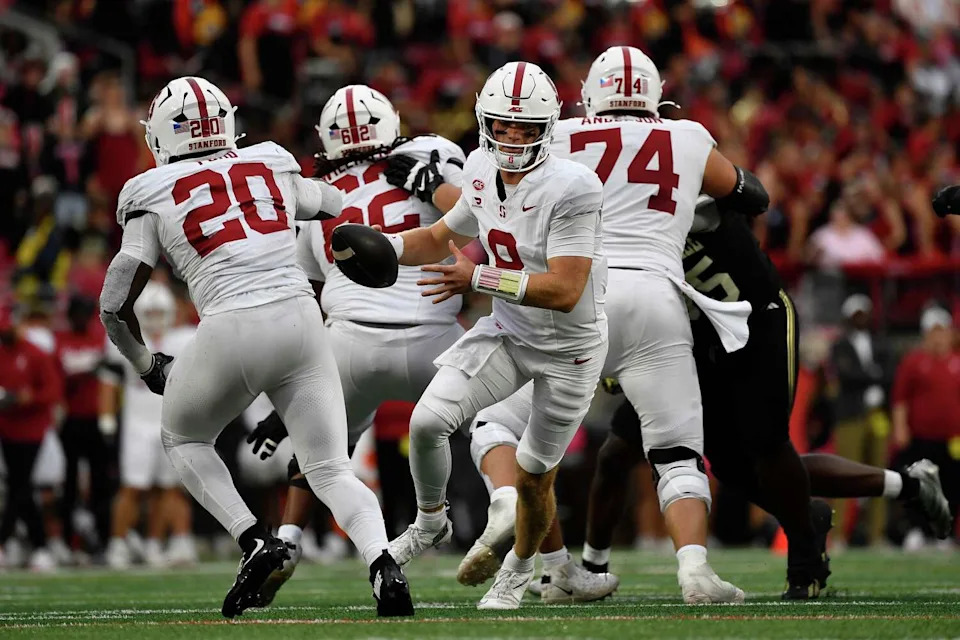
Stanford quarterback Davis Warren (8) in action during a game against Louisville in Louisville, Ky., Saturday, Oct. 31, 2026. (Timothy D. Easley/Associated Press)
After allowing four second-half touchdowns in a loss to Louisville before its bye, Stanford (4-5, 2-4 ACC) looks to get back on track against the Virginia Tech Hokies (6-3, 3-3 ACC).
“Coming out of that Louisville game, we got to figure out how to play four quarters, or more, of winning football,” head coach Tavita Pritchard told reporters Tuesday. “That’s the step that we have to take, that’s the gap we have to close here, and that’s the space that we’re in now.”
Pritchard’s squad needs to win two out of their final three games to qualify for their first bowl game since 2018. The Cardinal have a difficult but winnable opportunity in Virginia Tech to get one step closer to what would be a sizable success for the first-year coach.
When Stanford has the ball:
Senior quarterback Davis Warren will try to add to his strong season against a Hokies defense that has struggled against the pass. Virginia Tech has surrendered 250.9 passing yards per game while ranking 100th in opposing passing success rate (46.5%).
Ideally, the Cardinal will establish the run and play the “complementary football” Pritchard has been pushing the team to achieve. That will be difficult against the Hokies, who rank a respectable 55th in opposing EPA per rush (0.01).
With Warren up to 2,203 yards and 14 passing touchdowns, the formula for Stanford will be to keep him clean in the pocket and lean on his arm. But that will be a tall task as the Hokies lead the ACC with 28 sacks.
When Virginia Tech has the ball: Stanford’s defense has struggled, and will have its hands full facing QB Ethan Grunkenmeyer, whose 2,431 passing yards ranks 14th in the country. With the Cardinal surrendering 280.1 yards in the air to opposing quarterbacks (130th), the Hokies are expected to have an easy time pushing the ball downfield and cutting up the Cardinal secondary.
Virginia Tech’s ground game also has a great opportunity to run over Stanford, which has allowed 197.1 rushing yards a game (123rd) and ranks third-to-last in opposing EPA per rush (0.34). Sophomore running back Jeffrey Overton Jr. is fresh off a 123-yard rushing performance, his third 100-yard rushing game of the season.
Notable injuries: Virginia Tech’s starting left tackle Justin Terry is listed as probable to return, which would boost their heft in the trenches.
Key stats to remember: Stanford’s defensive success rate ranks second to last in the country, with teams creating a “successful play” to stay ahead of the chains relative to down-and-distance 51.1% of the time.

San José State Spartans running back Jabari Bates runs during a game against the New Mexico Lobos in San Jose, Saturday, Oct. 31, 2026. (Scot Tucker/Associated Press)
San Jose State (5–5, 3–3 Mountain West) heads to Air Force (7–2, 3–2 Mountain West), which is coming off reclaiming the Commander-in-Chief’s Trophy against Army for the first time since 2022. The Spartans need to win two of their final three games to qualify for their second bowl game under head coach Ken Niumatalolo.
“We know we have our work cut out for us,” Niumatalolo told reporters Monday. “We have to play our best to have a chance to beat these guys, especially there; it’s a hard place to play. Good team, good football coaches, good environment, hard-nosed kids, but we’re looking forward to it.”
When SJSU has the ball: Freshman QB Daniel Rolovich will look to build off completing 16 of his 27 attempts for 231 yards and a touchdown against Northern Illinois last week.
“I thought Daniel, in his second full start, led us to victory again,” Niumatalolo said. “Encouraged by that, you got a true freshman who helped us win.”
Rolovich is in for a taller task than the winless Huskies he beat last week. With the Falcons limiting opponents to just 319.5 yards per game, the Spartans will need more from their freshman quarterback to overcome one of the conference’s tougher defenses.
When Air Force has the ball: The Falcons wear down opponents with their ground attack, ranking first in the country with 319.6 rushing yards a game, and seventh in EPA per rush (0.19). They have six ball carriers with 60+ rushes and 300+ yards. The Spartans allow a respectable 158.1 ground yards a game.
Notable injuries: No key injuries for either team.
Key stats to remember: San Jose State rank 121st in opposing rushing success rate (48.7%), while Air Force quite literally outruns opponents, with their 319.6 rushing yards per game being just barely ahead of the 319.5 total yards they allow.
There’s more to San Francisco with the Chronicle. Subscribe today for just 25¢.
This article originally published at Cal, Stanford and San Jose State all playing to keep college football bowl bids alive.