Examining the biggest issues behind Ohio State football's consecutive losses
Ohio State is in unfamiliar territory following consecutive losses.
The two-game skid leaves the Buckeyes in their first regular season with three losses since 2011.
The injury to Julian Sayin in October marked a turning point, but the Buckeyes’ issues in recent weeks have extended beyond the loss of their starting quarterback.
Both sides of the ball, as well as special teams, have been fragile as Ohio State teeters on the edge of the College Football Playoff race.
Here’s what’s gone wrong during the Buckeyes’ rare slide:
Ohio State’s defense has gone from a strength to a vulnerability in a matter of weeks.
The Buckeyes have surrendered 35.5 points per game during their skid after allowing just 13.4 points over the first seven games. Both Oregon and USC burned Ohio State for big plays, accounting for nine of 24 gains of 20 or more yards given up by the Buckeyes.

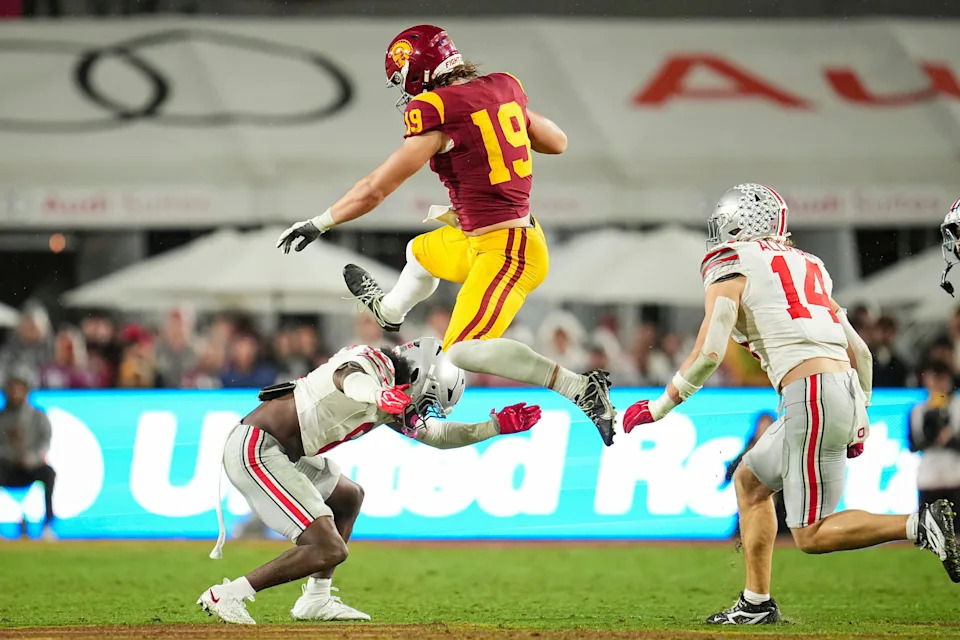
USC Trojans tight end Mark Bowman (19) leaps over Ohio State Buckeyes safety Jaylen McClain (8) during the NCAA football game at Los Angeles Memorial Coliseum on Oct. 31, 2026. Ohio State lost 30-18.
The chunk plays not only flipped the field, but also ended in the end zone. Oregon running back Dierre Hill Jr. ran for a 48-yard touchdown, while USC wide receiver Trent Mosley made a 69-yard touchdown the previous week.
It wasn’t until Ohio State’s trip to USC that the defense had allowed a play longer than 40 yards this year.
“The explosives are something that we’ve got to eliminate,” defensive coordinator Matt Patricia said. “Those plays that we haven’t really given up change everything, the rhythm of the game, the outlook and maybe some of the calls that come after that.”
Some of the breakdowns have emerged with Patricia seeking to make his side of the ball more aggressive. The Buckeyes have increased their blitz rate from 31% in the first two games to 48% over the past seven, according to Pro Football Focus. The uptick coincided with their loss at Texas in September.
But they have rarely been rewarded for taking more chances, leaving their back end more exposed. USC beat the Buckeyes’ five-man blitz when quarterback Jayden Maiava found Mosley on a screen that turned into his 69-yard touchdown on the second play from scrimmage.
Oregon picked up the blitz as well when quarterback Dylan Raiola threw two touchdown passes, including a screen to Brandon Smith that went for 15 yards.
Neither Maiava nor Raiola was sacked by Ohio State. They were under pressure on just 25% of their dropbacks, per PFF.
While the Buckeyes’ pass rush made a difference late in their win at Indiana on Oct. 17, it’s had a limited impact by and large. They have managed just 11 sacks in nine games, a total that ranked 120th in the Football Bowl Subdivision through Week 10.
Patricia said quarterbacks have had quick triggers, but they needed to identify more opportunities to affect them.
“We’ve got to just keep finding ways to get to the quarterback in those pass situations,” Patricia said, “and really take a look at all of it.”

Ohio State Buckeyes defensive coordinator Matt Patricia leads warm ups prior to the NCAA football game against the Oregon Ducks in Columbus on Nov. 7, 2026.
Blitzes are not the only instances in which the Buckeyes have found themselves outnumbered downfield.
When Hill broke loose for his 48-yard touchdown run last week, it came against a front that overloaded the left side of Oregon’s offensive line
The Ducks countered by pulling left tackle Fox Crader and left guard Tommy Tofi to the right side, opening a lane for Hill, who capitalized on their numbers advantage with a clear path to the second level.
Patricia pointed to a need for simplified communication and calls in order to avoid any misalignments.
“The fundamental philosophy of making sure that the alignments are quick and easy is something that we have to do a good job of,” Patricia said.
The Buckeyes have not been productive enough in the ground game to overcome the absence of Sayin.
Their average of 4 yards per carry ranks 95th in the FBS and is on pace to be the lowest in coach Ryan Day’s eight seasons.
The struggles are a result of a variety of factors, beginning at the line of scrimmage.
Despite a bevy of experience on the offensive line, which included four of five starters returning from last season, the Buckeyes have averaged just 3 line yards per rush, ranking 73rd in a weighted metric that estimates how many rushing yards are attributable to the offensive line, according to CollegeFootballData.com.

Ohio State Buckeyes running back Bo Jackson (25) runs the ball against Oregon Ducks defensive back Koi Perich (3) in the first half of the NCAA football game at Ohio Stadium on Nov. 7, 2026 in Columbus, Ohio.
Injuries and illness have kept the Buckeyes from maintaining continuity up front. Ohio State has used five different starting offensive line combinations through nine games and has not started the same group in consecutive weeks since opening their Big Ten schedule against Illinois and Iowa.
Most of the instability has been at right guard and right tackle as Austin Siereveld and Phillip Daniels have each missed multiple games.
“It makes it difficult,” center Carson Hinzman said.
But the frequent shuffling has not been the lone source of trouble. Hinzman pointed to missed assignments as also stalling the running game at various points.
“We’ve had so many plays that are blocked so well, but it’s always one off,” Hinzman said. “And then 25 one-offs kill you. It comes down to focus.”
Ohio State’s backfield has also missed Ja’Kobi Jackson, a seventh-year senior transfer from Florida who has been sidelined for three straight games after he reportedly underwent foot surgery.
Jackson had been the Buckeyes’ most efficient running back. He averaged 0.24 EPA per rush attempt over six games, ranking second among Big Ten running backs, according to Game on Paper.

Ohio State Buckeyes offensive lineman Carson Hinzman (75) motions across from Oregon Ducks defensive lineman A’mauri Washington (52) during the NCAA football game in Columbus on Nov. 7, 2026.
The Buckeyes have often fallen behind the chains on series.
“If you’re on schedule on first own, it gives you an opportunity to be more balanced and creating a third down that’s manageable,” Day said.
Even when the Buckeyes are efficient and remain ahead of schedule while moving the ball on the ground, they have rarely been explosive.
Ohio State has only six runs of at least 20 yards, a total that ranks 120th in the FBS. Only Michigan and Michigan State have gained fewer among Big Ten teams.
Bo Jackson leads the Buckeyes with three runs of 20 or more yards, but none of Ohio State’s other running back has produced more than one.
When Lincoln Kienholz transferred to Louisville in January, it left the Buckeyes in need of a backup quarterback.
The most likely option seemed Tavien St. Clair, a former five-star recruit from Bellefontaine who was third string as a freshman in 2025.
Day’s program has long stocked the quarterback room with blue-chip talent waiting in the wings.
Kyle McCord and C.J. Stroud were top-50 recruits who spent time as the No. 2 quarterback before becoming starters. Sayin was the No. 3 quarterback in 2024 before beating out Kienholz for the starting job last year.

LOS ANGELES, CALIFORNIA – OCTOBER 31: Julian Sayin #10 of the Ohio State Buckeyes watches as Tavien St. Clair #9 of the Ohio State Buckeyes warms up before the game against the USC Trojans at Los Angeles Memorial Coliseum on October 31, 2026 in Los Angeles, California. (Photo by Luke Hales/Getty Images)
But St. Clair didn’t slide up. He was surpassed on the depth chart by Luke Fahey in preseason training camp.
It ultimately thrust Fahey, who lacked a similar recruiting pedigree as a three-star freshman, into a bigger role sooner than expected.
“It’s something we have to make sure that we’re prepared for,” Day said, “because this is not about Luke Fahey, because Luke Fahey’s trying his tail off, but, like any position, when someone goes down, we have to be able to keep the standard and expectation the same thing.”
Sayin set a high bar for any replacement, especially pushing the ball downfield.
In his second season as the Buckeyes’ starting quarterback, he averaged 10.5 yards per pass attempt, the second-most in the FBS among qualifying passers. He also completed 54.5% of passes traveling at least 20 yards through the air, per Pro Football Focus.
Fahey has averaged 7 yards per pass attempt with a completion percentage of 31.3% on deep passes in his two starts against Oregon and USC.
The drop-off reflects the reality of turning things over from a Heisman Trophy finalist to a freshman in the middle of the year.
While special teams struggles have persisted for years, they have been pronounced amid a more difficult schedule this fall.
Consider each of the Buckeyes’ three losses.
Kicker Connor Hawkins missed a 45-yard field goal attempt at Texas in September that would have put Ohio State ahead by two scores with just over four minutes left.
At USC, the Buckeyes allowed Trent Mosley to return a punt 44 yards in the first quarter after their coverage overran him downfield.
Mosley not only flipped the field, but a late hit by defensive end Beau Atkinson allowed the Trojans to begin their series at Ohio State’s 31-yard line, putting them in position to take a 14-3 lead.

Oregon Ducks wide receiver Jalen Lott (10) leaps over Ohio State Buckeyes wide receiver Phillip Bell (7) on a fake punt during the NCAA football game at Ohio Stadium in Columbus on Nov. 7, 2026.
Then there was Oregon’s fake punt that picked up 30 yards late in the second quarter and swung momentum as the Ducks followed with 35 of their 38 unanswered points.
The problems culminated in the firing of special teams coordinator Robby Discher on Nov. 9. It was the first time Day let go of an assistant during the season.
The issues in the third phase might pale in comparison to others on offense or defense, but they have made it more difficult for Ohio State to prevail in close games.
Joey Kaufman covers Ohio State football for The Columbus Dispatch. Email him at jkaufman@dispatch.com and follow him on @joeyrkaufman on X.
This article originally appeared on The Columbus Dispatch: Examining the biggest issues behind Ohio State football’s consecutive losses