Voters Rejected Trump. Republicans Responded By Lurching To The Right.

A week after voters handed President Donald Trump and Republicans the worst electoral defeat in 50 years — a rejection of the president and his party’s leadership that shifted nearly every demographic group and state in the country dramatically to the left— the GOP has settled on their response: Moving even further to the right.
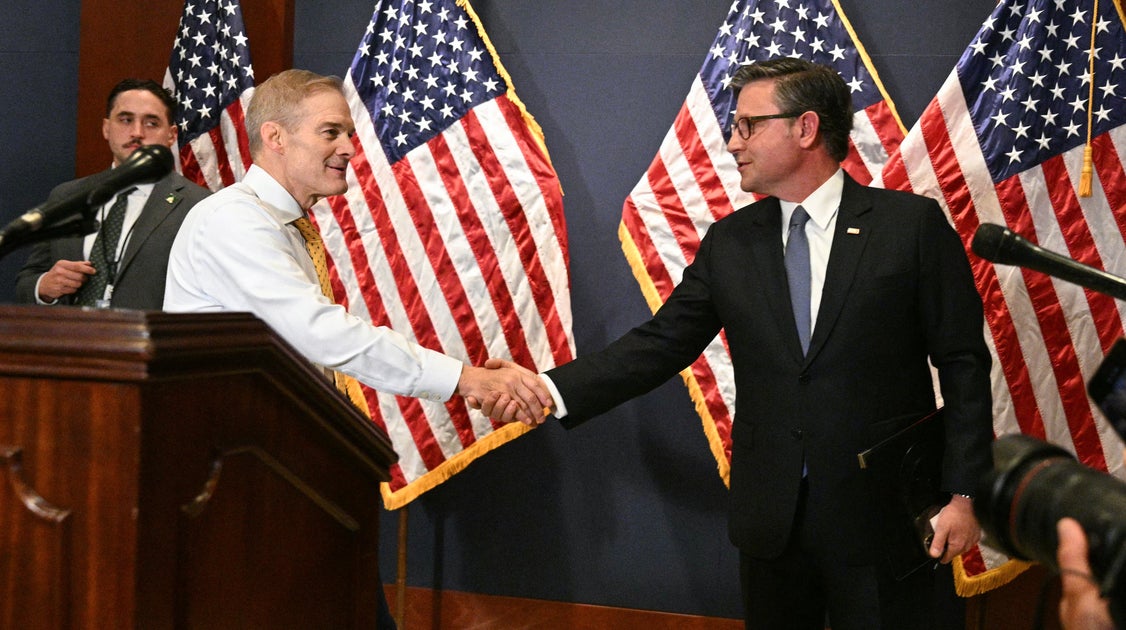
Trump selected Stephen Miller, arguably the furthest right figure in his entire administration, as his new chief of staff. House Republicans doubled down by selecting Rep. Jim Jordan (R-Ohio), a man rejected as too conservative to lead the party just three years ago, to assume the post of House Minority Leader come January.
The party’s elected leaders are open about their intent to fight Democrats every step of the way over the next two years, and are seemingly convinced 2026’s election results are a mere blip in a path to Trump’s “golden age.”
Advertisement
“To our colleagues on the left, enjoy this honeymoon phase,” declared Rep. Tom Emmer (R-Wis.), who was reelected Tuesday as House Republican whip. “Because come Jan. 3, 2027, you will regret ever putting your name on a ballot.”
Emmer’s sharp words came as Republicans selected Jordan as leader, bucking the still very conservative but comparatively moderate Rep. Steve Scalise (R-La.) and installing one of the GOP’s staunchest Trump defenders in party leadership at a time when the president is staggeringly unpopular.
Jordan has been an attack dog for Trump’s political grievances: During his time as chairman of the House Judiciary Committee, Jordan led the failed Republican effort to impeach former President Joe Biden. The Ohio Republican also sought to delegitimize investigations into Trump’s efforts to overturn the 2020 election, recommending the Justice Department charge former special counsel Jack Smith for allegedly lying to Congress last year (Smith has not been charged). He’s long claimed scrutiny of the president was politically motivated.
Advertisement
But House Republicans insisted Tuesday that making Jordan minority leader wouldn’t hurt their chances of retaking Congress, despite his close ties to a president whose shadow hung over last week’s midterm rout.
“I think Jim’s a realist,” said Rep. Tim Burchett (R-Tenn.) following the leadership vote, telling HuffPost in an interview that the new top Republican “knows where we’ve got to be and he knows what people are saying.”
Rep. Eric Burlison (R-Mo.) pointed out that Jordan had been in Congress long before Trump — the congressman has been in office since 2007.
Advertisement
“He was very principled and had that reputation, and he’ll continue in that,” he argued.
And Burlison hailed Jordan as “an amazing communicator” who would be well-positioned to help Republicans take back the House. “We’re at a place where people need a vision for where the country is going to go, and I think that he has the ability to put that principled vision together and communicate it well.”
Burchett said he was “very confident” in Jordan’s ability to lead the GOP to victory in 2028. But he added that he hoped his party had “learned our lesson” from the midterm elections. “We’ve got to do what we said we’re going to do when we get elected.”
Asked by HuffPost ahead of Tuesday’s GOP leadership elections whether the party needed to shift right after the midterms, Rep. Kat Cammack (R-Fla.) argued the Republican loss last week was less about politics and more about “results.”
Advertisement
“[P]eople can agree, whether they’re Republican or Democrat, that we have a broken healthcare system,” she said. “They can all agree, whether you’re a Republican, an Independent or a Democrat, that gas was too high. So what they were looking for was results, not necessarily if you were an R or a D — and I think that that was reflected in Tuesday’s election.”
Cammack didn’t clarify exactly what results she thought voters were seeking, or who was expected to deliver them.
Jordan isn’t the only Trump ally shifting Republicans toward the right after the midterms. The Senate on Tuesday elected Sen. Bernie Moreno (R-Ohio) to lead the National Republican Senatorial Committee, where he’ll lead efforts to claw back Democratic gains in the upper chamber.
Advertisement
But the most dramatic signal of GOP intent remains Trump’s appointment last week of Miller to serve as chief of staff.
Miller, who spearheaded the president’s deadly immigration enforcement surge and has referred to Democrats as “domestic extremists,” will now be the administration’s primary liaison with a Democratic Congress bent on investigating Trump and his allies. He’ll also set the policy agenda for a president who has already wielded expansive executive power and has promised to veto any legislation passed by Democrats. Whatever Trump has said publicly about reaching across the aisle post-midterms, Miller’s appointment puts a new swath of powers in the hands of one of the most fervent right-wing ideologues of his administration.
Though it’s unclear how Republicans’ rightward push will land with Americans who rejected the party just last week over its handling of the economy and the Iran war, the right wing has praised the GOP for elevating its more conservative voices.
Advertisement
“This represents a change from the old guard to the new guard,” said right-wing media figure Benny Johnson on Tuesday. “Extremely promising sign. Get ready.”