Sidera Imperii: the rules behind a blockade in a real-time space 4X
An enemy shipyard in Sidera Imperii can be shut down without one shot fired at the shipyard. A war fleet parked in orbit does it, once the colony has no war fleet of its own stationed there and no planetary defence, shield generator included, still working.
This article lays out the supply rules of the real-time space 4X strategy game, with their numbers, as they stand in the current pre-alpha build: what a jump costs in fuel, who dispatches the freighters, what pirates hunt, and what a blockade stops and what it leaves running.

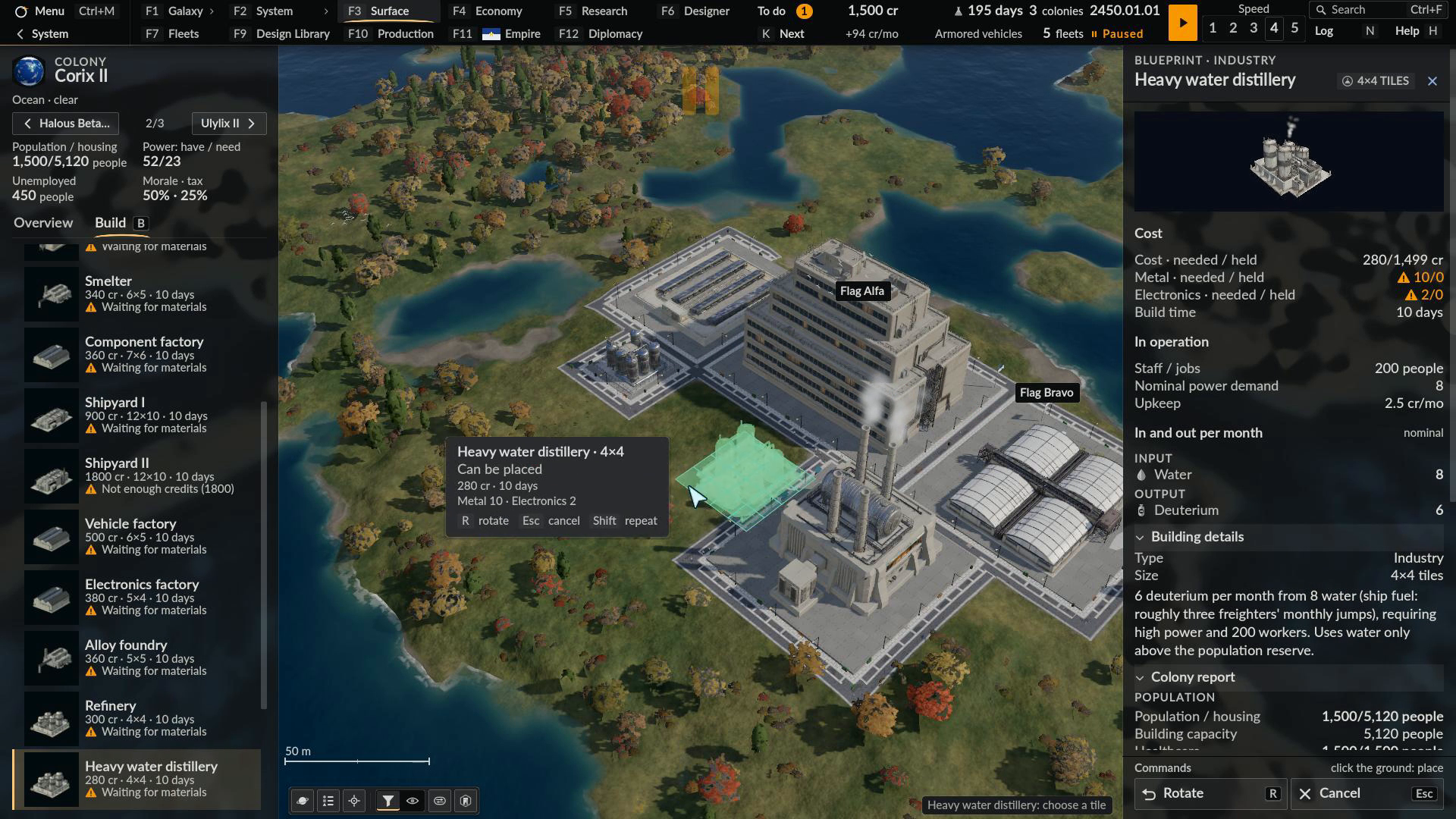
A heavy water distillery blueprint about to be placed on Corix II: 8 water in, 6 deuterium out per month. Most of the build list on the left reads “Waiting for materials”.
Each jump between star systems burns deuterium: one unit for a freighter or a frigate, two for a cruiser, four for a carrier. A new campaign begins with full tanks and a reserve of 120 in the capital, and with no building anywhere that makes more. Deuterium deposits exist only on gas giants and ice giants, and those can’t be settled.
So one of the earliest decisions is a fuel plant. The distillery in the screenshot employs 200 workers and turns 8 water into 6 deuterium a month, which the game’s own tooltip sizes as roughly three freighters’ monthly jumps. It only draws water above the reserve the population needs. The alternatives are a refinery, which wants hydrocarbons, and a gas collection station, which wants a gas giant or an ice giant in the same star system.
Nobody does. Once a day the game goes through the colonies’ shortages in order of urgency and assigns freighters to them. A campaign starts with three. The Economy screen holds a target for how many there should be, and a lost freighter is replaced automatically at one of your shipyards, as long as there is money, material and an available production line.
The same screen says why a colony is short, with a reason on every supply line, from “no freighter” to “blockade”. A plant that has filled its stock target goes idle and restarts by itself once the stock is needed again.

A convoy escort group of four ships on the galaxy map, the star system underneath, and the view from inside a jump.
Pirates don’t steal cargo. They destroy the ship, and the cargo is gone with it. Their prey is an unescorted civilian ship, freighter or colony ship, within five jumps of their lair, caught under way or sitting in a system where none of your warships is present. No raid sets out before the fiftieth day of a campaign.
There are two answers. Fleets standing in the same system can form a convoy: they move at the pace of the slowest member, arrive together and share one fuel supply, and the war fleet in it escorts the civilian ships. The lasting answer is the lair. Destroy its guard and the lair is finished: raiders already out scatter, and no new raid starts.
The rule has three parts: a foreign war fleet stationed over the colony, no war fleet of the owner stationed there, and no planetary defence still working, the shield generator included. From then on nothing is loaded or unloaded at that colony, nothing is exported, and the shipyard’s production lines stand still.
What keeps running is the surface. Mines and factories go on producing, and the colony lives on what it has in store. That is why a blockade bites unevenly. A world that feeds itself loses its exports and its shipyard. A world that eats imported food starts to starve when the stock is gone: it holds its numbers for thirty days, then loses five percent of its population every month.
A colony under blockade also stops being a fuel stop, so fuel is where the pressure spreads. By design a fleet never comes to a dead stop. With empty tanks it still jumps, marked “Dry jump in progress”: preparing a jump takes five times as long, travel speed drops to 20%, and in battle its fire rate, shield recharge and repairs run at 75%.
Two things stretch a fleet’s reach beyond its colonies: a tanker parked in a system that has no colony, which refuels the fleets stopping there, and a starbase in orbit, which stores deuterium for them and fights at their side.
Before a blockade there is usually a battle, and aimed fire is the tool for it. It has a cost: only direct-fire weapons can aim at a module, and they do it at 80% of their accuracy. In return, an aimed hit that gets through the shields damages a module 75% of the time, an unaimed one 22%. A ship with no working engine has no thrust.

An aiming reticle on one module of an enemy ship. On the right, the same idea in a ground battle, pointed at a tank’s running gear.
The radio is the other tool. An outmatched enemy can be told to withdraw or to surrender. It is never a certainty: the menu shows the chance before the call is made, and that chance tops out at 50%. Pirates can be talked into withdrawing from odds of two to one, and into surrender from three to one with 35% of their hull strength gone. Rival empires are harder: three to one for withdrawal, five to one and half their hull strength for surrender, at lower chances. Ships that do surrender join your fleet after the battle.

A larger fleet battle seen from far out, in the tactical view.
The landing comes last. While a single orbital defence still works, the game refuses the landing order. After that the landing site is the player’s pick, and a ground battle settles who owns the colony.

The order of events: the fight in orbit, the landing ships over the colony, the ground battle.

The ground invasion of Cenioor III under way, with a friendly tracked tank selected.
In the current pre-alpha build a campaign galaxy has between 24 and 240 star systems and, depending on its size, up to six rival empires, with difficulty running from Easy to Brutal or a custom setting. Both species, Human and Vyr, are playable.
Genre: space 4X, sci-fi grand strategy, real-time with pause. Platform: Windows PC. Players: single-player. Languages: English and Hungarian. Status: pre-alpha, coming to Steam; release date to be announced. Every image here was recorded in the game.

From the galaxy map down to one sun, a ringed giant in front of it, and city lights on a colonised planet.
Watch the Sidera Imperii trailer
Following the game here on IndieDB puts its next articles and pre-alpha footage in your updates. Questions about any of these rules are welcome in the comments.
Elsewhere: sideraimperii.com · Discord for development news, questions and ideas · Bluesky
The galaxy is not inherited. It is conquered.