this horse-shaped headset asks designers to see the world through animal eyes

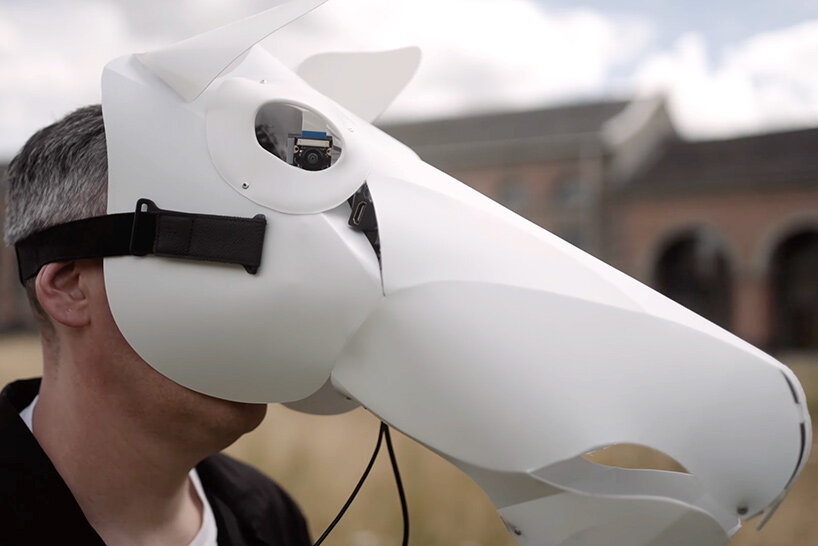
Ulster University researcher and designer Alan Hook develops Equine Eyes, a giant horse-shaped headset that allows people to experience an approximation of how horses see the world. The wearable forms part of his wider research into interspecies design, which explores how objects and environments might be designed with other animals in mind. What happens when the animals that share our spaces are considered users too?
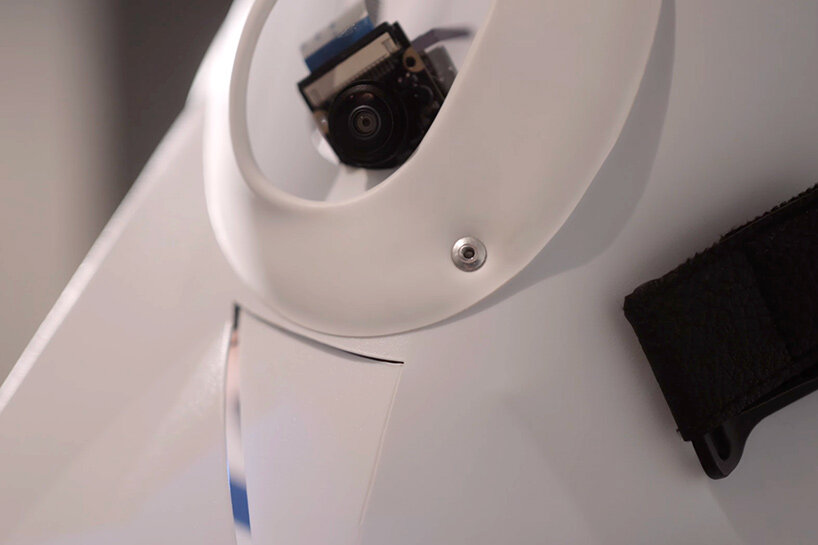
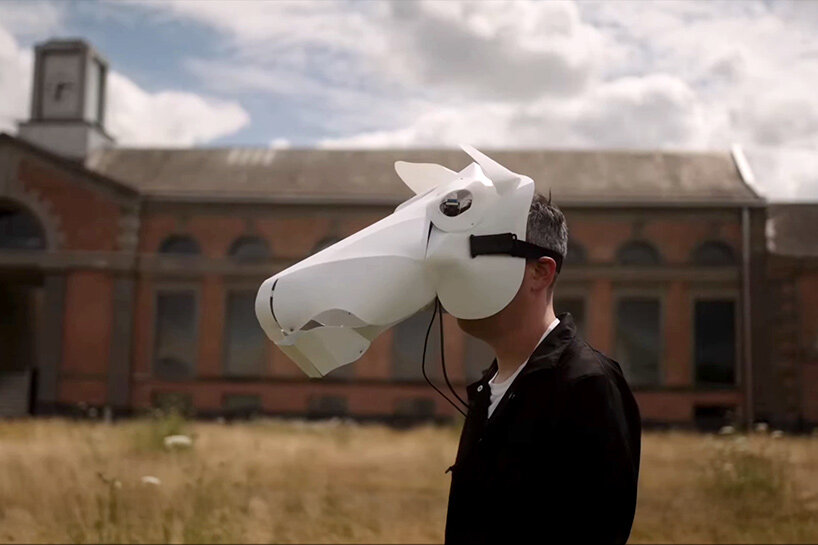
With its elongated white muzzle and upright ears, the headset has a peculiar, almost cartoonish appearance. Small cameras sit on either side of the head, where a horse’s eyes would be, while a virtual reality display translates their live footage for the human wearer. The experience is deliberately playful, inviting participants to temporarily step outside their familiar way of seeing.
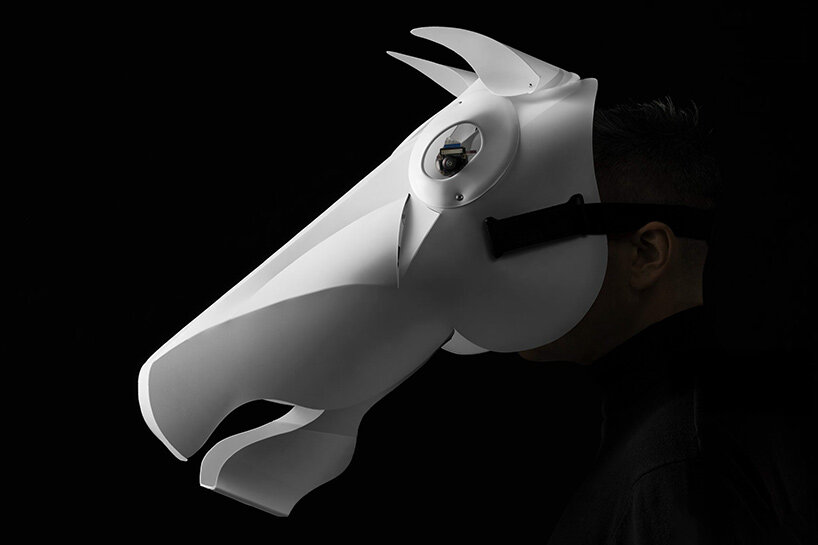
Horses have eyes positioned on either side of their heads, giving them a much wider field of vision than humans. To approximate this difference, Hook developed a system using two 180-degree cameras that together create a simulated view of approximately 350 degrees. The images overlap slightly at the front, while the sides of the wearer’s body become visible within their peripheral vision. The footage is also processed to reflect the horse’s dichromatic color perception, shifting the visual range toward blues and yellows.
During testing, one participant compared the disorienting experience to ‘taking your eyes out and sticking them on the sides of your head.‘ Familiar surroundings appear through a different visual arrangement, prompting wearers to reconsider how horses navigate space and respond to activity around them. Of course, the headset can only approximate certain aspects of equine perception. A horse experiences its surroundings through an entirely different body, extending well beyond what its eyes can see.
Alan Hook began developing Equine Eyes in 2017, initially using low-resolution webcams connected to an Oculus Rift headset. These early prototypes produced heavily pixelated images, making participants conscious of the technology itself.
The researcher began experimenting with a simple cardboard cutout of a horse’s head, placed between the cameras, and found that this addition changed how people responded to the experience. Participants reported feeling more transformed when the equipment resembled the animal they were trying to understand.
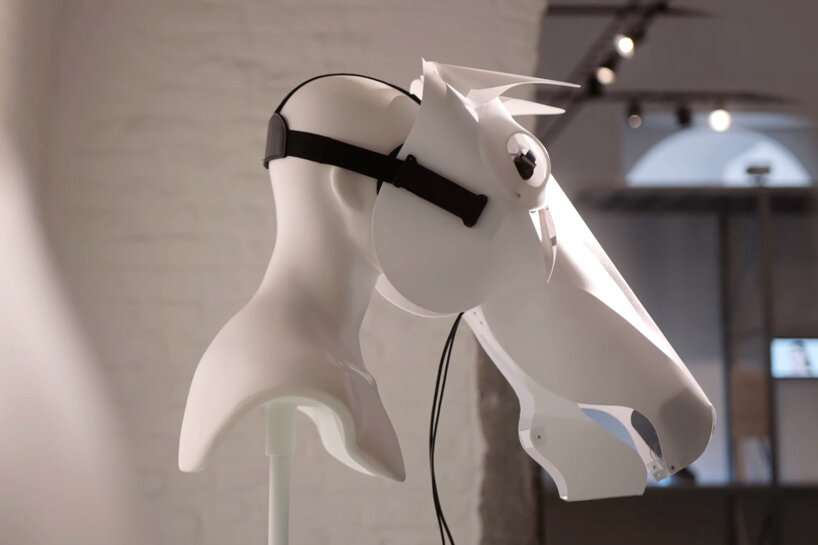
The project gradually evolved into the sculptural white mask seen today, with a lightweight shell that extends well beyond the wearer’s face. During earlier testing, Hook also experimented with removing the horse-shaped enclosure to make the equipment easier to transport. Participants felt that something was missing. The physical act of putting on the animal’s head had become an important part of the interaction, encouraging people to engage with the simulation through their own bodies.
The same questions inform Hook’s Interspecies Design Toolkit, a speculative proposal developed through his research at Imagination Lancaster and Ulster University. Drawing from Microsoft’s Inclusive Design Toolkit, the project examines how design processes could account for nonhuman animals. Microsoft’s original framework encourages designers to recognize exclusion among people with different abilities. Hook adapts this thinking to consider the diverse sensory experiences of other species.
The downloadable toolkit includes guidelines and activity cards intended for design workshops. Participants are encouraged to observe how animals interact with their surroundings, identify barriers created by human-centered design, and imagine alternatives based on those observations. One exercise suggests allowing an animal to initiate play, following its behavior instead of directing the interaction.
Another principle encourages designers to begin with an individual animal before considering how their findings might apply more widely. The approach offers a way to think about everything from domestic objects to architecture, where even a seemingly ordinary opening or interface can determine which bodies are accommodated.
Equine Eyes has since moved into exhibition spaces, allowing visitors to engage directly with the research. In 2024, the headset appeared in the Superpower Design exhibition at the Centre for Innovation and Design at Grand-Hornu, Belgium, where Hook led workshops and invited participants to test the device.
More recently, in July 2026, the National Museum of Racing and Hall of Fame in Saratoga Springs, New York, introduced two Equine Eyes headsets for public use and educational programming. Here, the experiment finds a particularly relevant audience among people who regularly work with horses.
The headset remains an exercise in speculation, with Hook acknowledging the limits of simulating another animal’s subjective experience. Its purpose is to encourage people to consider how differently another species might encounter the same environment. Equine Eyes makes this question physical, while the Interspecies Design Toolkit brings it into the design process itself.