North Dakotans To Vote On Giving Schoolkids Universal Free Meals

North Dakotans will vote next week on a ballot measure that would guarantee free meals for schoolchildren regardless of income, potentially showing the policy’s cross-party appeal and its ability to break through in a deep-red state.
Ballot Measure 2 would require public schools to provide one breakfast and one lunch to all students every day, with the state covering any costs to school districts not reimbursed by the federal government. The program would include public charter schools, while private and tribal schools could opt in.
Advertisement
Such policies have been passed in recent years in mostly blue states like California, Colorado, Massachusetts and Minnesota. Progress has been slower in red states where lawmakers might balk at having taxpayers foot the bill for universal school meals, even though research shows they boost student participation, improve health and behavior, and give parents a financial break.
But backers of the measure in North Dakota, where Republicans hold a statehouse supermajority, are bullish on its chances for passage by referendum. Its favorability has been polled at up to 82%, suggesting substantial support among conservatives in a state Donald Trump won by a 36% margin in 2024.
Robin Nelson, the chair of Together for School Meals, the group spearheading the initiative, said backing is “sky-high among families with little kids, teachers and farmers.” Nelson has managed Republican campaigns in the past and describes herself as “right of center.” She believes the concept of universal free meals is consistent with conservative values, equating it to a tax break.
Advertisement
“The price of everything is going up. This is one way we could really help our working families,” Nelson, a longtime Fargo school board member and CEO of the area Boys & Girls Club, told HuffPost. “What better way to market [North Dakota] to young families and companies to attract a workforce: We provide meals, we prioritize children. Come raise your family here.”
Proponents campaigned to put the measure on the ballot because state lawmakers failed to approve similar legislation in two previous sessions. In January, the bill passed the state House 55-38 but went down in the Senate, 24-22.
“The price of everything is going up. This is one way we could really help our working families.”
– Robin Nelson, chair of Together for School Meals
Advertisement
The state has pegged the program’s cost at between $124 million and $134 million every two years. The biggest beneficiaries stand to be working- and middle-class families, since the poorest households already qualify for free meals. The income cap is currently around $74,000 for a family of four, or 225% of the federal poverty limit, meaning many residents of modest means are not eligible.
North Dakota passed an anti-“lunch shaming” law in 2023 that bars school districts from withholding meals because of an unpaid balance. For some politicians, that law has become an argument against the ballot measure — that kids already aren’t turned away from a meal.
But as the North Dakota Monitor has reported, some families are still being referred to debt collectors, and at least one district is withholding transcripts from students who don’t pay up.
Advertisement
Nelson said some families stopped paying for meals after the 2023 law passed, and school districts now carry meal debt that could affect their ability to give teachers raises. Under the ballot measure, the money for school meals would come out of the state’s Legacy Fund, which is derived from oil and gas revenue, unless lawmakers specify another source.
Pat Finken, who was involved in Republican politics in North Dakota for decades before retiring, has come out in support of the plan.
“The Legacy Fund was created to provide a lasting harvest from our oil and natural gas bounty, and the earnings are to be used to fund big ideas,” Finken wrote in an op-ed in the Grand Forks Herald. “There are few ideas that are bigger and more important than helping our students succeed.”
Advertisement
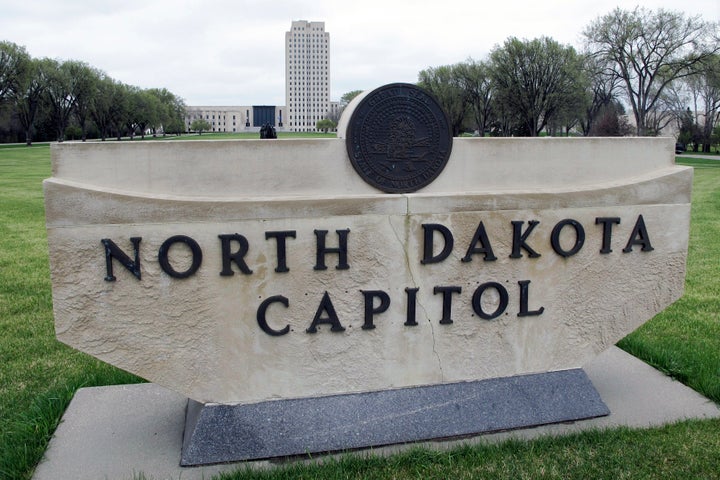
via Associated Press
If the measure fails, it might be because of how it’s structured — as an amendment to the state constitution rather than a new statute.
Backers of the proposal argue that a constitutional amendment would strengthen the measure, guarantee its funding every year, and prevent the state legislature from undermining it.
Advertisement
But some lawmakers have viewed it as an intrusion on their budgetary turf, and Republican Gov. Kelly Armstrong has opposed it.
“No matter what happens in the future of North Dakota’s budget, you could have $7 soybeans, you could have $12 oil, and this money comes off before anything else is spent,” Armstrong told the Monitor in July. “I don’t like constitutional mandated spending at all. Because by its nature, you are saying this is the single most important thing that exists.”
Measure 2 is part of a broader fight over ballot measures going on in North Dakota right now.
Next week, voters will also decide on Measure 1, which would require at least 60% voter support for changes to the state constitution, up from the current 50%. That measure would make it harder to pass ballot initiatives like Measure 2 in the future. The GOP-led legislature put Measure 1 on the ballot.
Advertisement
A lead backer of Measure 1 said it’s meant to prevent outside groups from using North Dakota’s ballot measure process to enact a “left-wing agenda.” The Fairness Project, a progressive group that pushes ballot initiatives around the country, has supported Measure 2 and pumped about $1.7 million into trying to defeat Measure 1.
“Proponents campaigned to put the measure on the ballot because state lawmakers failed to approve similar legislation in two previous sessions.”
Amy Jacobson, executive director of Prairie Action ND, a progressive advocacy group, said it’s unfair to paint the universal free school meals effort as an out-of-towners’ agenda.
Advertisement
She noted that the North Dakota coalition spent three years trying to get legislation over the line in Bismarck, only to be stymied by lawmakers. She said they have relied on allies like the Fairness Project to help fund their campaign, especially when it came to gathering 49,000 signatures for the ballot.
“It is a completely grassroots-developed and -led effort,” said Jacobson, who is a board member of Together for School Meals. “The ballot initiative process is expensive, so of course we are seeking contributions from any value-aligned organizations we can find to build our campaign.”
As for the school lunch proposal being a constitutional amendment, Jacobson noted that the state constitution enshrines the guarantee of public education under Article 8, which Measure 2 would amend.
Advertisement
“We believe feeding kids is just like providing a desk and a teacher,” she said. “The meals belong there.”