El-Sayed Is Aiming To Unify Michigan. There’s One Unknown That Could Cost Him.

WARREN, Mich. — Democrats are a little less worried about Abdul El-Sayed these days, even if they still can’t stop arguing about him.
The progressive Senate candidate, who won an $81 million battle against moderate Rep. Haley Stevens to claim the party’s nomination for U.S. Senate in August, spent months fighting concerns about his electability and whether he could unite a splintered Democratic Party.
Advertisement
But as he campaigned with the more moderate Sen. Elissa Slotkin and held town halls in a majority-Black city and a quintessential swing county over the weekend, the uber-confident El-Sayed’s certainty of victory seemed to have spread to the rest of his party. Still, loud holdouts remain, and concerns persist about GOP candidate Mike Rogers’ spending advantages in the state, with a media-buying source saying Republicans are expected to outspend Democrats by more than $20 million in the final weeks of the contest.
Asked if he was concerned about party unity, El-Sayed responded: “Of course.” But in an interview, he made clear his goal was broader.
“My goal is to unite the state around this campaign,” he told HuffPost. “We all understand, even if we had our differences in the primary, that what we’re up against is a lot worse than anything that divided us.”
Advertisement
And while El-Sayed’s progressive policies — including his support for “Medicare for All” and opposition to aid to Israel — defined much of his primary campaign, his efforts against Rogers have largely been in step with other Democratic campaigns, relentlessly focused on corruption, affordability and the link between the two.
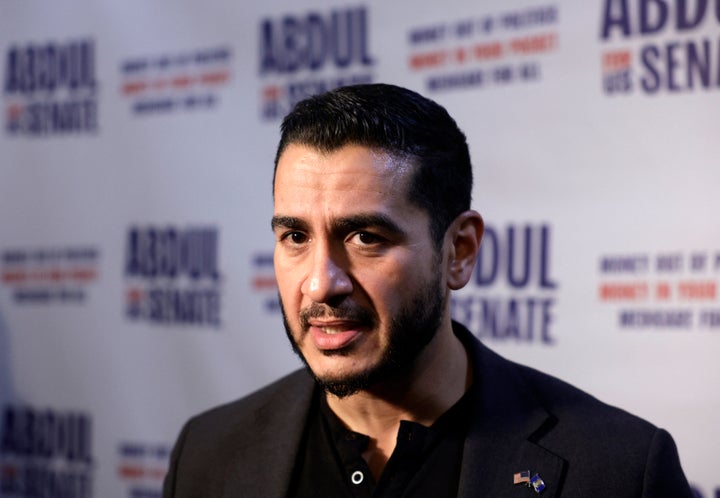
Polling indicates the efforts are working, with El-Sayed consistently holding a slight lead over Rogers. He’s also continuing to get backup from national party figures: After former Vice President Kamala Harris campaigned for him in September, Rep. Alexandria Ocasio-Cortez (D-N.Y.) and New York City Mayor Zohran Mamdani appeared at a fundraiser for him on Monday, just hours after President Barack Obama announced a campaign event for later this month.
JEFF KOWALSKY via Getty Images
Advertisement
And while Rogers’ campaign has made a significant show of reaching out to Democrats, polling gives little indication there are many defectors: a New York Times survey found just 3% of Democrats and 5% of those who backed Harris in 2024 were voting for the Republican, while El-Sayed was picking up 8% of those who supported Trump two years ago and dominating among those who didn’t cast a ballot.
This has led some of El-Sayed’s earlier detractors to admit his relative strengths: The Never-Trump Republican pollster Sarah Longwell marveled at his ability to win over Trump voters in a recent piece, and Center for American Progress President Neera Tanden — arguably Stevens’ biggest online booster — praised El-Sayed’s ability to unite the party during a Monday night appearance on CNN.
At the same time, the symbolism of a potential El-Sayed win, highlighted by Ocasio-Cortez’s prediction at Monday’s fundraiser that his victory would “break open the entire political calculus in America,” essentially guarantees his candidacy will remain a political football in the never-ending back-and-forth between the party’s progressive and moderate wings.
Advertisement
Rogers’ campaign did not respond to repeated requests for comment.
The enthusiasm for El-Sayed among some Michiganders was apparent standing in the back of a Flint, Michigan, church on Saturday, where supporters carrying signs and wearing football jerseys emblazoned with his name crammed into the sanctuary. The candidate, wearing a black, long-sleeve shirt under a suit jacket that he quickly shed as he took the stage, stayed issues-focused as he answered questions about Social Security, the cost of living and corruption in the Trump administration.
“A lot of the pundits — you know — the people on TV who are smarter than the rest of us, they’re always like, ‘he can’t win,’” El-Sayed told one supporter. “It’s like they think that people out here are running around thinking, ‘Where do I fit on the left-right spectrum? Is he a little bit too far to the left for me?’ I think most people are running around thinking, ‘How am I going to afford my rent, my car, my insurance and my groceries?’”
Speaking to HuffPost in an interview following the event, El-Sayed reiterated that he thought the popular momentum was behind him. “We know that the Trump agenda is devastating Michiganders,” he said. “I hear that from everywhere, and everybody that I talk to. You see the excitement here on the ground.”
Advertisement
“They think that people out here are running around thinking, ‘Where do I fit on the left-right spectrum? Is he a little bit too far to the left for me?’ I think most people are running around thinking, ‘How am I going to afford my rent, my car, my insurance and my groceries?’”
– Abdul El-Sayed
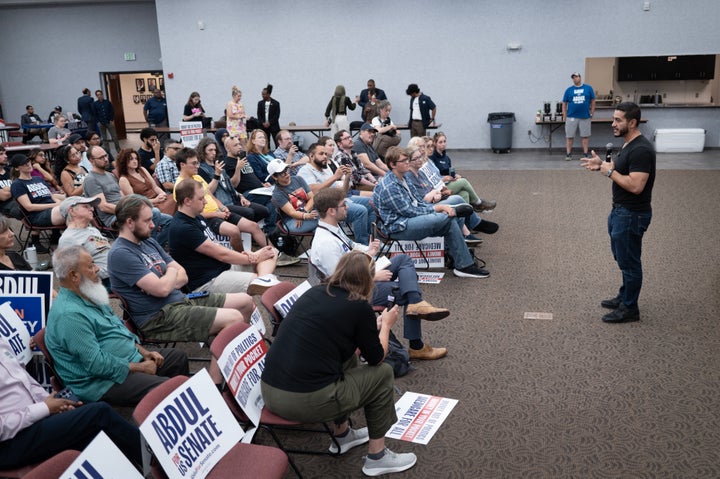
Later that day, El-Sayed made another stop at the carpenters’ union banquet hall in Warren, Detroit’s largest suburb and part of Macomb County, which decidedly backed President Donald Trump in the 2024 election. It was an event characterized by firsts — El-Sayed’s campaign had never before traveled to Warren, and he had never directly campaigned alongside Slotkin.
“We don’t agree on everything, and that’s OK,” said Slotkin. “We agree on the things that are really important: putting a check on this man in the White House who is trying to tell us America is over.”
Advertisement
And the sitting Michigan senator poured cold water on discussions about political rifts within her party. “The debate of moderate versus progressive is not the real debate,” she told the crowd. “The real debate among Democrats right now is fight versus flight. I need someone who is with me on ‘team fight.’”
The crowd in Warren, which filled the banquet hall to capacity, showed no signs of backing down from El-Sayed. Many voters felt his message spoke directly to them.
“We’re sick of the bullshit,” said Eric Ciaglo, a 75-year-old from Harrison, Michigan, who attended the event with his wife. “The corruption. It’s right in our face. All these years, I’ve never seen such corruption and bullshit … and people accepting it.”
Advertisement
And state Rep. Mai Xiong, a Democrat who represents parts of Warren, said she thought El-Sayed was within striking distance in Macomb County, which had gone for Trump in the past three presidential elections.
“They come here because they know that the pathway to winning runs through this community,” Xiong said, adding that she “100%” thought El-Sayed could flip the county. “To know that the Abdul campaign is hearing that and understanding the importance of picking up these votes here — that’s how we’re gonna win.”
Scott Olson via Getty Images
Advertisement
But behind the rosy atmosphere of El-Sayed’s campaign events, where most attendees appear to have made up their minds about casting their votes in November, there lies an undercurrent of tension, particularly among Black voters in the Detroit area who, according to state political leaders, are still wary of the Democrat after largely backing Stevens in the primary.
“I think there needs to be more solidarity with Black people,” said Kimberly Fisher, a small business owner running to represent parts of Detroit and Warren in the Michigan legislature. “Detroit is the Blackest city in the country, and there’s been no engagement.”
Anyone with worries about support for El-Sayed in Michigan’s Black communities would not have been placated by the crowds at his campaign events in Warren and Flint. Though the latter city’s population is 56% Black, the crowd gathered at St. Michael’s Conference Center was mostly white.
Advertisement
Fisher, who has a longstanding relationship with El-Sayed and supports his campaign, told HuffPost in an interview she thought the candidate had a “passion” for the Black community in Detroit — pointing to his work expanding a municipal financial aid program for childcare and his support following a recent tornado in the area — but that she hadn’t seen that same passion on the campaign trail.
And it might be too late for him to salvage those votes, warned Fisher, who previously raised her concerns directly with El-Sayed during a town hall meeting last month. At the time, El Sayed said he wanted to “bring communities together” as the son of an immigrant who understood “the debt of gratitude I owe to Black communities who advocated for the right of my dad to even immigrate here in the first place.”
“We’re talking months and months of missed opportunities,” Fisher said. “We’re talking about ignoring a community that is a large part of your voter base.”
Advertisement
Fisher said lingering tensions between Black and Arab communities are still hurting El-Sayed, with many Black people in Detroit feeling the Arab American community “looks down” on them.
Many of the state’s Jewish voters, too, continue to find El-Sayed’s opposition to aid to Israel and belief that the country is committing a genocide in Gaza to be unacceptable.
But while Rogers has focused extensively on El-Sayed’s foreign policy positions, there’s little indication it’s hurting the Democrat: Voters in the Times survey are split on who they trust more to handle the Israel-Palestine conflict, but say they would prefer a candidate who opposes aid to Israel by a 38% to 29% margin over one who supports it.
Advertisement